Power over Ethernet Has Many Benefits in Security
Applications currently driving the adoption of
PoE include IP security and surveillance cameras, wireless access points (WAPs)
and Voice over Internet Protocol (VoIP) telephones.
Power over Ethernet (PoE) is an established technology that extends the capabilities of Ethernet signaling by providing low-voltage direct current (DC) power delivery to network devices over the same wires that currently carry data.
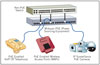
Since acceptance of the IEEE 802.3af Power over Ethernet standard in 2003, equipment vendors have been designing standards-based products that leverage the numerous advantages and benefits offered by PoE (see diagram below). Under IEEE 802.3af, 15.4 watts (W) of power are available for each powered device, which is adequate for most current PoE applications.
New standard IEEE 802.3at, commonly referred to as PoE Plus, is expected to be ratified this year and would increase power delivery up to a minimum of 30 W for more power-hungry devices, such as motorized pan-tilt-zoom (PTZ) network cameras, electromagnetic door strikes, proximity sensors or other security devices.
To implement PoE in a new or existing Ethernet network, customers have a choice of varied solutions that include PoE-enabled network switches, midspan power sourcing equipment (PSE), powered patch panels, and single port injectors. The most appropriate solution depends upon each customer’s requirements for:
- Scalability, such as power capacity and port growth — Will the
network be impacted minimally by future growth and changes, or will network
overhauls be required?
- Flexibility, such as moves, adds, and changes — General-purpose
devices such as IP telephones undergo significant movement in an enterprise.
However, security devices are installed in permanent locations and are seldom
moved. What degree of flexibility does an enterprise require?
- Manageability, such as simple power injection versus endpoint control and power monitoring — What level of device control and monitoring will users need?
Benefits and Capabilities of PoE
PoE offers two benefits that are consistent across applications: cost savings and flexibility of device placement. Because PoE runs data and power together over the same cable to each device attached to the local area network (LAN), devices can be installed without concern for the proximity to individual AC outlets. This saves money by eliminating the cost and time associated with AC outlet installations while providing the flexibility to locate PoE devices where performance is optimum.Additional benefits of PoE include manageability of power sources and battery backups to protect against outages and power spikes. By using a centralized power source, PoE offers the ability to remotely power connected devices on or off in the event of service disruptions or reconfigurations.
PoE also helps protect network investments, because it is an extension of the established 802.3 Ethernet protocol and is supported under 10Mbps, 100Mbps, 1Gbps and eventually 10Gbps data rates. Although no devices take advantage of 10Gbps data rates and PoE, it is only a matter of time for equipment vendors to recognize a need for this high data rate, such as for multimedia communications.
These capabilities and benefits have helped PoE gain rapid interest for communications applications such as voice over Internet Protocol (VoIP) telephones and wireless access points (WAPs).
Security applications such as network surveillance cameras, electromagnetic door locks and radio-frequency identification (RFID) systems are beginning to see wider integration with PoE due to reduced power demand from clients’ devices and greater availability of pre-standard PoE Plus equipment.

With the ongoing digitalization of security and
surveillance systems, organizations today can take advantage of Ethernet,
Internet, or wireless technologies as the backbone of their security
infrastructure to gain the advantages of greater device capabilities, network
convergence, interoperability and remote or local accessibility.
IP Surveillance Applications
IP security cameras and surveillance devices are gaining rapid acceptance beyond the enterprise among new and diverse markets such as public safety, traffic control and education. In fact, it is anticipated that IP security cameras will outsell analog closed-circuit television (CCTV) systems as soon as 2009, driven by new and smarter products with better resolutions, image tracking, and response and alert systems. The growing adoption of IP security technologies also is driving the price of equipment down.The use of these devices can broaden enterprise security initiatives without the expense of proprietary hardware and software or traditional CCTV equipment purchases, such as multiplexers, repeaters and signal splitters.
With a digital signal, camera views can be monitored over a virtually unlimited number of screens by utilizing almost any workstation with a common Web browser. Additionally, digitizing the camera signal enables the use of IP multicast solutions and enhanced hard-disk-based recording devices and storage options not available with traditional CCTV systems (see diagram below).
When combined with Power over Ethernet (PoE) systems, IP surveillance devices offer unique opportunities to lower an organization’s total cost of network ownership through scalability, flexibility of device placement and cost-effective deployment.
Remote manageability of PoE-enabled devices gives organizations the ability to access, manage and control power to cameras that are placed in inaccessible or hard-to-reach areas. Functions such as camera resets and calibration of connected devices can be performed either at an internal management workstation or from an external Web access point without the need to physically touch a device that is placed out of reach.
PoE systems also increase the reliability of security networks by providing cost-effective centralized backup power to all connected IP surveillance devices. During local power interruptions, a single UPS unit supporting a PoE-powered patch panel can provide seamless, reliable power for all surveillance cameras connected to it.
Centralized backup power through PoE offers the additional benefit of increased reliability, lower total cost of ownership through simpler maintenance procedures, easier monitoring and higher efficiency than a traditional system would offer.
RFID Systems
RFID is gaining popularity as another application, which can leverage the advantages of PoE, with some analysts projecting the deployment of up to 2 million PoE-enabled RFID readers by 2010.One of the most common applications of RFID (as driven by retailers such as Wal-Mart, Best Buy and other big-box stores) is asset management. Retailers benefit by reduction of inventory shrinkage, elimination of incorrect deliveries (at the receiving dock), and an improvement in distribution logistics.
End customers achieve greater satisfaction as retailers benefit in reduced stock outages because of being able to track a pallet’s movement through the warehouse.
A fully implemented, warehouse-wide RFID system can track shipping containers or a pallet’s movement from the time the pallet enters the warehouse to the time it leaves. These systems rely on fixed RFID readers placed throughout the warehouse and at other points between receiving and shipping (see diagram above).
Each reader must be powered as well as able to transmit data: an immediate and natural match for PoE. Cost savings achieved through reduced installation times and reduced multiple cable pulls make PoE-enabled RFID systems a logical choice as new systems are being installed.
Unlike Wi-Fi, which has a relatively large coverage radius, RFID readers must be spaced strategically and closer together along the entire inventory flow route for accurate asset tracking. Proprietary tracking systems typically require system elements to be hard-wired according to the number of monitored nodes.
However, PoE-enabled RFID readers become part of the network fabric and can be increased or reconfigured as the needs of the business change by increasing or decreasing corresponding PoE ports.
Unused PoE ports may be utilized for other functions, such as network cameras, which when combined with RFID asset tracking, maximize security in warehousing and enterprise applications.
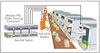
PoE is a natural fit for RFID readers, which
must be powered and transmit data. Unused PoE ports may be used for network
surveillance cameras.
Strategies to Manage Heat Under PoE Plus
Heat is generated as current flows through copper twisted pairs, and this heat raises the temperature of cable bundles in an installation. Temperature rise is a function of several factors, including current strength, bundle size, cable construction, DC resistance and installation conditions.Most fixed-direction network surveillance cameras and RFID readers can run on the 15.4 W of power provided under the current IEEE 802.3af standard using existing Category 5e or 6 cabling.
For existing PoE installations, the specified current and power limits were designed to maintain a cabling temperature rise of less than 10 degrees C and a maximum cabling temperature lower than 60 degrees C. This is the sum of ambient temperature and expected temperature rise in cabling.
Therefore, in most cases, these lower power levels do not present significant concerns regarding the heat rise over twisted-pair bundles.
However, devices such as room sensors, electronic door locks and other building controls may require up to 30 W per device to operate. These devices would be powered over twisted pairs in conformance with the PoE-Plus standard, and the amount of heat generated in cable bundles at these higher power levels must be addressed.
Under PoE Plus, the maximum power transmitted over any individual cable bundle should not exceed 5,000 W up to an ambient temperature of 45 degrees C. At temperatures from 45 degrees C to 60 degrees C, it is recommended to reduce the power output and/or the power consumption by de-rating the system until the ambient temperature falls back to 45 degrees C.
The de-rating process can include several strategies such as reducing the number of cables in the bundle, or improving the mix of PoE/PoE Plus powering to reduce the number of powered end points on a particular cable span.
Additionally, higher performing cables with lower DC resistance, such as Category 6 and 6A, tend to generate a lower temperature rise and therefore have fewer associated bundling constraints.
Professional installers and security integrators should take advantage of the time and installation cost savings afforded by Power over Ethernet technologies. Applications that call for surveillance, monitoring and asset tracking can be fulfilled with a wide array of network camera and RFID reader technology choices.
Designs for future growth and additional security automation should take into account what high-powered devices may be used and ensure the proper installation of infrastructure components, such as cabling, cable routing and PoE/PoE Plus systems, to scale and support future growth needs.
Looking for a reprint of this article?
From high-res PDFs to custom plaques, order your copy today!