MULTI-UNIT RESIDENTIAL INTERCOM
A-BUS Audio Boosts the Features of this Intercom

The ComPoint system integrates with any décor
throughout the Meadowbrook Pointe complex.

The speaker in the A-BUS system can be used by
the ComPoint system.
Westbury is such a community and a destination of sorts, thanks to its shopping and fine dining choices, and at one time, a world-class raceway, Roosevelt Raceway.
From 1940 to 1988, Roosevelt Raceway’s half-mile harness racing dirt track was considered one of the preeminent tracks of its kind. After years of profit losses, the site was acquired by a group of investors in 1984, with a promise to bring a long-needed facelift to the raceway. Instead, years of neglect only continued until the doors were permanently closed four years later.
Fast-forward to 2008: Westbury continues to be a major draw for new residents and new businesses. Shopping malls, luxury retailers and restaurants dominate the region surrounding the Raceway’s former home on Old Country Road; this 51-acre property is now undergoing a major renovation of its own.
As part of a $400 million project scheduled to be completed within the next three years, the Beechwood Organization is building Meadowbrook Pointe, a development with more than 700 condominium apartments, duplexes and attached houses.
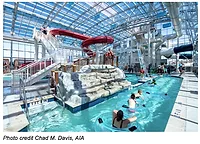
Anchoring the community is a 25,000-sq.-ft. clubhouse which will serve as the main venue for activities for residents, all of whom will be active singles and retirees. When completed, the clubhouse will be an all-encompassing community center and entertainment facility, with a large ballroom, lounge and a bar that leads to two swimming pools, a public barbecue pit, business center, gymnasium and separate sports bar with 14 televisions, and – in a nod to the past – betting terminals.
With all of the advanced technology that goes into such a project, it is easy to assume that something as seemingly basic as an intercom system would be an easy choice to make.
However, as Laszlo Tordai of Media-Wire Inc., Stony Brook, N.Y., observes, the trick is to find an option that offers seamless integration with the overall audio system rather than a series of unsightly add-ons that clash, aesthetically and sonically with the main multiroom system.
“Intercom systems are often added to an existing system, but not integrated with it,” Tordai says. “It’s something that is often added as a second system, on top of the primary audio, rather than becoming a part of it.”
Tordai is particularly familiar with the subject. He and his partners George Pertot and Paul Drossel own and operate Media-Wire. Their specialties encompass home automation and multiroom audio as well as low-voltage installations and structured wiring; in short, the foundation of any whole-house (or whole-clubhouse) installation.

The intercom system is used throughout the
facility, including the retail areas and locker rooms.
Tordai cites ComPoint as being a time and money-saver because it did not require add-on phones and speakers. Instead, ComPoint conveniently meshed with the A-BUS whole-house audio system when, for example, the front desk needs to communicate with fitness center locker rooms.
“Lockers are usually big and echo-y; not exactly an ideal environment for paging members,” Tordai observes. “ComPoint allowed us to utilize the A-BUS speakers while adding additional stations for private conversations.”
As Tordai describes it, the A-BUS keypad at the concierge desk controls the volume for large spaces, such as lockers and the lounge. Because the keypads do not have much power to output, ComPoint instead utilizes speaker output for crisp, clear sonic resolution that is easily heard by members and employees.
“Our customers will appreciate how easy it is to access the system throughout the facility, but as far as we’re concerned, one of the best things about ComPoint is that we don’t have to be concerned about how well the intercom works alongside the A-BUS system,” Tordai notes. “It’s as efficient and simple a solution as you’re going to find.”
Sidebar: On the Job
From Russound (www.russound.com):- Compoint Intercom System Hub (3)
- Compoint keypad with A-BUS audio (9)
- Compoint keypad with built-in speaker (10)
Sidebar: PROJECTS in the News
Optelecom-NKF Inc., a global manufacturer of IP video solutions based in Germantown, Md., announced recently that it is deploying its S-44 video server, a recently introduced 4-channel video codec, as part of three major subway system projects underway around the world. The largest installation is for the new rail line, Line 10, of the Beijing Metro System (BMS) in China and will support the transport and recording of more than 1,000 video signals. This is the third major contract award for Optelecom-NKF from BMS and the first to feature the new S-44 MC (multi-codec) version. The company won this contract based on S-44 superior performance, scalability, and price-per-channel, it said. The other two strategic project wins are subway security systems for major cities in France and Spain. These key project wins, both of which include the S-44, demonstrate the market’s strong response to the S-44 series, Optelecom-NKF’s newest addition to the Siqura product family. The S-44’s design combines four Texas Instrument DSPs on a single board. Each DSP can simultaneously transmit two MPEG-2/4 video streams and one Motion JPEG stream, with all of them simultaneously running at full D1 resolution. This capability to “triple stream” makes each channel available for simultaneous recording, live viewing, and screen capture. The S-44 combines maximum functionality with density by helping customers scale up to 44 channels into a single, 3RU rack-mountable system resulting in an extremely low cost per channel. The S-44 also has a “quad” feature, making it possible to view content in a quad split-screen configuration on any standard Web browser.Looking for a reprint of this article?
From high-res PDFs to custom plaques, order your copy today!