SDMmag logo
search
Go to Ask SDM AI
cart
facebook twitter linkedin youtube
  • Sign In
  • Create Account
  • Sign Out
  • My Account
SDMmag logo
  • NEWS
  • PRODUCTS
  • TOPICS
    • Access Control & Identification
    • Integration & Network Solutions
    • Life Safety & Fire Alarm
    • Monitoring
    • Smart Home
    • Trends & Industry Issues
    • Video Solutions
  • COLUMNS
    • Digital Shuffle
    • Editor's Angle
    • Insider News & Business
    • Integration Spotlight
    • Marketing Madmen
    • Security & the Law
    • Security Comings & Goings
    • Security Networkings
    • Technology @ Work
    • Technology Solutions & Skills
    • SIA Waypoints
    • Cybersecurity Chronicle
  • EXCLUSIVES
    • Annual Industry Forecast
    • Dealer of the Year
    • Project of the Year
    • SDM 100
    • State of the Market Series
    • Systems Integrator of the Year
    • Top Systems Integrator Report
    • TMA Excellence Awards
  • BLOG
  • MEDIA
    • Videos
    • Podcasts
    • Polls
    • White Papers
  • EVENTS
    • Industry Calendar
    • Webinars
  • MORE
    • Classified Ads
    • Newsletters
    • SDM Store
    • State of Security eBook
    • Sponsored Insights
  • BUYERS GUIDE
    • Buyers Guide
    • Take a Tour
  • EMAG
    • eMagazine
    • Archive Issues
    • Monitoring Today
    • Advertise
  • SIGN UP!

For a Switch, Detect This Error

November 1, 2004

1. Which UL standard covers intrusion detectors?

a. 634

b. 635

c. 639

d. None of the above

2. When installing NC door contacts (open on alarm), the EOL resistor should be placed:

a. at the device in parallel with the contact.

b. at the device in series with the contact.

c. at the control in parallel with the zone terminals.

d. at the control in series with the zone terminals.

e. None of the above

3. When installing NO door contacts (short on alarm), the EOL resistor should be placed:

a. at the device in parallel with the contact.

Looking for quick answers on security topics? Try Ask SDM, our new smart AI search tool. Ask SDM →

b. at the device in series with the contact.

c. at the control in parallel with the zone terminals.

d. at the control in series with the zone terminals.

e. None of the above

4. A motion detector that uses a transmit frequency of 20 to 40 KHz is referred to as being a:

a. photoelectric detector.

b. ultrasonic detector.

c. microwave detector.

d. None of the above

5. A motion detector that uses a transmit frequency of 10 to 20 GHz is referred to as being a:

a. photoelectric detector.

b. ultrasonic detector.

c. microwave detector.

d. None of the above

6. PIRs transmit on a frequency of 100 to 200 KHz.

a. True

b. False

7. PIRs are most sensitive to motion toward and away from the detector.

a. True

b. False

8. Microwave detectors are most sensitive to motion toward and away from the detector.

a. True

b. False

9. Biased magnetic contacts are used for:

a. loosely fitting doors and windows.

b. high security applications.

c. wet environments.

d. explosive environments.

e. None of the above

10. Microwave detectors can penetrate what type of com- mon construction material?

a. Glass

b. Wood paneling

c. Sheetrock

d. All of the above

e. None of the above

11. Dual technology motion detectors are used to reduce power consumption.

a. True

b. False

12. PIRs utilize the Doppler shift principle to detect motion.

a. True

b. False

13. Reed contacts are plated with rhodium or similar materials to reduce cost.

a. True

b. False

For a Switch, Detect This Error

If the control panel is the brains of a security system, then the detection devices are the senses that allow the system to detect and react to possible intrusions. For these devices to function properly, you must select the correct device and install it so it will detect an attack but not cause any false alarms. To check your detector smarts, take the following quiz.
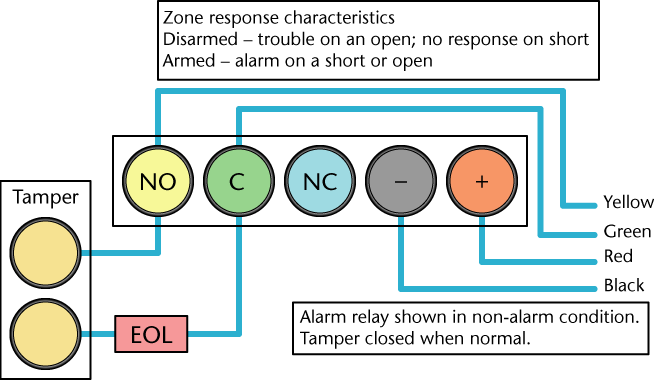
What’s Wrong with This?

Wally `Larman installed a motion detector with a tamper switch that was intended to alert the user if someone removed the cover of the device. Wally selected a motion detector with a tamper that is closed when the cover is in place and wired the unit as shown in this diagram. After programming the control for the proper zone parameters, Wally tested the device but found that he could walk up to it and remove the cover without tripping the alarm. However, as he was returning to the control, the zone did finally go into trouble. Can you see what Wally did wrong and what he should do to correct the problem?

1. c – UL 639 covers intrusion detectors. UL 634 covers connectors and switches, and UL 635 covers insulated bushings.

2. b – Since the contact is closed when normal, the eol should be in series with the device.

3. a – Since the contact is open when normal, the eol should be in parallel with the device. For proper zone supervision, the eol should not be installed at the control.

4. b

5. c

6. b – PIRs are passive devices, which means they do not emit or transmit any energy.

7. b – PIRs are most sensitive to motion across the detection pattern.

8. a – Unlike PIRs, microwave and ultrasonic detectors are most sensitive to motion toward and away from the detector.

9. b – A biased magnetic contact is used for high security applications because it is more difficult to defeat by using an external magnet. Wide gap contacts should be used on loosely fitting doors and windows. Sealed and intrinsically safe switches should be used for wet or explosive environments, respectively.

10. d – Microwaves can penetrate all these common construction materials. They also can be channeled through metal ductwork or detect liquid moving inside plastic pipes.

11. b – Dual technology detectors are used to reduce false alarms because two different detection technologies must be activated for an alarm to be generated.

12. b – PIRs operate by detecting a change in infrared energy. Microwave and ultrasonic detectors utilize the Doppler shift principle to detect motion.

b – Plating of reed contacts is done to prevent welding of the contacts.

Answers to: What's Wrong With This?

Wally caused the problem by connecting the tamper switch after the alarm relay of the device. As Wally approached the unit, it detected his motion and went into alarm condition, shorting the zone before the tamper. When he removed the cover, the unit was still in alarm, which prevented the tamper contacts from opening the zone. As he walked back to the control, the unit reset, which allowed the open of the tamper to be detected by the control. Wally should rewire the unit as shown in this diagram with the tamper before the alarm relay. In this manner, the control can sense the tamper even if the unit is in alarm. He also could wire it as shown in the alternate diagram, which will provide the same tamper protection but also will provide better supervision of the alarm relay, because the zone wiring passes through both the NO and NC contacts. When the unit detects motion using this alternate wiring technique, the zone is opened and then shorted.

Under normal conditions, the open is too quick for the control to react, but if the NO contact becomes corroded, preventing the unit from shorting the zone, the open will be detected.

Share This Story

Looking for a reprint of this article?
From high-res PDFs to custom plaques, order your copy today!

Recommended Content

JOIN TODAY
to unlock your recommendations.

Already have an account? Sign In

  • SDM 100

    SDM 100: Top 100 Security Dealers of 2026

    The top 100 security dealers navigated a complex...
    Exclusives
    By: Karyn Hodgson
  • Security camera

    State of the Market: Video Surveillance

    As video surveillance shifts from siloed systems to...
    Exclusives
    By: Brianna Wilson
  • 2026 Industry Forecast

    SDM 2026 INDUSTRY FORECAST

    Rapid technology advances meet shifting economic...
    Annual Industry Forecast
    By: Karyn Hodgson
Manage My Account
  • SDM Newsletters
  • Online Registration
  • eMagazine Subscriptions
  • Subscription Customer Service
  • Manage My Preferences

More Videos

Sponsored Content

Sponsored Content is a special paid section where industry companies provide high quality, objective, non-commercial content around topics of interest to the SDM audience. All Sponsored Content is supplied by the advertising company and any opinions expressed in this article are those of the author and not necessarily reflect the views of SDM or its parent company, BNP Media. Interested in participating in our Sponsored Content section? Contact your local rep!

close
  • Doctor examining child patient with mother present in medical clinic
    Sponsored byHID

    The Human Side of Hospital Security: How Modern Visitor Management Protects People First

Popular Stories

Video surveillance camera

Why Video Health Monitoring Is a ‘No Brainer’

ESA Board of Directors Q2 26 Elections

Electronic Security Association Announces 2026 Board of Directors Election Results

TMA & SDM Logos

Becklar, Elite & Puget Win 2026 TMA/SDM Monitoring Center Excellence Awards

SDM Dealer of the Year 2026 Promotion

Poll

What’s the most promising trend in the industry?

What’s the most promising trend in the industry?
View Results Poll Archive

Products

Physical Security Assessment Handbook An Insider’s Guide to Securing a Business

Physical Security Assessment Handbook An Insider’s Guide to Securing a Business

See More Products
SDM 100 2026 Rankings

Related Articles

  • Using a Parallel Network for a Video Camera

    See More
  • Helen M. Heneveld

    Interoperability: A Big Word For a Simple Concept

    See More
  • Pedaling Cross Country for a Cure

    See More

Related Products

See More Products
  • Physical Security and Safety: A Field Guide for the Practitioner

  • security culture.webp

    Security Culture: A How-to Guide for Improving Security Culture and Dealing with People Risk in Your Organisation

  • integrated.jpg

    Integrated Security Systems Design, 2nd Edition - A Complete Reference for Building Enterprise-Wide Digital Security Systems

See More Products

Events

View AllSubmit An Event
  • June 6, 2012

    Basic Remote Connection for AXIS Camera Companion

    In this webinar, you will learn how to setup basic forwarding rules and Network address translation (NAT) in a router. We will also show you how to setup remote connection using AXIS Camera Companion.
View AllSubmit An Event

Related Directories

  • IPtelX

    IPtelX is a nationally peered telecommunications carrier offering voice, data, and cloud solutions for security, alarm, and enterprise customers. Services include IP-based alarm signal transport, VoIP interconnection, origination and termination, hosted PBX, call routing, messaging, E911, toll-free, internet access, switched ethernet, and managed network services with 24/7 monitoring.
  • JLM Wholesale, A Div. of Lockmasters

    JLM Wholesale, A Division of Lockmasters is a national wholesale distributor of commercial-grade door hardware and access control products. Products stocked include Allegion, ASSA ABLOY, Stanley Security Solutions and many more.
×

Be in the forefront of security intelligence when you receive SDM.

Join over 10,000+ professionals when you subscribe today.

SIGN UP TODAY!
  • RESOURCES
    • Advertise
    • Contact Us
    • Directories
    • Store
    • Want More
  • SIGN UP TODAY
    • Create Account
    • eMagazine
    • Newsletter
    • Customer Service
    • Manage Preferences
  • SERVICES
    • Marketing Services
    • Reprints
    • Market Research
    • List Rental
    • Survey/Respondent Access
  • STAY CONNECTED
    • LinkedIn
    • Facebook
    • YouTube
    • X (Twitter)
  • PRIVACY
    • PRIVACY POLICY
    • TERMS & CONDITIONS
    • DO NOT SELL MY PERSONAL INFORMATION
    • PRIVACY REQUEST
    • ACCESSIBILITY

Copyright ©2026. All Rights Reserved BNP Media, Inc. and BNP Media II, LLC.

Design, CMS, Hosting & Web Development :: ePublishing