Field Guide to Access Control: 20 Questions about Access Control
Access control installations can be a complex arrangement of controllers, readers, user credentials, and door hardware – all designed to function like clockwork based on myriad programming selections. To determine if you are knowledgeable about access control installation and programming, take our 20 Questions quiz. Then turn to page 30 and find out how you scored.
Check your answers below.

Answer below.
Answer below.
- The most popular access control credential technology used today is:
- Magnetic stripe
- Wiegand swipe readers
- Proximity
- Bar code
- Wiegand protocol readers are wired to access controller panels using:
- Cat 5e UTP
- Cat 3 UTP
- RG-6
- 18-gauge five-conductor with an overall shield
- Wiegand protocols can be transmitted as:
- 37 bits
- 32 bits
- 26 bits
- all of the above
- An access system's “site code†is:
- an identification number that's included in each access credential
- the access controller panel’s MAC address
- the client’s access software activation code
- the installer’s account number
- Standard proximity credential readers have a two-foot “read†distance.
- True
- False
- Typically, biometric access control devices cannot read:
- palm prints
- fingerprints
- human irises
- human pulse rates
- Electronic REX devices are typically connected directly to credential readers.
- True
- False
- A door release that goes “open†when power fails is considered:
- fail-secure
- fail-safe
- The most important issue when planning an access control system is:
- the number of credentials to be issued.
- the number of doors to be secured.
- life safety and AHJ approval.
- how fast credentials can be read and access allowed.
- Door releases, such as strikes and magnetic locks, typically are powered by:
- self-contained batteries.
- separate power supplies.
- AC
- power from the access controller panel.
- The average number of credentials in a typical access control application is:
- 50
- 100
- 200
- 500
- Access controller panels can communicate with the host computer via:
- Ethernet
- Internet
- RS-485
- telephone modem
- Keypad access control input devices provide high-speed, high-volume entry functions.
- True
- False
- Select the incorrect answer. Door position switches:
- also can be connected to intrusion alarm systems.
- provide door close/open status to the access control system.
- can be contained in hinges.
- can be surface mount or concealed.
- Which type of system typically provides real-time monitoring and reporting of access control events?
- Mid-sized systems.
- Enterprise-level systems.
- Electronic REXs should be protected with bridge rectifier circuits when connected to a magnetic lock or door strike.
- True
- False
- Proximity readers can be used as direct replacements for magnetic stripe readers, while retaining the existing host system.
- True
- False
- The current draw of a typical door strike is:
- 1.5 amps @ 24 VDC
- 2 amps @ 24 VDC
- 300 milliamps @ 24 VDC
- 150 milliamps @ 24 VDC
- When two or more people pass through an access door when only one credential is presented, this is called:
- cheating the system
- papoosing
- tailgating
- a “spare tireâ€
- Secure funneling is when two or more doors are logically connected so that one door must be closed before another door can be opened.
- True
- False
Check your answers below.
Help Complete this Door Installation
The door illustrated at this facility is used for both entering and leaving the building. The door has a push bar to exit. What devices are missing from this installation?Answer below.
Why Does Door Strike Release from the Inside?
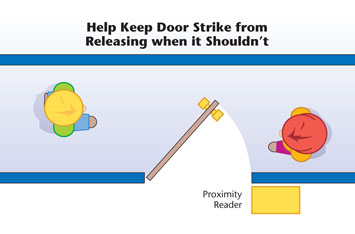
When some authorized users walk past this door from the inside, they hear the door strike release. What's causing this?Answer below.
20 answers
- c
- d – In most cases six-conductor OAS (over all shielded) is installed, as cable manufacturers don’t regularly manufacture equivalent five-conductor. It’s important to properly connect the reader cables shielding to ground.
- d – Card populations can be purchased with different bit formats.
- a – The site code (also called a facility code) is like the prefix of a telephone number and is included in the data string of each credential issued for a particular system.
- False
- d – Human pulse rate. Biometric readers can be purchased that can read all of the other listed inputs.
- False – Credential readers are usually connected to an access controller panel.
- b – Fail-safe.
- c – Life safety and AHJ approval.
- b – Separate power supplies.
- c – 200.
- a, b, c, and d – The communications capability of particular access controller panels can be one or multiple methods.
- False – Keypads are slower than cards or “hard†credentials, as the user must remember his or her number and punch it in.
- a – Door position switches should not be connected to both the access control system and the intrusion alarm system, unless the switch selected is DPDT (double pole, double throw) which provides electrically separate connections to the respective systems.
- b
- True – Some magnetic locks and strikes have electric spike protection built in (this is sometimes called diode protected). If the door release isn’t internally protected, a bridge rectifier circuit should be connected.
- True
- d – Door-release devices operating at 12 VDC typically have a higher current requirement than those that operate at 24 VDC do.
- c.
- False – The correct term is “mantrap.â€
Answer to: Help Complete This Door Installation
If the door is also regularly used for egress, either another card reader or request to exit device must be installed on the interior side, so that people exiting the door will not generate an alarm on the access control system.Answer to: Why Does Door Strike Release from the Inside?
Proximity readers can have detection fields that extend both in front of and behind the reader. If a person has his or her proximity credential in a pocket or purse, the reader may inadvertently read the credential when it nears the door. Installing a metal plate behind the reader will reduce or eliminate this problem.Looking for a reprint of this article?
From high-res PDFs to custom plaques, order your copy today!