SDMmag logo
search
Go to Ask SDM AI
cart
facebook twitter linkedin youtube
  • Sign In
  • Create Account
  • Sign Out
  • My Account
SDMmag logo
  • NEWS
  • PRODUCTS
  • TOPICS
    • Access Control & Identification
    • Integration & Network Solutions
    • Life Safety & Fire Alarm
    • Monitoring
    • Smart Home
    • Trends & Industry Issues
    • Video Solutions
  • COLUMNS
    • Digital Shuffle
    • Editor's Angle
    • Insider News & Business
    • Integration Spotlight
    • Marketing Madmen
    • Security & the Law
    • Security Comings & Goings
    • Security Networkings
    • Technology @ Work
    • Technology Solutions & Skills
    • SIA Waypoints
    • Cybersecurity Chronicle
  • EXCLUSIVES
    • Annual Industry Forecast
    • Dealer of the Year
    • Project of the Year
    • SDM 100
    • State of the Market Series
    • Systems Integrator of the Year
    • Top Systems Integrator Report
    • TMA Excellence Awards
  • BLOG
  • MEDIA
    • Videos
    • Podcasts
    • Polls
    • White Papers
  • EVENTS
    • Industry Calendar
    • Webinars
  • MORE
    • Classified Ads
    • Newsletters
    • SDM Store
    • State of Security eBook
    • Sponsored Insights
  • BUYERS GUIDE
    • Buyers Guide
    • Take a Tour
  • EMAG
    • eMagazine
    • Archive Issues
    • Monitoring Today
    • Advertise
  • SIGN UP!
Security & the Law

Liquidated Damages: Who's Entitled to Attorney’s Fees?

By Lessing E. Gold, Contributing writer
September 11, 2012

A recent case in the state of California dealt with a number of issues, including the effect of a liquidated damage clause. In this column, we’ll discuss the issue of whether the plaintiff who recovered the liquidated damage amount was entitled to attorney fees.

In the case at hand, the plaintiffs filed a lawsuit against an alarm company. The District Court granted summary judgment in favor of the defendant alarm company with respect to plaintiffs’ action for gross negligence, but awarded the plaintiffs $1,000 for the liquidated damage amount set forth in the contract. Despite the fact that plaintiffs were awarded judgment for the liquidated damage amount and were the prevailing parties and despite the fact that the contract between the parties contained a provision awarding attorneys’ fees to the prevailing party, the court refused to award attorneys’ fees in favor of the plaintiffs.

The plaintiffs appealed.

The Appellate Court held that the District Court properly granted summary judgment in favor of the alarm company on the gross negligence claim. Although the alarm company failed to properly install the alarm system and failed to provide notification services when it actually received an alarm signal from the defendant, the court held that the alarm company’s legal obligation to provide either service arose solely from its contractual relationship with the plaintiffs and not from any duty independent of the plaintiffs’ contract.

The court further held that the District Court properly limited the plaintiffs’ damages for breach of contract to $1,000, holding that in California, liquidated damages provisions in commercial contracts are presumed valid, “unless the party seeking to invalidate the provision establishes that the provision was unreasonable under the circumstances existing at the time the contract was made.”

The court then pointed out that the plaintiffs did not identify any circumstances that existed at the time of contract formation that would support a conclusion that the liquidated damages provision was unreasonable.

In discussing the attorney fee provision, the court held that the District Court properly denied the plaintiffs’ request for attorneys’ fees because although the plaintiffs were successful in obtaining a breach of contract judgment against the defendant for $1,000, “prevailing party” status for purposes of an attorneys’ fee award under California Civil Code §1717 was measured by “comparing the relief awarded on the contract claim or claims with the parties’ demands on those same claims and their litigation objectives as disclosed by the pleadings . . . and similar sources.”

Looking for quick answers on security topics? Try Ask SDM, our new smart AI search tool. Ask SDM →

The plaintiffs succeeded in obtaining only a minute portion of the claimed damages. It was well within the trial court’s discretion to decline the plaintiffs’ prevailing party status in such circumstances.

The court also determined that the alarm company’s request for attorneys’ fees was properly denied. In comparing simple monetary results, the alarm company was ostensibly more successful in achieving its litigation goals than were the plaintiffs. However, a determination of prevailing party status does not solely examine monetary results; rather, it requires evaluation of overall litigation success. To that end, the court found that it was not an abuse of discretion for the District Court to decline the alarm company prevailing party status as well when considering the alarm company actively sought to avoid both the entry of judgment and the entry of $1,000 damages against it on the plaintiffs’ breach of contract claim.


Readers Ask

Q: I have just taken over a small alarm company. A number of the customers are not under contract. What is my exposure?

A: If you have already taken over the accounts, they are your responsibility and unless you have an indemnification from the seller, you are responsible if anything goes wrong. If there is a contract between the company and its subscribers, it should contain the protection provisions afforded to an alarm company, i.e., liquidated damage clause, limitation of liability provision, third party indemnification and a subrogation provision. If there is a loss and the company is not negligent, there should be no exposure other than attorneys’ fees. If there is a question of negligence, you no longer have the protection afforded by the contract and there is a definite exposure.

The next question is whether you have insurance and whether your carrier will cover you if there is no contract. Solution: Ask each customer with no contract to sign one. If they refuse, give them notice and terminate the service.

To ask Les Gold a question, e-mail sdm@bnpmedia.com.

KEYWORDS: gross negligence

Share This Story

Looking for a reprint of this article?
From high-res PDFs to custom plaques, order your copy today!

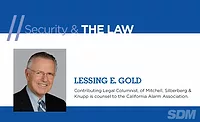
Lessing E. Gold of Mitchell, Silberberg & Knupp is counsel to the California Alarm Association and a contributing legal columnist. He can be reached at sdm@bnpmedia.com.

Recommended Content

JOIN TODAY
to unlock your recommendations.

Already have an account? Sign In

  • SDM 100

    SDM 100: Top 100 Security Dealers of 2026

    The top 100 security dealers navigated a complex...
    Exclusives
    By: Karyn Hodgson
  • Security camera

    State of the Market: Video Surveillance

    As video surveillance shifts from siloed systems to...
    State of the Market Series
    By: Brianna Wilson
  • 2026 Industry Forecast

    SDM 2026 INDUSTRY FORECAST

    Rapid technology advances meet shifting economic...
    Annual Industry Forecast
    By: Karyn Hodgson
Manage My Account
  • SDM Newsletters
  • Online Registration
  • eMagazine Subscriptions
  • Subscription Customer Service
  • Manage My Preferences

More Videos

Sponsored Content

Sponsored Content is a special paid section where industry companies provide high quality, objective, non-commercial content around topics of interest to the SDM audience. All Sponsored Content is supplied by the advertising company and any opinions expressed in this article are those of the author and not necessarily reflect the views of SDM or its parent company, BNP Media. Interested in participating in our Sponsored Content section? Contact your local rep!

close
  • Doctor examining child patient with mother present in medical clinic
    Sponsored byHID

    The Human Side of Hospital Security: How Modern Visitor Management Protects People First

Popular Stories

Video surveillance camera

Why Video Health Monitoring Is a ‘No Brainer’

ESA Board of Directors Q2 26 Elections

Electronic Security Association Announces 2026 Board of Directors Election Results

TMA & SDM Logos

Becklar, Elite & Puget Win 2026 TMA/SDM Monitoring Center Excellence Awards

SDM Dealer of the Year 2026 Promotion

Poll

What’s the most promising trend in the industry?

What’s the most promising trend in the industry?
View Results Poll Archive

Products

Physical Security Assessment Handbook An Insider’s Guide to Securing a Business

Physical Security Assessment Handbook An Insider’s Guide to Securing a Business

See More Products
SDM 100 2026 Rankings

Related Articles

  • Awarding Attorney’s Fees Gets Tricky

    See More
  • The Agreement Must Provide for Liquidated Damages

    See More
  • Security  Law 2019

    Revisiting an Old Case -- Was Insurance Company Entitled to Sue?

    See More

Related Products

See More Products
  • 9780367221942.jpg

    From Visual Surveillance to Internet of Things: Technology and Applications

  • introduction.jpg

    Introduction to Security, 10th Edition

  • physical security.webp

    Physical Security Assessment Handbook An Insider’s Guide to Securing a Business

See More Products
×

Be in the forefront of security intelligence when you receive SDM.

Join over 10,000+ professionals when you subscribe today.

SIGN UP TODAY!
  • RESOURCES
    • Advertise
    • Contact Us
    • Directories
    • Store
    • Want More
  • SIGN UP TODAY
    • Create Account
    • eMagazine
    • Newsletter
    • Customer Service
    • Manage Preferences
  • SERVICES
    • Marketing Services
    • Reprints
    • Market Research
    • List Rental
    • Survey/Respondent Access
  • STAY CONNECTED
    • LinkedIn
    • Facebook
    • YouTube
    • X (Twitter)
  • PRIVACY
    • PRIVACY POLICY
    • TERMS & CONDITIONS
    • DO NOT SELL MY PERSONAL INFORMATION
    • PRIVACY REQUEST
    • ACCESSIBILITY

Copyright ©2026. All Rights Reserved BNP Media, Inc. and BNP Media II, LLC.

Design, CMS, Hosting & Web Development :: ePublishing