Five Minute Tech Quiz: Standards & Codes

1. Which of the following is referred to as the National Electric Code?
a. NFPA 70
b. NFPA 72
c. NFPA 101
d. UL 681
e. UL 827
2. Which of the following is referred to as the National Fire Alarm Code?
a. NFPA 70
b. NFPA 72
c. NFPA 101
d. UL 681
e. UL 827
3. Which of the following UL standards covers installation of burglar alarm systems?
a. 681
b. 827
c. 1981
d. 365
e. 611
4. What does the ANSI/SIA OSIPS DVI standard cover?
a. Burglary alarm systems
b. Access control systems
c. Video and IP related interface
d. Fire alarm systems
Looking for quick answers on security topics? Try Ask SDM, our new smart AI search tool. Ask SDM →
5. When used in a code, the word “should” indicates a mandatory requirement.
a. True
b. False
6. TIA/EIA 568 standard relates to
a. analog video signals.
b. RF signal transmission.
c. structured wiring.
d. All of the above
e. None of the above
7. When used in a code, the word “shall” indicates a recommendation.
a. True
b. False
8. Which of the following has the final say on fire alarm system installation?
a. Local building code
b. NFPA
c. AHJ
d. All of the above
e. None of the above
9. Codes and standards both have the same meaning.
a. True
b. False
10. Since the ADA is a law, it has no effect on codes.
a. True
b. False
11. Which of the following standards is referred to as the Control Panel Standard, Features for False Alarm Reduction?
a. ANSI/SIA DC-09-2007
b. ANSI/SIA CP-01-2007
c. ANSI/SIA OSIPS
d. All of the above
e. None of the above
12. ANSI is a leading standards developer in the United States.
a. True
b. False
13. ISO is the world’s largest developer and publisher of international standards.
a. True
b. False
14. ISO 9000 describes the fundamentals of quality management systems.
a. True
b. False
15. Which of the following standards is referred to as the Digital Communication Standard, Internet Protocol Event Reporting?
a. ANSI/SIA DC-09-2007
b. ANSI/SIA CP-01-2007
c. ANSI/SIA OSIPS
d. All of the above
e. None of the above
Quiz Answers
1. a
2. b – NFPA 70 is the National Electric Code; NFPA 72 is the National Fire Alarm Code; NFPA 101 is the Life Safety Code; UL 681 is the standard for Installation and Classification of Burglar and Holdup Alarm Systems; and UL 827 is the standard for Central-Station Alarm Services.
3. a – UL 1981 is the standard for Central-Station Automation Systems; UL 365 is the standard for Police Station Connected Burglar Alarm Units and Systems; and UL 611 is the standard for Central-Station Burglar-Alarm Systems.
4. c
5. b
6. c
7. b – When used in a code, the word “shall” indicates a code requirement, while “should” indicates a recommendation.
8. c – Although they all have a direct impact on fire alarm systems the AHJ (Authority Having Jurisdiction) always has the final say in fire alarm system design and operation.
9. b
10. b – The ADA (Americans with Disabilities Act) may affect the type and location of alarm initiating devices, notification appliances, door-release devices and other similar equipment.
11. b
12. b – ANSI (American National Standards Institute) itself does not develop standards but coordinates voluntary consensus standards in the United States and represents U.S. interests in regional and international standardization activities.
13. a – ISO (International Organization for Standardization) is a non-governmental organization that is the world’s largest developer and publisher of international standards.
14. a
15. a
What’s Wrong with This?
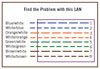
Wally ‘Larman was asked to install the wiring for a small commercial company’s LAN. Wally used the proper cables, connectors, and was very careful when running the wires so that there would not be any problems. Wally ran all of the cables and then installed the appropriate jacks at each end as shown in this diagram, but when the IT department began connecting the network devices they were displeased. Can you see what Wally did wrong and what he must do to correct the problem?
Answer to: What's Wrong with This?
Wally’s problem is caused by the way he connected the network jacks to the cables. The proper way to connect the jacks is by either using the 568-A or 568-B standard. They specify the cable pairs and PIN numbers for each wire within the cable. Generally you can use either method as long as you do not intermix the two, unless you are making a crossover cable in which case one end is wired as 568-A and the other end as a 568-B.Looking for a reprint of this article?
From high-res PDFs to custom plaques, order your copy today!