Hone Your Access Control Knowledge

1. What should you consider when designing an access system?
a. Building codes
b. Fire codes
c. Electrical codes
d. Americans With Disabilities Act (ADA)
e. All of the above
f. None of the above
2. Which of the following locking devices can be configured as fail-safe?
a. Magnetic locks
b. Electric locks
c. Electric strikes
d. All of the above
e. None of the above
3. Which of the following locking devices can be configured as fail-secure?
a. Magnetic locks
b. Electric locks
c. Electric strikes
d. All of the above
e. None of the above
4. According to code, delayed egress devices must release the door after how many seconds?
a. 15
b. 45
c. 60
d. Any of the above
5. Optical turnstiles offer higher traffic movement over traditional mechanical units.
a. True
b. False
6. What is the bit structure of a Weigand proximity card?
a. 26
b. 33
c. 37
d. All of the above
e. None of the above
7. The armature of a magnetic lock is installed on the stationary door frame.
a. True
b. False
8. What type of cable is typically used for a Weigand card reader?
a. RG-59U
b. CAT-3
c. Shielded multi-conductor
d. None of the above
9. MOVs are used to reduce crosstalk.
a. True
b. False
10. A locking device that requires power to unlock is referred to as being fail-safe.
a. True
b. False
11. A device that tells you that the lock is powered and that the strike plate is aligned is called a:
a. bond switch.
b. status switch.
c. micro-switch.
d. Any of the above
e. None of the above
12. When designing an access system that includes fire stair doors, re-entry from the stairwell is not important.
a. True
b. False
13. Distributed processing is a technique that integrates fire alarm systems into access control.
a. True
b. False
14. Access control systems that control egress doors should be connected to the fire alarm system.
a. True
b. False
15. What is the frequency typically used for proximity cards?
a. 10 Hz
b. 60 HZ
c. 100 Hz
d. 125 KHz
e. None of the above

What's Wrong with This?
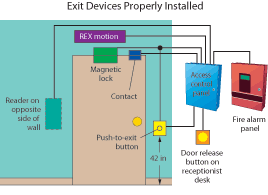
Wally `Larman installed an access system that included a magnetic lock, door status switch, proximity reader, request to exit motion detector and a door release button. Wally installed the devices as shown in this diagram and connected the access panel to the fire alarm panel so the door would release when the fire alarm was activated. Wally tested all functions and everything worked properly, but when the client’s compliance officer inspected the system, he was not satisfied. Can you see what Wally did wrong and what he must do to correct the problem?Correction: The answer to Question 13 of the “Five-Minute Tech Quiz” (SDM, February 2007, p. 116) should have been true, not false. FPLP cable can be used in riser applications. SDM regrets the error.
5-Minute Tech Quiz Answers
Here are the answers to What's Wrong with This? and the 5-Minute Tech Quiz that appears on Page 65.- e
- d
- b and c — Because magnetic locks require power to energize, they are inherently fail-safe and cannot be configured as fail-secure.
- a — Section 7.2.1.6.1 of NFPA 101 states, “An irreversible process shall release the lock within 15 seconds, or 30 seconds where approved by the authority having jurisdiction, upon application of a force to the release device required.”
- a
- d — Weigand cards are available in many different bit configurations. The access controller must be programmed for the type being used.
- b — The armature is installed on the door itself, not the door frame.
- c — Most Weigand readers use a five-conductor shielded cable. You should check with the manufacturer to determine the exact number of conductors and AWG required for the readers and controller installed.
- b — MOVs (metal oxide varistors) are used to reduce the harmful effects of electromagnetic interference (EMI).
- b — A device that requires power to unlock is called fail-secure because it is locked without the application of power. A fail-safe lock is unlocked in the absence of power.
- a
- b
- b — Distributed processing is a technique that allows access controllers to continue to function even when the main computer is off-line.
- a
- d — Although not all proximity cards use the 125 KHz frequency, it is the most common.
Answer to: What's Wrong with This?
Wally has two problems: First, the request-to-exit motion detector does not directly disconnect power from the magnetic lock. Second, NFPA 101 7.2.1.6.2 requires that a push-to-exit device be installed within 60 inches of the door and that it also directly interrupts power to the lock, independent of the access control system electronics. The push-to-exit device should be mounted according to the same NFPA section at a height of between 40 and 48 inches. Wally should rewire the request-to-exit motion so that it directly interrupts power to the lock and sends a request-to-exit signal to the access controller. He also should install a push-to-exit device and wire it so that in addition to acting as a request-to-exit input to the access system, it also directly interrupts power to the lock, as shown in this diagram.Looking for a reprint of this article?
From high-res PDFs to custom plaques, order your copy today!