Check Your Depth in Structuring Wiring

More homes are using a structured wiring system to distribute telephony, data network and TV services. It is important that you fully understand the technologies involved before you dive into the structured wiring market. To see if you have the knowledge necessary to add structured wiring to your offerings, take the following quiz.
ANSWERS BELOW.
- Which of the following wire types should be used for satellite TV signals?
- Cat 3
- Cat 5
- RG-59U
- RG-6U
- IEEE standard 802.11 covers:
- hardwired data networks.
- satellite TV systems.
- wireless networks.
- All of the above
- None of the above
- A typical structured wiring installation uses:
- two four-pair Cat 3 or better cables and two RG-59U cables.
- two four-pair Cat 3 or better cables and two RG-6U cables.
- two four-pair Cat 6 or better cables and two RG-59U cables.
- two four-pair Cat 6 or better cables and two RG-6U cables.
- The maximum segment length of Cat 6 cable is 100m.
- True
- False
- Cat 3 cable supports a higher data transfer rate than Cat 6 cable.
- True
- False
- Which of the following cable faults can adversely affect the operation of a LAN?
- Crossed pairs
- Reversed pairs
- Open/short pairs
- All of the above
- None of the above
- Poor splices can cause static or noise on a telephone line.
- True
- False
- Which of the following tests can a quality cable tester perform?
- Impedance
- Length
- Attenuation
- Wire map
- All of the above
- A multimeter can be used to measure voltage, resistance, and current.
- True
- False
- When pulling Cat 6 cables, you should be careful not to pull too hard or make sharp bends.
- True
- False
- Which of the following terms refers to the weakening of a signal due to distance?
- Attenuation
- RFI
- EMI
- Crosstalk
- None of the above
- The higher the AWG number, the larger the wire size.
- True
- False
- Satellite and cable TV systems typically use BNC connectors.
- True
- False
- A method of assigning temporary IP addresses to computers on a network is called:
- ATM.
- DHCP.
- HTML.
- USB.
- When running data cables, you should avoid:
- electric cables.
- fluorescent ballasts.
- electric motors and switching gear.
- All of the above
What’s Wrong with This?
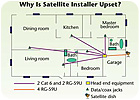
Wally ‘Larman was asked to install a structured wiring system for one of his residential accounts. Wally determined that the customer was using a satellite TV provider for TV and the local telephone company for DSL and voice services. He determined the exact locations of the jacks, the satellite dish location and telephone company demarcation point. Wally ran the cables as shown in this diagram and then he tested all cables to make sure that they were terminated properly and free from any defects. Everything looked good, but when the satellite installer arrived, he was not happy. Can you see what Wally did wrong and what he must do to correct the problem?5-Minute Tech Quiz Answers
Here are the answers to the 5-Minute Tech Quiz and What’s Wrong with This? that appears on page 47.- d
- c — There are three versions of the standard: a, b, and g. The slowest of the three is b.
- d — Although not all applications are identical, a typical structured system will use two data cables and two coaxial cables. You should check with the owner and any audio/video vendors before beginning any work to ensure that you run the correct number and type of cables.
- a
- b — Cat 6 supports a much higher data rate than Cat 3 cables.
- d
- a — Splices should never be used in a structured wiring system, but some older installations may employ splices.
- e
- a
- a — It is very important when running any data cables that you do not pull too hard, make sharp bends or do anything that can distort the cable’s integrity.
- a
- b — The higher the AWG number, the smaller the size of the wire and the lower its current capacity.
- b — Typically cable and satellite TV systems use type F connectors.
- b — Dynamic Host Configuration Protocol (DHCP) is a method of assigning temporary network addresses to computers. If a permanent network address is required, then a fixed IP address configuration is employed.
- d — All of these can cause electrical interference, which can degrade the operation of the data network.

Answer to: What’s Wrong with This?
The problem is caused by the type of cable Wally ran for the satellite TV system. While RG-59U cable was used for many years for terrestrial antenna and even cable TV systems, today’s high performance satellite and digital cable TV systems need a cable with lower loss and higher frequency rating. Wally should replace the RG-59U cable with RG-6 as shown in this diagram. (Quad shield is better, but it may not be necessary.) It is very important whenever you are running cables for other vendors that you determine exactly what type of cable they require, whether they have any restrictions on how it may be run and what type of termination connections are needed. It is better and much less expensive to find out before you run the cables.Looking for a reprint of this article?
From high-res PDFs to custom plaques, order your copy today!