The Beginnings: Beyond the PC
While the benefits of mainframe computer networks were quickly apparent to the business world in the 1970s, the rise of the personal computer (PC) provided the means for individuals to access and use computing power in their daily lives. As the power of microprocessor chips increased, we have seen the development of desktop and laptop computers that can do much more – and cost much less – than the mainframe systems of yesterday. With the increased usage of network protocols, such as Ethernet and Token Ring, these powerful PC devices were being connected to business networks, providing users with large-scale processing power at their fingertips.
Network Protocols
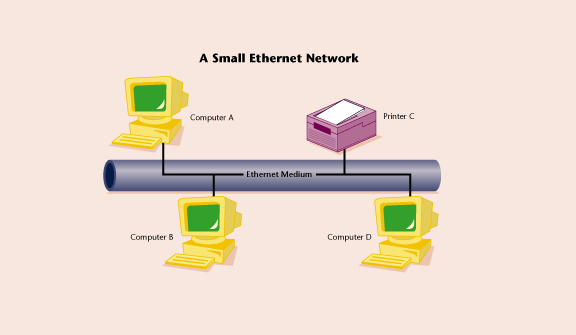
The initial concept behind the development of computer network communications was to allow the sharing of common devices, such as printers, with a number of users. As printers were expensive, it made sense to devise a method where such equipment could be shared.
In the mid-1980s, two networking protocols, or languages, emerged as the primary contenders in this market, those being “Ethernet†and “Token Ring.†Over the past decade, Ethernet has emerged as the dominant computer language for network communications. (Ethernet communications will be covered in detail in a future edition of this column.)
The Internet
As the usage of networks within a business or enterprise rose rapidly in the 1980s and 1990s, a need emerged to connect various computer networks across the country and around the world. If an enterprise has office locations in Dallas, Chicago, Los Angeles, and Hong Kong, there are many needs for inter-office communications, ranging from simple messaging (e-mail) to billing, receivables, and inventory reporting.On a parallel track, the armed forces and scientific communities in the United States were interested in the development of a communications network that would be essentially immune to a nuclear attack that could devastate a large area, cutting all communications links into and out of the blast confines. For such a network to continue functioning, information would have to be able to quickly take alternative routes from one point to another.
The initial “Internet†was this military/scientific network. It linked universities, military bases, and other locations onto a network that provided multiple paths for the information to travel. By dividing longer files into shorter “packets,†which include a numeric address for the receiving computer, files could be sent along different routes to the receiver, and be re-assembled in their proper order for viewing and usage at the receiving end.
Individuals and businesses quickly became accustomed to using the Internet for communications, particularly after the adoption of alternative “name†addresses, such as www.Google.com, that are much easier to remember than their numeric equivalents.
The Internet is now everywhere in our lives, from our business and personal communications to online shopping, and new applications are being developed continuously.
Network History and Electronic Security
For the security professional, the history of computer networking reveals a mature and vibrant networking industry, which combines standardized cabling, computer languages, and network structures into communications networks that are relied on by virtually every business, government, and enterprise. With the increasing production of network devices for the electronic security market, such as IP cameras, video servers, and digital video recorders, networking adds new features and benefits for installation companies and their clients.Of utmost importance to the electronic security industry is the reliability of the products installed. Because of the investment, development, and acceptance by users of these communications networking systems, security installation companies can rely on them to faithfully and accurately perform when transmitting video or security information.
Looking for quick answers on security topics? Try Ask SDM, our new smart AI search tool. Ask SDM →
Looking for a reprint of this article?
From high-res PDFs to custom plaques, order your copy today!