Panoramic Cameras: A 360 Degree View
Industry experts answer integrators’ questions about technology, best practices, and application opportunities.
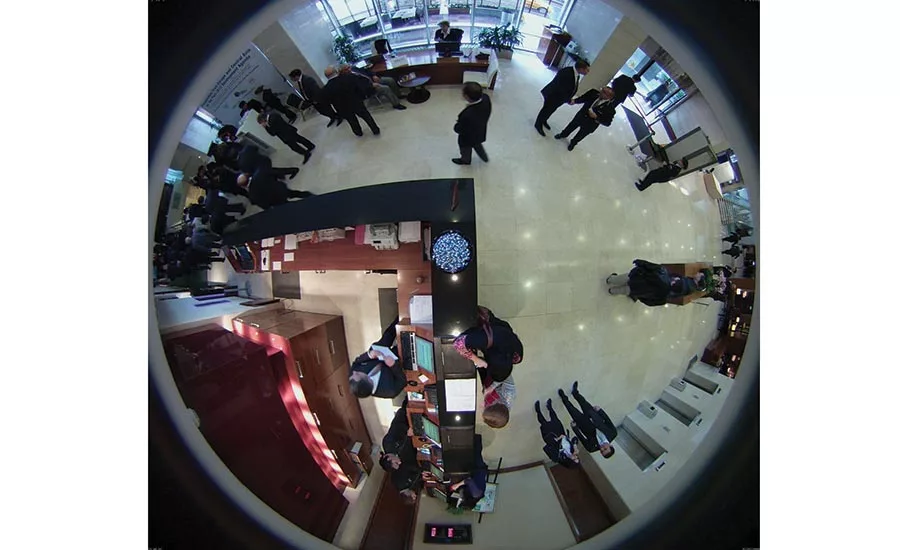
A single 360-deg. camera can provide coverage of a large area, and in many cases can be deployed in place of multiple cameras to cut equipment and installation costs. PHOTO COURTESY OF ONCAM
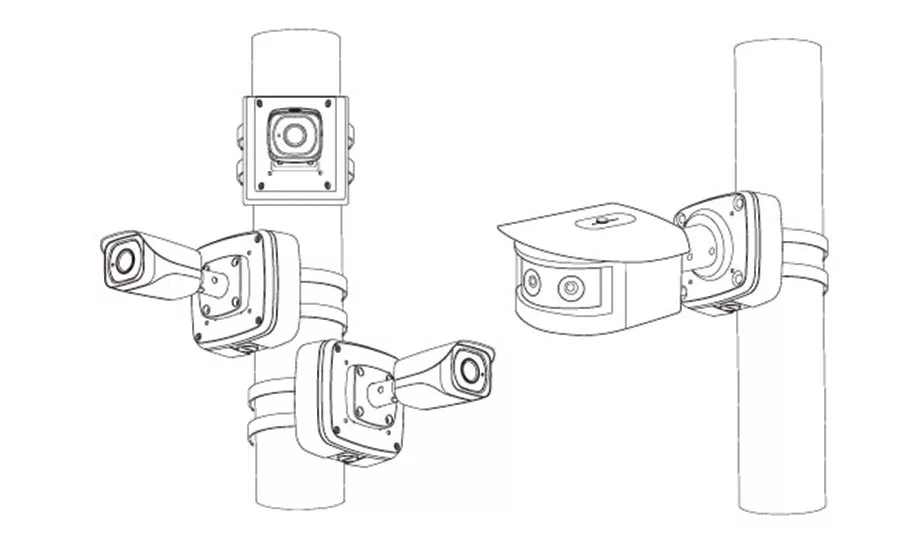
The graphic below illustrates how multi-sensor panoramic cameras can streamline and declutter an installation, with a single six-megapixel multi-sensor camera able to replace three two-megapixel models. IMAGE COURTESY OF DAHUA TECHNOLOGY USA
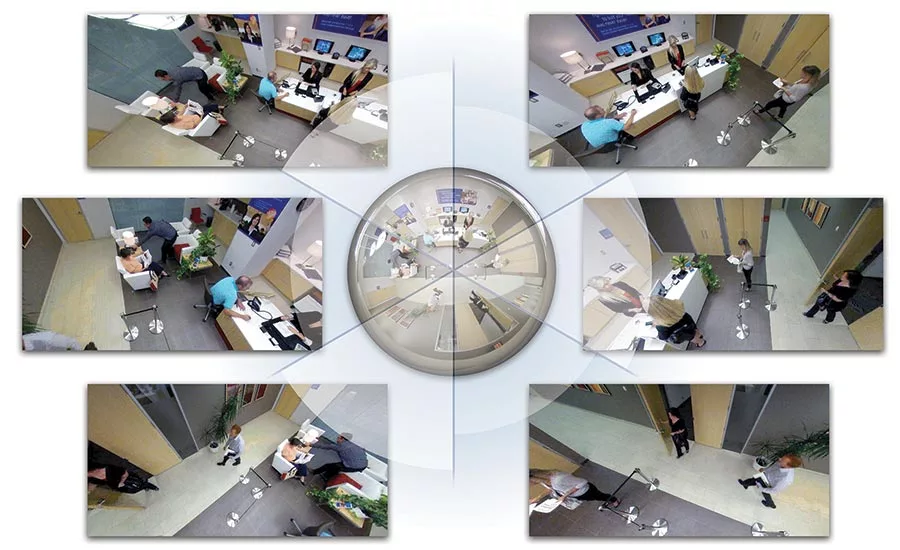
While panoramic cameras are able to capture views of up to 360 deg., those raw images are difficult for the human eye to comprehend and must be transformed by software for viewing. PHOTO COURTESY OF MARCH NETWORKS
The last few years have brought significant advances in 180- and 360-degree panoramic camera technology, along with increasingly affordable price points. Together with lower equipment, installation, maintenance and other costs, these factors have led to significantly greater traction within the video surveillance industry.
When it comes to panoramic cameras, security integrators can choose between 180- and 360-degree models, as well as single- and multi-sensor cameras. This requires a deeper understanding of not only the technology that makes panoramic cameras tick, but also ideal applications and best practices. To this end, SDM posed questions — provided by security integrators — about panoramic cameras, which were answered by industry experts.
SDM: What are some emerging technologies and/or trends in panoramic surveillance and what impact will they have on integrators?
“This is hard to nail down,” says Joel White, regional marketing manager, Bosch Security, Fairport, N.Y. “In single-sensor cameras, you should expect to see higher resolutions, better low-light performance and high dynamic range as processing power and 4K sensors improve. There are also some optical improvements in lensing to increase edge resolution, brightness and clarity, but these will likely be marginal when compared to normal focal length and field-of-view lensing.
“On multi-sensors, we’ve seen higher resolutions, but often these come with tradeoffs of increased costs in deployment dollars and ongoing higher cost for bandwidth and storage,” he continues. “Another gap in multi-sensors is analytics at the edge, which would require the camera to process and stitch an image together so the analytic can assess the entire three- or four-image field of view as a single image.”
SDM: What types of lenses are used with panoramic cameras today, and which is best suited for 180- and 360-degree surveillance?
“In a single-lens panoramic fisheye type, extreme wide-angle lenses are generally used,” White says. “There are also proprietary panamorph lenses offered that are used by a number of manufacturers in some camera models. The claim with panamorph technology is the image is improved with optical correction to lens distortion, but the level of improvement is highly questionable and the maximum resolution these lenses support is lower, with cameras only being in the five- to six-megapixel range.
“On multi-sensor cameras, generally fixed lenses are used to lock in alignment of the images. Some manufacturers pressing for differentiation have started adding in varifocal lenses and even motorized varifocal lenses. Whether the varifocal lenses improve on imagery and camera usability is questionable, but this definitely pushes the multi-sensor further down that ‘multiple-cameras-in-one’ value proposition, because alignment to achieve a panoramic representation becomes increasingly difficult when focal length of each lens is variable.”
SDM: Taking a look “under the hood,” what technologies do panoramic cameras use to generate images for viewing that will make sense to the human eye?
“Panoramic cameras can be viewed in a variety of formats to form seamlessly stitched wide angle views to groups of images or individual images,” says Tom Cook, vice president of sales, Hanwha Techwin America, Ridgefield Park, N.J. “This option is left to the user to decide based on their viewing preferences and specific application needs. In any event, the ability to capture wide-angle or even 180- or 360-degree high-quality images using a single panoramic camera delivers outstanding efficiency while increasing overall security and situational awareness.”
Looking for quick answers on security topics? Try Ask SDM, our new smart AI search tool. Ask SDM →
Brian Levy, CEO of Tehachapi, Calif.-based Hero Security and Surveillance, who also serves as a consultant for Pompano Beach, Fla.-based IC Realtime, adds, “The new ability to stitch multiple camera views together to form a seamless 360 image is really the most dominant trend in multi-lens panoramic cameras.”
Regardless of the format or technology used, the primary goal remains the same. “Making sense to the human eye is the important question,” White says.
SDM: What exactly is a multi-sensor camera and what is driving their development?
“Multi-sensor cameras were created to capture a wider area of coverage than a regular PTZ or fixed camera,” says Kevin Saldanha, senior product manager, Pelco by Schneider Electric, Clovis, Calif. “Some of them are arranged to produce panoramas. Others are intended for flexibly covering multiple areas of interest from a single location, but not as a panorama. Multi-sensor cameras provide a higher level of overall situational awareness and security. They can record the entire field-of-view all the time. Going further, many security operators are limited by the number of traditional PTZ cameras they can oversee, so the use of a multi-sensor camera allows these operators to effectively view significantly more area, improving his or her ability to view multiple areas of interest.”
SDM: Which type of panoramic camera is most prevalent today, single-sensor or multi-sensor? How, if at all, might this change in the future?
“Single-sensor is much more common in the market,” says Charles McCready, senior product specialist, Panasonic Security, Seacaucus, N.J. “Of course, there are some customers that are acclimated to the multi-sensor product so they may stick with that and want that moving forward. As a manufacturer, we evaluate the market opportunity and make a decision whether or not to design for it based on demand. As of today, we still see it as a niche area.”
Nathan Dinning, edge devices product manager, March Networks, Ottawa, adds, “Both types of cameras are popular; it really depends on the application. Panoramic multi-sensor cameras are ideal for applications that need very detailed surveillance over a large area, such as a big stadium or commercial parking lot. Single-sensor panoramic cameras are more practical for businesses that want high-quality video coverage over a smaller area, such as a lobby or display area. Single-sensor cameras remain a popular choice for many banks and retailers because they do an excellent job of capturing an entire location, and can replace the need for three or four separate surveillance cameras.”
SDM: What are the pros and cons of each?
“Multi-sensor and single-sensor panoramic cameras are really in two different leagues,” Cook says. “Multi-sensor cameras can deliver tremendous resolution to cover wide areas such as parking lots or multiple streets in challenging lighting conditions. They are designed for surveillance applications that are typically more critical and demanding. Single-sensor panoramic cameras typically employ some form of fisheye lens that requires de-warping to make the wide-angle images more usable. These cameras serve many purposes, and can complement their more expensive counterpart multi-sensor cameras for use in less critical applications, such as crossing interior hallways. Both are very cost efficient and have come a long way in recent years, so we believe they will continue to gain popularity in 2017.”
Dinning adds, “In some cases, multi-sensor cameras are prone to having a few more blind spots versus a traditional 360-degree camera. More sensors per camera also means there are more components that can potentially fail. On the pro side, multi-sensor cameras can be useful in hallway intersections, large areas or outdoor terminals. There are a few that have taken the multi-sensor approach but most manufacturers have opted for the 360 form factor.”
Says Jennifer Hackenberg, product marketing manager, Dahua Technology USA, Irvine, Calif., “Multi-sensor cameras are designed to make the overall design, installation, aesthetics and post-forensic analysis simpler. For an integrator, a primary benefit of a multi-sensor camera is that it can drastically simplify the planning process. Creating a design for large projects with multiple camera installations can sometimes get complicated. Therefore, a single camera that can do the job of multiple cameras is ideal for simplifying an application in terms of cabling, networking, VMS licenses, and installation. For example, not only will the additional cables add to the overall cost, but the labor for multiple camera installations will be substantially higher compared to installing a single multi-sensor camera.”
SDM: What are ideal applications for panoramic cameras?
“Given their performance and cost-efficiency, panoramic cameras are really ideal for most mainstream applications across all verticals whether it be gaming, retail, healthcare, homeland security, etc.,” Cook says. “Given the lower price points now available, we will continue to see panoramic cameras be used in lieu of traditional and often more costly PTZ cameras, as well as in lieu of multiple fixed cameras.”
In terms of specific applications, Dinning says, “Panoramic or 360-degree cameras are ideal for retail, banking and some commercial/industrial environments. Just one strategically located 360 camera can take the place of several surveillance cameras, and give you complete surveillance coverage of a large area. They can also be used to complement existing surveillance cameras capturing specific areas of a scene, giving customers both those more specific views plus a complete overview of their entire area.”
SDM: Given the availability of 360-degree technologies, are the days of traditional motorized PTZs numbered?
“While panoramic cameras are certainly growing in popularity and demand is increasing, there are still many end users that also use PTZ cameras to be able to get higher resolution in a particular area of interest,” says Jumbi Edulbehram, regional vice president – Americas, Oncam, Billerica, Mass. “The downside with PTZ cameras is that while they’re zoomed into a particular part of the view, something going on elsewhere could be missed, both in live as well as stored video. To address this, many PTZ users are augmenting their security solution by implementing a combination of both PTZ and panoramic cameras to create a solution that achieves full coverage and greater situational awareness.”
However, this dynamic is likely to change in the future.
“PTZ cameras dominated the surveillance market for decades, but have been completely surpassed by multi-sensor cameras,” says Jeff Whitney, vice president of marketing, Arecont Vision, Glendale, Calif. “Multi-sensors typically are less costly than expensive professional-grade PTZs, do not require ongoing maintenance for moving parts like PTZs, and reduce the number of cameras required for superior, non-stop situational awareness. Multi-sensors make viewing video simpler by covering larger areas, requiring fewer video screens to be monitored in order to maintain situational awareness.
“With these factors added in, PTZ technology is clearly a legacy technology whose time has passed,” he adds.
SDM: How can integrators generate ROI using panoramic cameras?
“For integrators, 360-degree cameras offer upgrade opportunities for end users that are looking to migrate to higher quality HD and Ultra HD cameras and can deliver significantly better image quality and results than previous generation cameras with lower resolution quality. Essentially, it’s another way to add value and migrate customers to current-generation technology in a cost-effective way,” McCready says.
Looking at specific benefits, Cook says, “Integrators can typically increase overall situational awareness and coverage area while reducing costs with a well-planned system employing panoramic cameras. In many instances, a single panoramic camera can do the job of multiple cameras, reducing overall equipment and installation costs. This is a smart business strategy that many integrators have adopted.”
Perhaps the most significant factor in the ROI equation is potential cost savings, Hackenberg says. “A multi-sensor camera reduces the total number of single-sensor cameras required to provide effective surveillance, thus lowering the total cost of ownership while not sacrificing video coverage. And, thanks to the camera’s ultra-wide field of view, a single multi-sensor camera can do the job of several standard-definition cameras at a fraction of the price.”
Advice for Installing Panoramic Cameras
Tom Cook, Hanwha Techwin America: “Take care in calculating camera coverage capabilities, taking the field of view and distance of the cameras’ lenses into consideration, as well as the lighting conditions for each camera’s location. It’s also critical to properly estimate the bandwidth that will be needed to transmit, view and record the desired level of resolution and motion for each camera in the system.”
Jennifer Hackenberg, Dahua Technology USA: “Determine a proper mounting area that will capture the application’s requirements. Make a decision about the quality of the image that the application requires. Is detection-level surveillance adequate or does the application require identification-level images?”
Brian Levy, IC Realtime consultant: “Embrace new technologies slowly. Test these cameras before you decide to introduce them to your customers. Make sure they can solve your customers’ needs.”
Charles McCready, Panasonic: “In terms of placement, panoramic 360-degree cameras are typically installed between 13 to 15 feet high for optimal performance.”
Jeff Whitney, Arecont Vision: “Don’t be fooled by spec sheets. It’s easy to copy the look of a multi-sensor camera, and publish matching specs. Doing so does not mean that the cameras will perform equally. Protect yourself and your customer by performing a side-by-side physical test of the cameras from any vendors you are considering.”
Jumbi Edulbehram, OnCam: “Look at recommending the best possible technology for an organization’s needs.”
MORE ONLINE
For more information on the topic of 180- and 360-degree cameras, visit SDM’s website where you’ll find the following articles:
“Popping the Hood on 180- & 360-Degree Cameras”
www.SDMmag.com/popping-hood-360-cameras
“San Francisco Shelter Protects At-Risk Families With IP Video & Access Control
www.SDMmag.com/san-fran-shelter-at-risk-families
“Security Integrators Help School District Respond & Move Forward After Tragedies”
www.SDMmag.com/integrators-help-school-after-tragedies
Looking for a reprint of this article?
From high-res PDFs to custom plaques, order your copy today!