5 Trends in Operational Software You Can’t Afford To Ignore
Artificial intelligence, easier payment methods and other software advances can streamline dealer operations and offer greater flexibility in a competitive marketplace.
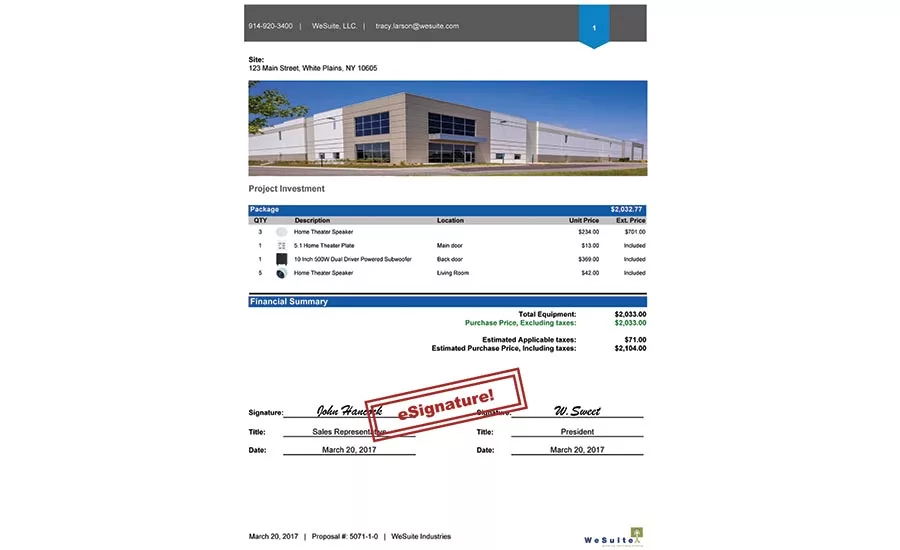
Customers are increasingly comfortable with the idea of signing contracts electronically. IMAGE COURTESY OF WESUITE
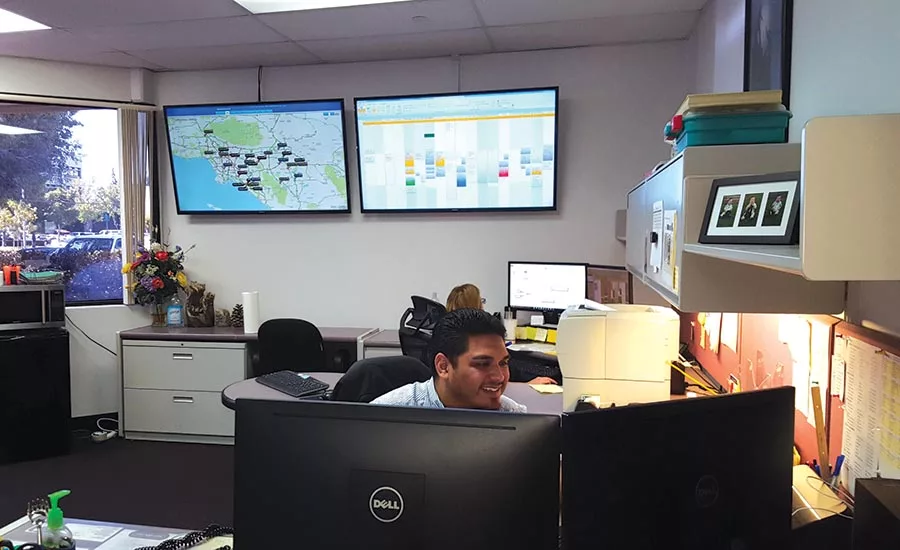
Security dealer operations personnel can use the SedonaOffice software from Perennial to handle a wide range of functionality. Features include tracking technicians’ vehicles through an integration with Fleetmatics (screen on the left) and a schedule board showing technicians’ service tickets and jobs (right). PHOTO COURTESY OF PERENNIAL SOFTWARE
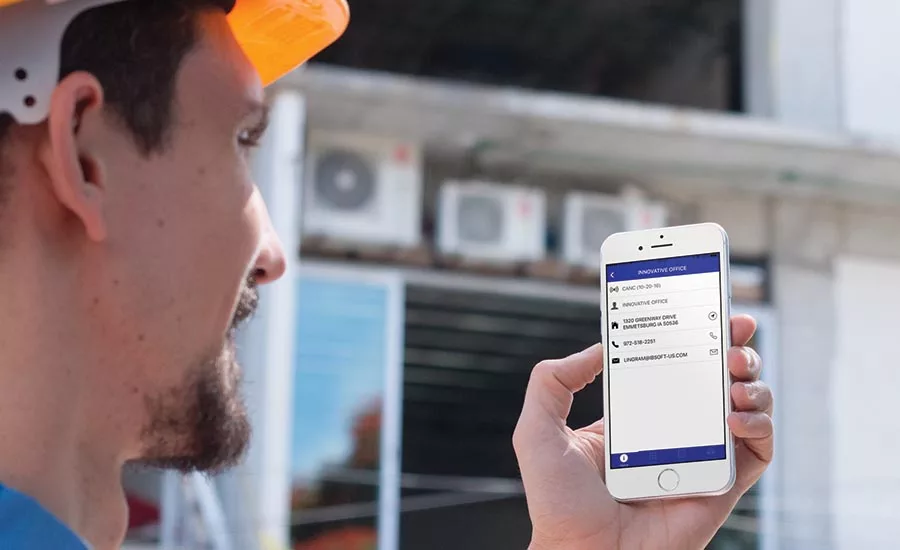
Operational software from Innovative Business Software lets technicians use a smartphone to put an account on test. PHOTO COURTESY OF INNOVATIVE BUSINESS SOFTWARE
Advanced operational software isn’t a luxury. Instead, it may be an essential element of a security dealer’s strategy in a competitive marketplace. The dealer that can use advanced software to shave percentage points off billing or acquisition costs gains that much more flexibility in the market — and as more and more dealers adopt new capabilities in their operational software, those features may be critical to a company’s ongoing strength and viability.
Some software providers are enhancing their offerings with artificial intelligence or by making it easier to integrate with other software systems. Meanwhile, dealers are increasingly open to using technology advances that may have been around for a while but initially may not have been widely adopted — including cloud-based services. Customers also are opening up to the idea of using technology options such as the ability to sign contracts electronically or to click a button to pay online.
SDM asked software providers about the latest trends in operations software — including billing, sales management and other software other than central station automation software (which could merit an article in and of itself.) Based on providers’ comments, we identified five key trends that dealers should take care not to ignore.
1. Artificial Intelligence comes to operations software.
Security dealers are accustomed to programming equipment and software to customized settings established in advance by the product developer. But it’s not always possible to plan the best way for equipment and software to behave in advance, which is why some developers are beginning to add artificial intelligence to their offerings. For example, Virginia Beach, Va.-based software provider AlarmSoft has built artificial intelligence into its fleet management software.
As Christopher Brackett, general manager of AlarmSoft explains, the software learns as you go. Brackett cites the example of a technician responsible for inspections. “When you first set it up, you give it general parameters [for how long a typical inspection should take],” he explains. “As the system gets used, it takes the general information you set up and modifies it. Maybe I put an hour in there and it shouldn’t be an hour. It might say I need to shorten that up. It makes the adjustment and can send me an email to tell me what happened.”
By fine-tuning this information, supervisors have a better idea of when they should check in with a technician because a job seems to be taking an unusually long time.
As artificial intelligence becomes more accurate and as its cost comes down, expect to see it in more software products moving forward.
Looking for quick answers on security topics? Try Ask SDM, our new smart AI search tool. Ask SDM →
2. Integrating with other systems becomes easier.
Integrating different types of software with each other can yield important benefits for security dealers. For example, by enabling customer information to be entered into a sales tracking system that is integrated with billing and monitoring to flow through into the other systems, dealers can avoid double data entry, save time and enhance accuracy.
“As a software developer you have to be willing to work with and partner with everybody else,” observes Michael Marks, co-founder of Chagrin Falls, Ohio-based Perennial Software. “You can’t be close-minded anymore.”
Marks argues, though, that “synergies” has become a more important word than “integration.” Nowadays, he says, “people want to go beyond integration and interface; they want true synergies; they want multiple applications to work together transparently as one.”
He points to a recent integration of Perennial Software’s business operations software with a major security equipment distributor as an example of how tightly integrated software can benefit security dealers. In the past, dealers had to fax or call in purchase orders. Now they can just hit a button and the order is received at the distributor, Marks explains.
“The time it took to place an order went from five to 10 minutes to milliseconds,” Marks observes. “Even more than time savings, it’s accuracy. We can show you pricing and we can verify pricing…. We get a receipt acknowledgement so we know the order was received and [the system] automatically notifies the client if an item is on backlog.”
Integration is typically achieved through application programming interfaces (APIs). When demand merits, Perennial Software will undertake the work needed to integrate with software developed by other parties, Marks notes. In other cases, the other developer may handle that process. And dealers with their own software development team may handle that task on their own, particularly if the dealer was the developer of the software to which it wants Perennial to integrate.
APIs enable dealers to use what some people call a “best-of-breed” approach to software.
“You can take any element of our package out and integrate [to other software] with a strong API; we don’t force [people] to use our elements,” says Jens Kolind, CEO and president of Irving, Texas-based Innovative Business Software Inc.
Dealers wanting to use a best-of-breed approach should investigate the APIs that a software provider offers. Kolind notes, for example, that as Innovative Business Software upgrades versions of its software, it makes sure that functionality delivered through APIs will not change.
One popular way that dealers use APIs is to create self-service portals for their customers, Kolind adds. “Everybody wants to be unique and different,” he observes.
3. Dealers embrace the cloud.
Security dealers increasingly are participating in a broader trend impacting numerous types of software supporting different industries and applications. Instead of buying their own operations software and installing it on their own servers, dealers are increasingly open to relying on subscriptions to cloud-based software delivered from companies such as Fox Lake, Ill.-based Cornerstone Billing Solutions.
As Cornerstone President Scott MacDougal explains, Cornerstone has been offering operational software for security dealers on an outsourced basis since before people used the term “cloud” to describe such offerings. MacDougal notes that he is seeing wider acceptance among traditional dealers that 15 years ago wanted to do everything themselves.
“Dealers are realizing that the cloud gives you more leverage if you can find a specialist to do these things [so you can] focus on account growth and making money on jobs,” MacDougal says.
Marks also has noted this trend. He estimates that 75 percent of security dealers that are looking to modify their operational software systems are opting for a cloud-based solution.
Cloud-based offerings may be particularly appealing to dealers who are beginning to see opportunity in the consumer trend toward do-it-yourself security, observes Jody Schuhart, vice president for Cornerstone. The idea is to create websites to enable consumers to go online to order motion detectors and contacts they can install themselves and then turn on monitoring from the dealer. The solution is to set up a shopping cart that can integrate with Cornerstone’s offering.
“We’ve helped dealers to be able to take [customer] data and input it into the system in an easy fashion,” Schuhart says.
4. Consumers open their minds on electronic signatures.
Dealers aren’t the only ones whose attitudes toward operational software are changing. Tracy Larson, president of White Plains, N.Y.-based software provider WeSuite, has seen a change in consumer attitudes as well.
WeSuite several years ago introduced an electronic signature option to the software it offers that dealers’ salespeople can use to create customer contracts. But as Larson explains, “Initially it was difficult to get people to be OK signing electronically.”
As electronic signatures have become more commonplace in the broader consumer market, however, that has changed. “What we’re seeing now is a lot of demand for [consumers to] sign electronically on the salesperson’s tablet,” Larson observes.
As a result, salespeople may find they make more sales because there is no lag time between when they meet with the customer and when the customer signs up for service. “You’re making more sales and … you have access to your paper,” Larson says. “You have access to the contract at any time and the client does as well.”
5. Online payment grows in popularity.
In a similar vein, consumers also are becoming more open to the idea of paying for security services online, notes Mike Wiseman, vice president of sales for Orlando, Fla.-based Security Information Systems, which provides billing software for security companies.
“‘Click here to pay now’ is the number one trend,” Wiseman says.
It wasn’t so long ago that some consumers thought the idea of online banking was “nuts,” Wiseman comments. But here, too, a broader consumer trend toward online payment has helped overcome consumers’ security concerns while also demonstrating the potential convenience and time savings of paying online.
“People want to do transactions without human interfaces,” he says. “[Dealers] want to be able to send a bill via email.”
At one time, online payment was an optional capability for Security Information System’s software. “Today it’s a standard part of our feature set,” Wiseman adds.
Whether cloud-based or premises-based, advanced operations software can give dealers an edge in today’s marketplace. As Marks puts it, “It’s very competitive out there and you have to do more with less.”
Meeting — or Exceeding — Expectations
Smart software developers try hard to anticipate how new offerings will impact dealer operations. When software enhancements are predicated on saving costs or generating more revenues, it’s critical for the software to deliver on those expectations.
Investing in new operational software shouldn’t be a leap of faith, observes Michael Marks of Perennial Software. Instead, software providers should have real-world data to illustrate claims about time or cost savings.
Sometimes software not only meets dealer expectations; it exceeds them.
WeSuite’s Tracy Larson cites the example of a capability that WeSuite added to its software to automate the approval process when a salesperson wants to offer pricing that is outside traditional guidelines. Although the goal was just to simplify that process, Larson says that some salespeople preferred to avoid that process and instead made fewer deviations from established pricing.
“They try to avoid approvals, which drives margins up,” she observes. Salespeople also like a capability in the WeSuite software that calculates their commission as they build quotes, Larson adds.
Why Security Needs Its Own Software
At first glance, the security business might not seem so different from many other industries, so it might appear that dealers could use any old billing or sales tracking software. But dig a bit below the surface and it quickly becomes apparent that the security industry has some characteristics that generate unique requirements when it comes to operations software.
“It’s not any one thing; it’s everything put together,” says Michael Marks of Perennial Software.
“It’s not a one-time sale,” Marks explains. “You have the sales organization, the marketing, the proposals. Then you get the win. Now you have a customer; you have to do the installation, you have to manage it. There’s project management, job costing. And once it’s installed, there’s ongoing recurring monthly revenue. You need recurring billing, collection management, credit card billing, online Web portals so people can pay when they want to. You also have service management — service, warranty, inspection, scheduling of technicians…. Whether you’re ADT or a mom and pop company, you’ve got to do the same thing.”
Monitoring also is rather unique to the security industry — and integrating that software with other operations software such as billing is becoming increasingly critical, notes Jens Kolind of Innovative Business Software Inc. “An integration package makes organizations more efficient,” he says.
MORE ONLINE
For more on business operations software visit SDM’s website where you will find the following links:
“The Benefits of Having the Right Back Office Software”
www.SDMmag.com/the-right-back-office-software
“Software Helps Make the Sale”
www.SDMmag.com/software-helps-make-the-sale
“Office & Central Station Software Update”
www.SDMmag.com/office-central-station-software-update
Looking for a reprint of this article?
From high-res PDFs to custom plaques, order your copy today!