Perimeter Motion Detectors on the Move

- Any dual detector can be used for outdoor protection.
a. True
b. False
- Outdoor photoelectric detectors use dual beams to:
a. increase range.
b. overcome the effect of bright sunlight.
c. reduce false alarms.
d. All of the above
- Which of the following can cause false alarms when installing outdoor detectors?
a. Snow, rain, temperature and fog
b. Animal activity
c. Blowing leaves or debris
d. All of the above
e. None of the above
- Which of the following can affect the coverage of an ultrasonic detector?
a. Temperature
b. Humidity
c. Furniture and wall/floor coverings
d. All of the above
- The width of the light beam in a photoelectric detector increases with its length.
a. True
b. False
- Which of the following can cause a microwave detector to false alarm?
a. Moving fan blades
b. Water moving inside plastic pipes
c. Movement in adjacent areas
d. All of the above
e. None of the above
- Incorrect alignment of a photoelectric beam can prevent it from detecting motion.
a. True
b. False
- Microwave energy can penetrate many commonly used building materials.
a. True
b. False
- What frequency range do most ultrasonic detectors utilize?
a. 10HZ to 100Hz
b. 20KHz to 40KHz
c. 3MHz to 6MHz
d. Any of the above
- HVAC ducts can inadvertently channel microwave detector energy into undesired areas.
a. True
b. False
- Dual technology detectors are used to
a. increase the range of the detector.
b. reduce the cost of the detector.
c. reduce false alarms.
d. All of the above
e. None of the above
- Infrared detectors operate using the Doppler Shift principle.
a. True
b. False
- Infrared detectors operate in the frequency range of 50KHz to 100KHz.
a. True
b. False
- When installing multiple detectors that have normally closed alarm contacts (open on alarm) to a single zone, you should wire the relays in parallel.
a. True
b. False
- What is the total current requirement in amps for a system that incorporates 15 motion detectors if each detector draws 35mA?
a. 0.0525 amps
b. 0.525 amps
c. 525.0 amps
d. None of the above

What's Wrong with This?
Wally `Larman installed a burglar alarm system for a small jewelry store located in a local shopping mall. As requested, he designed a two-area system, one area for the premises and the second area for the safe, and installed the devices as shown in this diagram. When Wally was finished, he carefully tested and adjusted the system and found that everything worked as expected, but when the customer began using the alarm, frequent false alarms were caused by the front microwave detector. Wally readjusted the microwave and even replaced it, but the false alarms continued. Can you see what Wally did wrong and what he must do to correct the problem?5-Minute Tech Quiz Answers
Here are the answers to What's Wrong with This? and the 5-Minute Tech Quiz that appears on Page 45.- b — Due to the extreme conditions encountered when installing outdoor detectors, only those devices specifically designed for outdoor installation should be used.
- c
- d
- d — All of these conditions can affect the overall coverage of an ultrasonic detector. Temperature/humidity affect the sound waves’ ability to travel through the air, and furniture and wall/floor coverings can absorb or reflect the ultrasonic energy.
- a
- d
- a — If the receiver is installed so that other sources of light, such as sunlight or lighting fixtures, can be seen by the receiver, it is possible that it will not detect motion along its entire length. This is why you always should test photoelectric detectors at many points along their lengths.
- a — Microwaves can penetrate most common building materials except for metal, which will reflect the energy.
- b
- a
- c
- b —Infrared detectors detect a change in infrared energy. Ultrasonic and microwave detectors utilize the Doppler shift principle.
- b — Infrared detectors are passive, hence the name passive infrared detector, and as such do not transmit any energy.
- b — Contacts that open on alarm should be wired in series, and contacts that short on alarm should be wired in parallel.
- b — If each detector draws 35mA, then the total for 15 devices would be 15 x 35mA = 525mA, which can be represented as 0.525 amps.
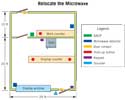
Answer to: What's Wrong with This?
Wally’s problem is caused by where he located the front microwave detector. Because microwave detectors can penetrate materials such as glass easily, the false alarms are caused by people walking near the show window in the mall after the store is closed. Wally should relocate the microwave detector as shown in this diagram and re-test the system. As an alternative, he also could replace the microwave with a PIR, which will not detect motion outside the store. It is important when designing a system to fully understand the capabilities of the devices used and carefully look for potential sources of false alarms.Looking for a reprint of this article?
From high-res PDFs to custom plaques, order your copy today!