Fire Alarm Systems: State of the Market

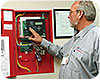
James Stanley from JM Electronic Systems, Round
Rock, Texas, reviews the programming at a school in the Killeen Independent
School District.
Haig Service Corp., Green Brook, N.J., is still experiencing good growth, reports Richard Haig Jr., president/CEO.
“We’re looking at between 10 to 15 percent organic growth, and then we are hoping to do some acquisition — more likely a merger — in one of our markets in New Jersey that will give us some additional growth, for an overall growth rate of 20 percent,” Haig predicts.
His healthy growth rate may be due to the segment of the fire market in which he specializes. “The retrofit market better suits us, because we’re not primarily a construction company; we’re a service company,” Haig explains.
An advantage often attributed to the fire alarm market is its reliance on fire codes to drive growth.
“You’ve got to love an industry that is code-driven, and we have branches in at least one if not two of some of the most code-driven states in the country,” Haig declares, citing Florida and New Jersey. “In the south Florida area, we are seeing a large number of projects where they are enforcing codes that really were in place a few years ago, but they didn’t have the manpower to enforce,” Haig notes. “So many companies are being put in the position of having to spend some money to retrofit their buildings.”
Harold Sowell, owner of Pioneer Communications, Cookeville, Tenn., also is seeing stricter code enforcement in his area.
“Now the nationwide fire codes are being enforced across the board,” Sowell says. “If we see areas that need additional protection, we usually go above what the code requires on a home — we’re putting in a lot more carbon monoxide detectors in spaces the code doesn’t require. If we see there is an area that needs protection, we’ll recommend it, and normally the homeowner will put it in.”
An opportunity for additional business Haig points out is when an elevator is installed in an existing building. “As soon as you put an elevator in, there are all sort of requirements, so they use it as an excuse to upgrade the building in general,” Haig maintains.
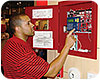
Matthew Moore, Fire-Lite technical service
representative, inspects an addressable fire alarm panel.
“In addition, we provide over 2.5 million sq. ft. of fire protection for Mylan Pharmaceuticals, the largest generic drug manufacturer in the U.S.,” Brozik continues. “We do approximately eight off-site locations. We’re seeing a lot of growth in the residential apartment /condo markets again, because of the growth of West Virginia University.”
Ken Hoffmann, CEO of DynaFire Inc., Casselberry, Fla., is enthused about commercial development. “To me, the fire alarm business has been excellent this past year,” he reports. “The commercial economy has been very strong in the Orlando area.
“We do more with the University of Central Florida Hospital,” Hoffman continues. “We just finished the fire alarm system in a new football stadium built for the University of Central Florida, and a 38-story condo building in downtown Orlando.”
But the residential condominium market in Hoffman’s area has not been doing well. “There’s definitely been a softening almost to the disaster point in high-rise condos,” he reveals. “I don’t see that coming back in the next 12 months. That’s probably going to be dead for the next two years.”
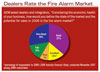
Nearly eight in 10 security installation
professionals have a positive outlook on the potential for fire alarm sales in
2008, rating market conditions “good” or better.
SUPPLIERS OPTIMISTIC, BUT REALISTIC
Jeff Hendrickson, director of marketing at Silent Knight by Honeywell, Maple Grove, Minn., reports business is very good for his company. “There’s certainly a lot of noise about the economy, but on the commercial side, it has remained very good,” he says. “It’s tied mainly to the healthy growth of certain segments of the market.”When new construction slows, Hendrickson’s company concentrates on retrofit work. “The retrofit work goes on continuously,” he points out. “There are times when you might see a slight slowdown in new building construction, and you see a little more activity with some of the retrofit systems. The Silent Knight brand has some advantages in that we can utilize a lot of the existing building wiring and infrastructure to retrofit a fire system.”
John Maccone, national account manager for Fire-Lite Alarms, Northford, Conn., also thinks the business is very good. “What’s a little different about the fire alarm business is it’s mandated,” he points out. “Whether the customer’s business is growing, if they need to stay in business, they need a fire alarm, so it’s code-driven as opposed to desire-driven.”
He also notes that testing and inspection business is necessary. “When it comes to fire protection systems, you have to have service, maintenance and monitoring,” Maccone adds. “It’s not ‘let’s opt to do a fire system;’ it’s mandatory. There’s a different driver there.”
Although Scott Sturgess, director of product marketing for intrusion and fire products at ADI, Melville, N.Y., says 2007 was very strong, economic reports are moderating his expectations for 2008 and 2009.
“If you look at new building construction reports for 2007, it was really a lot of residential bad news,” Sturgess concedes. “In 2008, I think it found its way to the commercial side of the business. I’m looking at a report right now that says limited growth is projected over a two-year period in 2008 and 2009.
“Our fire alarm sales are very tied into the success of the commercial building market,” he points out. “I think everybody is going to feel the pinch, and that it will translate into a little softer market in 2008 and 2009 for the fire business. The retrofit market will always remain pretty steady.”
Because of a three- to six-month lag between the time that commercial projects are specified, approved and worked on, depending on the size of a project, “The first three months of the year have been pretty strong,” Sturgess admits.
Tom Potosnak, vice president of marketing for System Sensor’s U.S. business, System Sensor, St. Charles Ill., concedes, “Obviously, the economic conditions are starting to change overall from a macro perspective. That is going to have an impact on the fire protection market, as it will many others.”
Shawn Laskoski, marketing leader for fire and communications at GE Security, Bradenton, Fla., concedes that even though new construction is slowing, “we see underlying opportunity for retrofits and upgrades to fill the gap. We still see a very strong market in 2008.”
Potosnak points out that code-driven business, while steady, is not often spectacular. “That’s the downside to the code-driven side of the business,” he points out. “Unless there are some dramatic changes in the codes, you’re not going to see massive spikes where you get the staggering growth rates and then similarly staggering drops. So it’s a nice steady business.”
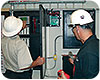
DynaFire Inc. employees John Creamer (left),
project engineer, and Jack Gondeau, project manager, inspect a smoke control
panel and a fire alarm panel in the fire command center of The Vue, a 37-story
multi-residential high rise in Orlando, Fla.
HOT PRODUCTS
Like many in the industry, Hendrickson sees addressable systems as being where the growth is. “I would say conventional fire systems are fairly flat to slightly down,” he concedes. “So we see the lion’s share of the growth in the addressable side.”Conventional systems are being used more in retrofit applications, thinks Joe Donato, national sales manager for Summit Systems Technologies, Vaughan, Ontario, Canada.
“We sell a lot of the conventional systems in retrofit applications, where you don’t want to rip out the smoke detectors,” Donato says. “It’s less expensive to buy a conventional system than addressable, but that margin is getting smaller. The cost is such that for maybe a few dollars more, you can put in an intelligent addressable system that gives you a lot more flexibility.”
As addressable systems become more affordable, they are edging conventional fire panels to approximately 40 percent to 45 percent of the market, Maccone estimates. “The newer, more intelligent products are about the same price as the old, more labor-intensive-to-install system of five to 10 years ago,” he observes.
Brozik has witnessed a large increase in addressable systems in his area. “Most systems we install now, about 95 percent, are fully addressable, where five years ago it might have been 50:50,” he reveals. “The price of addressable systems has come down significantly, and there’s much more of a demand, especially for larger facilities.”
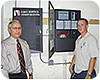
Haig Service Corp. employees Richard Mayer
(left), general manager of the company’s Fort Lauderdale, Fla. branch, and
Brent Dupont, field service technician, check out a broadband voice evacuation
system.
“Monitoring has almost become a commodity,” he insists. He points out that addressable systems now report many more zones than they used to.
“There’s a lot more involved in monitoring of alarms than 20 years ago, but some dealers have that perception of a very inexpensive price because of advertisements,” Cohen asserts.
Maccone is enthused about fire alarm systems that use IP communicators in place of two telephone lines, each of which can cost $80 to $90 monthly.
“One of our many end users has 3,300 stores nationwide,” he reports, calculating the cost of two phone lines at $130. “How many widgets do those retail stores have to sell to profit $429,000?”
Among the products Sturgess is seeing growth in is voice evacuation. “We’re starting to play in the mass-evacuation space, and that’s another trend that I think will continue to be strong,” he predicts.
Laskoski, also, believes mass notification systems will be important this year. “How mass notification really plays out with the fire industry, I think that is going to be a very strong focus for 2008,” Laskoski predicts. “A lot of regulations are starting to form around that.”
Brett Bean, president of F.E. Moran Inc. Alarm, Champaign, Ill., thinks enforcement of voice evacuation systems is increasing.
“We are seeing a lot more of the voice evacuation systems installations,” Bean reports. “While codes say they are required, it might be overlooked. We are seeing more of that enforced.”
Another growth product is wireless. “We’re continuing to see more wireless fire systems,” Sturgess declares. “This was almost a taboo for the fire industry, but the reliability of the wireless system is very good right now, along with its ease of installation. One of the things we hear from our dealers all the time is it’s often hard to get qualified installers, and when you can put up a wireless system, you have a tremendous amount of savings in labor.
Gas detection also is a growing area, although some uses Sturgess thinks are high-end. “We’re experiencing a nice increase in gas detection for parking garages and farms with methane gas,” he notes. “Ammonia detection is another one.”
Carbon monoxide (CO) legislation is not just for northern states anymore, where more CO legislation has been passed, but southern ones as well.
“You think about states such as Florida, where often you have hurricanes and the power goes out,” Potosnak points out. “Portable generators inside the house are susceptible to causing CO poisoning. It could be your water heater, furnace, portable generators — anywhere where there’s incomplete combustion.”
Potosnak even heard of a homeowner who ran his barbecue in his garage with the door closed during bad weather and caused CO buildup.

Lenny Minervini (right), president of Rainbow
Home Systems, purchases fire products at his local ADI branch in Plainview,
N.Y., from Frank Defilippis, inside sales representative.
NON-PROPRIETARY SYSTEMS
Maccone praises fire alarm systems that are non-proprietary. “The life of a fire alarm system is the life of the building, even in an upgrade,” he maintains. “If you have a proprietary system, you’ll probably have to rip out everything and start from scratch.”Sturgess also thinks end users are moving away from proprietary systems. “They are looking to go with non-proprietary systems so they can select from a bunch of dealers for the install or a maintenance call,” he observes. “They’re not locked into one dealer in a particular area that has a proprietary system.”
Haig thinks the consolidation of manufacturers is standardizing product lines and lowering costs. “Manufacturers are embracing the technology that is out there and relatively cheap, and building it into the product, which is getting better and cheaper,” he asserts.
At the same time, Haig bemoans shorter credit terms from vendors. “I think that openly hurts the industry, given that most are small businesses, not large well-funded companies,” he emphasizes.
Another complaint is product availability. “They seem also to have scaled back manufacturing so inventory is almost built to order; we are frequently waiting for equipment, and quality control remains an issue,” he comments.
A possible reason for product delays is attributed to Underwriters Laboratories (UL).
“In 2007, UL publicly acknowledged past issues that have impacted delivery of UL 864 9th edition approvals for all manufacturers in this industry,” explains Tom Hauder, product marketing manager, fire protection products for Bosch Security Systems Inc., Fairport, N.Y. “UL’s issues have caused some products from various vendors to be late to market.
“This delay has impacted sales growth in the industry overall, as some customers are postponing purchasing decisions until the systems receive listings for UL 864 9th Edition,” Hauder declares. “As the AHJ community begins to accept other listing agencies beyond UL, the flow of new products to the industry should increase greatly.”
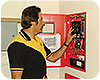
Joe Mesich of Advanced Technical Services works
on a panel at the Little Sisters of the Poor assisted living facility in
Gallup, N.M.
TRENDS & ISSUES
Just as the IT influence has been felt in the video surveillance and access control markets, it also is having an influence on the fire alarm market. Haig is seeing increasing participation of IT managers in fire and security systems jobs. “We are finding the fire alarm is moving from the facilities manager to the IT manager, so you’re getting a techno-geek instead of a nuts-and-bolts guy,” Haig observes. “There are pluses and minuses to both.“We’re struggling with IT a little bit because the IT guys tend to geek it up,” he laments. “They try to get really technical about it, almost too technical, and many times fire alarms and security systems are not really rocket science. They’re code-driven — it’s compliance, it’s not reinventing the wheel.”
Sidebar: End Users Want More Information
End users are looking at the long-term costs of a system, thinks Jeff Hendrickson, director of marketing for Silent Knight by Honeywell, Maple Grove, Minn. “They are getting a lot smarter,” he observes. “They’re looking at the lifetime cost of the fire system. I think the facilities managers are just more aware that these are buildings and systems that are going to be in for the long haul, and they certainly want to make sure a system is maintainable and easy to service.”Mitch Brozik, president and CEO of Secure US, Morgantown, W.Va., agrees that end users are paying much more attention to after-the-sale and recurring costs, maintenance service fees and test and inspection costs.
“I think that is one of the ways they’re starting to life-cost the price of the system, rather than letting a general contractor come in and low-ball it to get it locked in with a proprietary product, and be stuck with that vendor for a long time,” Brozik relates.
Shawn Laskoski, marketing leader for fire and communications at GE Security, Bradenton, Fla., has seen increased interest from end users in having access to the fire alarm event information.
Harold Sowell, owner of Pioneer Communications, Cookeville, Tenn., also has experienced this with his customers. “Fire alarm systems are more accepted now than they were in the past, and the newer systems aren’t as much of a nuisance as the older systems,” Sowell insists. “I think the addressable systems give the customer more information so they know what causes the alarm to go off, which puts them more at ease.”
Sidebar: Testing and Inspecting Adds to Revenue
Fire alarm testing and inspection represent a source of recurring revenue for Secure US, Morgantown, W.Va., which operates its own testing and inspection (t&i) department. “Our state does require t&i, and it’s part of the legislation in most of the cities,” notes Mitch Brozik, president and CEO of Secure US. “We’re seeing more and more stringent requirements and much more enforcement than we have in the past.”Secure US also performs sprinkler system tests and semi-annual inspections of fraternity and sorority houses.
Pioneer Communications, Cookeville, Tenn., uses t&i as an opportunity to touch base with customers. “We supplement our sales by doing fire alarm testing and inspections through the year,” reports Harold Sowell, owner. “That keeps us up-to-date.”
“A lot of the time the state requires it, and a lot of times their insurance company requires it,” he explains. “We go out and certify that the system is functioning, do a communication test, battery test each device and clean the detectors.”
Doyle Security Systems, Rochester, N.Y., is planning expansion of its inspection and maintenance services. “In 2008, we will go after fire inspection and maintenance agreements with our existing cus-tomer base and new customers,” declares Kevin Stone, Doyle’s COO. “We’re targeting an 18 percent growth in our RMR for the fire side of the business.”
Sidebar: Which Vertical Markets Do You Think Will Offer the Greatest Potential for Sales in the Next 12 Months?
“We’re experiencing continued strength in the institutional school markets. We have a large contract right now with a VA hospital. In our Florida market, the growth is going to come from the multi-tenant dwellings because of the code they’ve already had in place. In all cases in New Jersey, the work is retrofit, and in Florida, it is almost exclusively retrofit work.”— Richard Haig Jr., Haig Service Corp., Green Brook, N.J.
“Apartment and condo and health care — we don’t see any government stuff coming to us right now. A lot of higher education projects, and we’re seeing a lot of upgrades of older educational facilities being done also.”
— Mitch Brozik, Secure US, Morgantown, W.Va.
“Where we’ve had good strength is in retail, medical and educational development.”
— Ken Hoffmann, DynaFire Inc., Casselberry, Fla.
“The educational market is doing very well. K-12, secondary education and college campuses are very active. If you look at the health care industry, that’s another bright spot in terms of both the hospital clinic systems as well as assisted living or elder care-type facilities. There’s been good activity in the retail segment. Right now, the hotel-motel industry is going very well.”
— Jeff Hendrickson, Silent Knight by Honeywell, Maple Grove, Minn.
“The retail market is just booming. Better assisted living or health care is definitely a huge thing just starting to get tapped.”
— John Maccone, Fire-Lite Alarms, Northford, Conn.
“College campuses, universities, schools, large commercial locations where they need voice evacuation. I think the residential markets for carbon monoxide detection are going to do very well.”
— Scott Sturgess, ADI, Melville, N.Y.
“The spaces that are least susceptible [to economic slowdowns] in the short term are health care and education.”
— Tom Potosnak, System Sensor, St. Charles Ill.
Looking for a reprint of this article?
From high-res PDFs to custom plaques, order your copy today!