Get the Mega-Picture
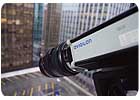
This 11-megapixel camera over a parking lot can zero in on license plates and see into near infrared wavelengths.

The view on the right is from a conventional video surveillance camera. The view on the left demonstrates the added information contained in high dynamic range images provided by megapixel cameras. On both views, the levels have been enhanced.
“The maximum number of pixels you can get on [standard NTSC-resolution CCTV] is 704 by 480,” asserts Paul Bodell, vice president of sales and marketing for IQinVision Inc., San Clemente, Calif. “You can buy a cheap cell phone that has a higher resolution imager than that. A cell phone camera is three times the resolution of the best CCTV camera in the world.”
The smallest 1.3 megapixel camera has a resolution of 1,280 pixels wide by 1,024 pixels high. The number of megapixels escalate from there to 2, 3, 5 and even 11 megapixels.
“There are two things a megapixel camera can do for us,” lists Fredrik Nilsson, general manager of Axis Communications in North America, Chelmsford, Mass. “It can reduce the number of cameras because of its resolution. You can use one camera and cover the same area as two. I know some customers we have want to limit the number of cameras outside their building.
“The other [benefit of a megapixel camera] is you can use them in hallways to identify people,” Nilsson continues. “On the video, you can identify what is happening, but it is hard to see details of the face if a person is 20 to 40 feet from the camera using a normal camera.”
The more detail a video image has, the fewer cameras and hence less equipment and wiring are necessary. “When you need to cover a wider area and get good detail, there are only a couple ways you can do it,” Bodell maintains. “Use a lot of CCTV cameras or use fewer megapixel cameras with wide-angle lenses.”
As a rule of thumb, Bodell says, a megapixel camera will cover the same area as four CCTV cameras will. He adds that a 2 megapixel camera will cover the same area as seven or eight CCTV cameras. This means savings in fewer housings, less wiring and sometimes even less bandwidth consumed for network transmission and storage.
Some of today’s cameras with a higher number of megapixels have the additional feature of being able to digitally zoom in on any portion of a view. Some systems can even zoom in on different areas simultaneously.
Such zooms have the advantage of not requiring mechanical systems that can break down and also require no foreknowledge on the part of a PTZ operator to know where to zoom in before an event occurs. Instead, the zoom can be performed after the event is recorded on video.
One use in which even the proponents of megapixel cameras admit they do not excel is in low-light situations.
“Normally, a megapixel camera is a little less light-sensitive,” Nilsson concedes. “If you have more pixels on the same space, you get less light to each pixel. If you use it in a well-lit office or in an area outside where you know there is going to be good lighting and not view pictures at night, a megapixel camera is definitely a very viable option.”

Faces can be recognized easily with an image from a megapixel camera.
More Megapixels at Lower Cost
The trend will move toward increased usage of digital video and megapixel cameras in particular, think proponents of the technology.“I think most of the industry is a bit surprised at how quickly the migration has taken place from analog to megapixel IP video,” Bodell says. “We expected it to not get deployed in environments like casinos and retail for a while, but people are realizing at the end of the day that megapixel is much more affordable from a new installation perspective than CCTV systems. Our company has grown faster than we expected, and we have pretty aggressive growth plans.”
Bodell predicts the cost of megapixel cameras will decrease in the next few years as competitors come into the market, pixel densities increase and imager performance improves. He estimates price reductions of five percent annually are possible.
“The most common response we get from end users is, ‘I didn’t know you could have picture quality like this,’” he relates. “So by and large, the market has conditioned end users to accept mediocrity. Once the big guys start marketing it, it will take over very quickly.”
Alexander Fernandes, CEO of Avigilon Corp., Vancouver, British Columbia, agrees that the trend in the future is toward IP video. He estimates that most video surveillance cameras have life spans from four to seven years, depending on whether they are outdoors or inside.

Reading video gambling machines and even the numbers and suits of playing cards can be achieved with megapixel cameras.
“At the simplest level, everybody likes a better picture, but what’s missing from surveillance today is the identification,” he laments. “People don’t necessarily want to rip out the $2 million worth of surveillance equipment because it tells a story, but what they’re not getting is identification.”
Installing megapixel cameras at key points like doorways can positively identify people, Fernandes points out.
Nilsson thinks the market will tend toward cameras with lower numbers of megapixels, but that number will increase by 1 or 1.5 megapixels annually. Because of the cost of megapixel cameras in the 5- to 11-megapixel range, “They are a very expensive solution, more of a tech showcase than something that is viable for customers to buy,” Nilsson maintains.
“The main market today is between 1 and 2 megapixels — that is where you have the sweet spot with technology,” he concludes.
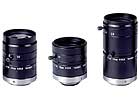
High-quality lenses must be used to obtain the full benefit of megapixel cameras.
Sidebar: TIP: GET A GOOD LENS
Putting a plastic lens on a megapixel camera is like looking through someone else’s prescription eyeglasses, compares Alexander Fernandes, CEO of Avigilon Corp., Vancouver, British Columbia.Paul Bodell, vice president of sales and marketing for IQinVision Inc., San Clemente, Calif., agrees. “…A megapixel camera with a plastic lens on it is the equivalent of putting bicycle tires on a Porsche,” he asserts.
“In megapixel cameras, it’s crucial to use a top-notch lens that is designed for them,” emphasizes Steve Beaulieu, national sales manager, Tamron USA Inc., Comack, Long Island, N.Y. “The center of the lens is usually where you get the highest resolution, and from the center to the edge in different lenses is where things get degraded. But in megapixel lenses, from center to edge, you lose virtually nothing.”
Adds Bodell, “The simplest analogy I’ve heard is if you shine a light through the lens, and that beam is 1 micron wide, if it comes out the other side of the lens at 1 micron, and your pixel is 1 micron big, then everything is perfect.
“However, if you shine a 1-micron beam through a low-quality lens, it’s going to disperse it a little bit, so it might come out 3 or 4 microns wide,” Bodell cautions. “This means instead of just illuminating one pixel on the imager, it will illuminate surrounding pixels, and you will get a softening of the picture.
“If your lens isn’t matched to the pixel size you’re dealing with, you won’t see the full potential of what that camera can deliver,” he concludes.
The size of the image sensor in a megapixel camera can vary from 1/4-inch to 2/3-inch, Fernandes notes. “You can have three lenses that physically look the same, but if you don’t project the right size image, you’re not going to get the right resolution,” he emphasizes. “You can get a myriad of lenses that will screw into the camera but will be inappropriate for the camera.”
Sidebar: TIP: Don’t Compress Out the Quality
Compressing a high-quality image too much is like sitting on a soufflé — it flattens all the quality out of it. “There’s no free lunch — if you compress images, you’re going to lose image quality,” stresses Paul Bodell, vice president of sales and marketing for IQinVision Inc., San Clemente, Calif. “Because the cost of storage is so cheap, what we’re finding is most companies are opting to not go with a very aggressive compression algorithm. Instead, they’re going with high-quality images.”In fact, Avigilon Corp., Vancouver, British Columbia, maintains its gigabit Ethernet transmission systems preserve the quality of the images from its company’s 11-megapixel cameras.
“We actually transmit all of the data that the cameras and sensors are capable of capturing, which incidentally goes beyond human vision,” maintains Alexander Fernandes, Avigilon’s CEO.
“The other key thing is we faithfully record that information losslessly,” he continues. “Lossless compression preserves all of the image quality.”
He thinks this can be important in a court of law, because recording raw data does not manipulate the image through compression algorithms.
“At the end of the day, you cannot assert that the data has not been manipulated, because it is manipulated before it is recorded,” he says of compression. “If you look at it as physical evidence, it would be absurd to start manipulating evidence at the crime scene.”
Looking for a reprint of this article?
From high-res PDFs to custom plaques, order your copy today!