Renovation Illustrates the Elevator’s Role in the Connected Business
When searching for office space, companies today are looking for more than just a building. They need a space that strategically positions the company to gain competitive advantages and improve business processes. These reasons explain why the notion of the “connected business” is gaining traction as companies seek ways to use technology intermixed with physical space as a tool to achieve strategic business objectives. There are three core principles that define a connected business: energy savings, operational efficiencies, and high-tech security functionality. The most obvious and talked-about places to accomplish this involve subsystems such as HVAC and lighting. However, building designers are now looking at every part of a commercial space — from architecture to building subsystems — to contribute to strengthening the connected business.
A good example of this can be seen at a recently renovated property at 680 Folsom, a commercial office building located in the heart of San Francisco’s South of Market District that was recently recognized by a local business publication as one of the best complete renovations in the city. During the remodel of the building, developers took a close look at design options that would increase efficiency, reduce energy consumption and improve security at the property. Everything — from the aging concrete façade to the structural allocations of internal components — was open to renovation. And that included the elevators.
Two-button elevator systems have been the standard for decades in office buildings, despite being inefficient in regards to energy, time and space allocation. The renovation of 680 Folsom provided an opportunity to design the first Mitsubishi Destination Dispatch elevator installation in the United States integrated with Honeywell Security access, video and intrusion technology. The integration reinforced the connected building concept through full integration of security, vertical traffic control and visitor management systems that enable more efficient security and better awareness for building management and tenants.
Optimizing Building Transportation
680 Folsom was built in 1963 for Pacific Bell and remained largely unchanged for decades. A development company that purchased the property in 2006 decided to overhaul the structure and add innovative, scalable building systems that would appeal to a wide range of tech-savvy businesses. Later that year, Boston Properties, one of the largest owners, managers and developers of Class-A office properties in the United States, acquired it after design plans were set and extensive renovations underway.
As a key part of the renovation’s elevator design, Mitsubishi Electric’s ∑AI-2200C Artificial Intelligence System offered something standard elevators don’t: deliberate, intelligent passenger grouping to increase efficiency and reduce time to destination. Called a Destination Oriented Allocation System (DOAS), or Destination Dispatch, the elevators group passengers by destination instead of randomly, decreasing both trip and wait times for all passengers.
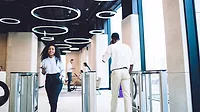
Passengers arriving in the elevator lobby enter their destination on the keypad control, and are assigned to an elevator. Behind the scenes, the elevator’s cooperative optimization algorithm is constantly assessing other passengers’ requests, from all 14 floors of the building, considering wait times and operational efficiencies to determine the most time- and energy-efficient options. The algorithm even predicts passenger traffic every few minutes to proactively plan for elevator allocation.
“Destination dispatch, particularly when integrated with access control, provides significantly greater handling capacity and reduced wait times and trip times when compared to a conventional system,” said George von Klan, principal and owner of GVK Elevator Consulting Services Inc., which specified and designed the elevator system. “It also allows greater flexibility to adapt elevators to specific tenant requirements, while providing a high level of security and saving energy.”
Looking for quick answers on security topics? Try Ask SDM, our new smart AI search tool. Ask SDM →
Deliberate passenger grouping also adds a green aspect, as the group control system balances operational efficiency and energy consumption in assigning elevators to passengers, taking each car’s location and passenger load into consideration. According to Mitsubishi, an elevator car uses energy most efficiently when it travels down with a heavy load or up with a light load. The group control system takes this guideline and others into account as it assigns cars to passengers.
The elevator system certainly met the energy and operational efficiency expectations of a connected business, but security efficiencies also would be important to the equation. The building has a guest visitor system that sets a standard on how to get guests upstairs; it also needed a security system that would be customizable to the tenants’ requests.
“Tenants obviously take this very seriously. Once they get past the first door, we want to make sure we have a solid system in place for identifying the building visitors and where they are permitted to be,” Aaron Fenton, project manager for Boston Properties, described.
As this was the first-ever integration of Honeywell’s access control systems and Mitsubishi Electric’s destination dispatch elevators in the United States, custom software needed to be developed to allow the systems to communicate with one another. Microbiz, a security integration company, along with ESI engineers, used Honeywell’s software development kit (HSDK) to craft the programming necessary to tie the security, access control and video management systems with the destination dispatch system.
“Integrating disparate systems usually requires rewriting complex code for each individual project,” said David Chritton of Microbiz. “Honeywell’s HSDK allowed us to craft the language for the systems efficiently and develop an application and middleware to interface the security with the elevator controllers.”
Through the integration, the destination dispatch elevators become subordinate to the access control system — meaning that they, too, are bound by access control rules and restrictions. For example, a passenger who works for a company comprising floors 3 through 6 of a given office building will have free range of the included floors. However, if he or she tries to access floors 7 through 10, where a different company resides, he or she will not be allowed to access that space.
The software developed for 680 Folsom can be repurposed for other project installations within the same version.
“The technology in this building is definitely cutting edge, and it needs to stay cutting edge, so we’re continually upgrading all systems. It’s important that the security systems in our buildings are scalable,” Fenton said.
The building installed Honeywell’s Pro-Watch 4.0 as its overarching hub for the access, security and video management systems. The program allows for easy management, use and control of a variety of disparate security, video and access control components — ranging from card access and badging systems to a video management system (Honeywell’s MAXPRO VMS), cameras and custom elevator cameras.
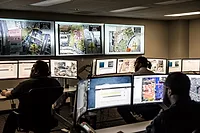
“A guard in the building has a wealth of resources to monitor security within and around the property,” Chritton described. “At this central control center, guards can look at video feeds and receive alarm notifications from the entire building. Then they can use the integrated intercom and video systems to speak with and visually identify an individual who may, for example, be locked out of the building before letting them inside.”
The access control system limits traffic into and within the building, and allows the security management team to review traffic and learn from past experiences. For example, the building management team can look back at traffic logs at peak times to determine ways to improve security and streamline traffic during the busiest times of the day. The team also can quickly alter or remove permissions for access, useful in cases where employees are terminated or when guests and visitors have access credentials for a limited duration.
Macys.com and Riverbed Technology Inc. will use the majority of office space at 680 Folsom — a combined 450,000 rentable square feet. The two tenants are finalizing improvements and customizations, and are beginning to move into the building. The move is scheduled to be completed by the end of the summer.
Regardless of the tenant, the newly renovated building itself now can speak volumes about the future of business settings. In such environments, the facilities themselves are expected to be able to contribute to a company’s bottom line by reducing energy costs and improving operational efficiencies.
Looking for a reprint of this article?
From high-res PDFs to custom plaques, order your copy today!