SECURITY DRONES & ROBOTS
Welcome to the Future
As remote monitoring becomes more important than ever with the continuation of the COVID-19 pandemic, drones and robots become less of an ideal for the future, and more of a reality.
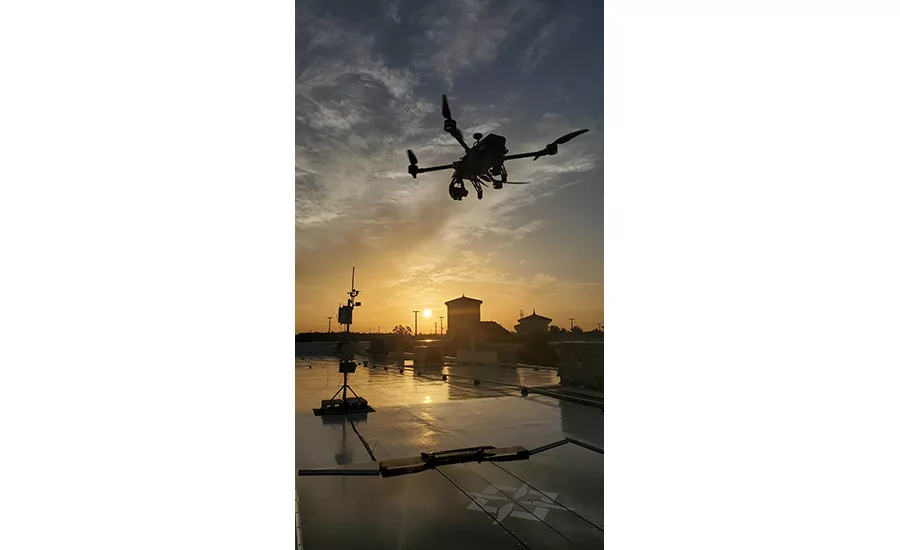
After years of focusing on the mechanical elements of robotics, Asylon is now able to leverage its own software to communicate with an unlimited number of complementary security systems.
IMAGE COURTESY OF ASYLON
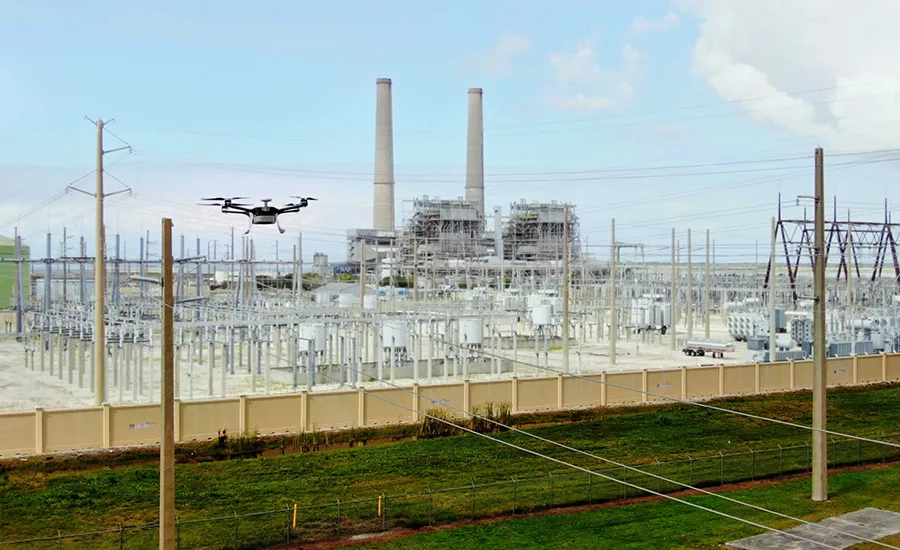
Percepto’s autonomous drone-in-a-box solution is deployed in more than 10 countries across five continents.
IMAGE COURTESY OF PERCEPTO
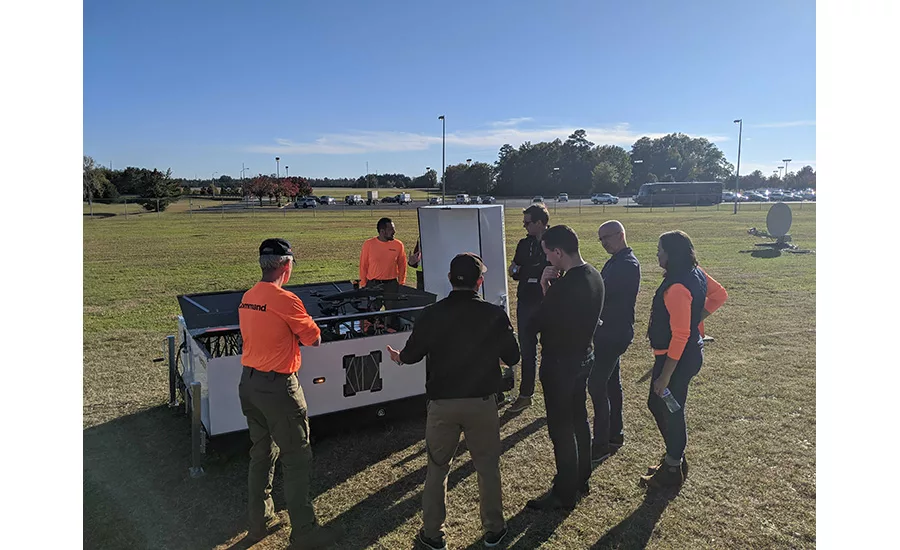
Attending demonstrations of unmanned systems in action is essential to selling the technologies.
IMAGE COURTESY OF NEXTGEN
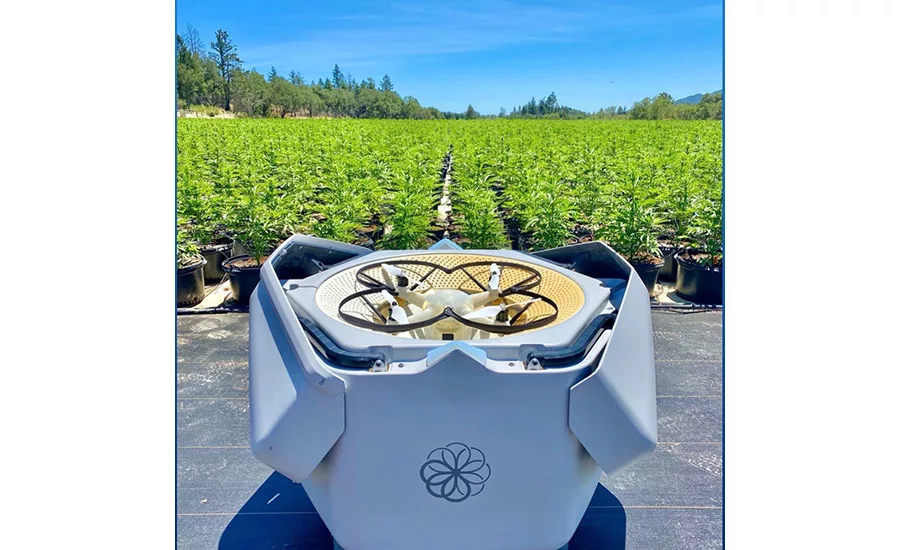
While Sunflower Labs’ autonomous drone was designed with the residential market in mind, it is also a useful solution for small Cannabis farms.
IMAGE COURTESY OF SUNFLOWER LABS
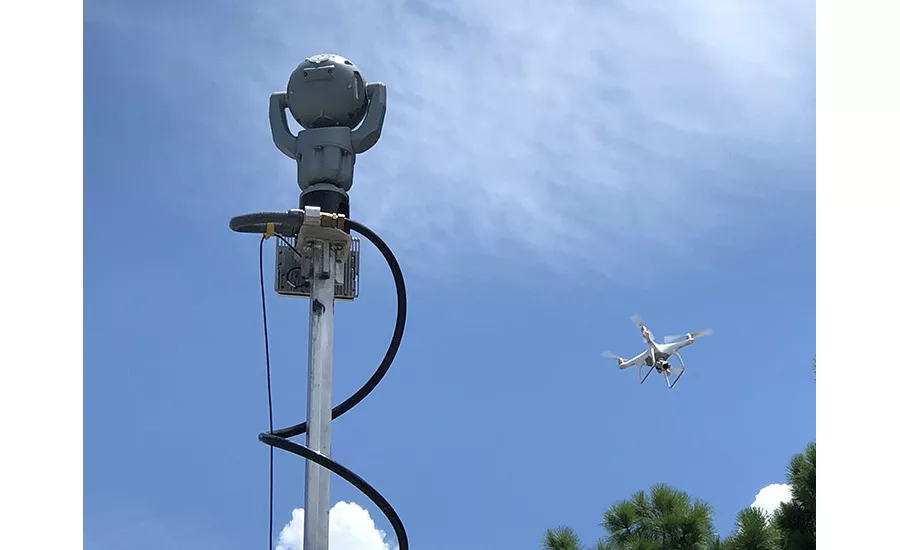
Sentry View’s EchoGuard radar, pictured here, is just one of the growing number of counterdrone technologies.
IMAGE COURTESY OF Sentry View Systems
Drones and robots have always had sci-fi appeal. Even before the technologies were advanced enough to be very useful in security deployments, the interest was there — everyone wants to check out the new shiny toy. But today, as the COVID-19 pandemic proves how vital remote monitoring capabilities are, drones and robots are finally becoming a truly realistic, and incredibly valuable tool for security systems integrators.
“Drones and robots are becoming a part of our everyday activities at an exponential rate,” says Scott T. Crino, CEO of Red Six Solutions, a strategic advisory consulting firm out of Savage, Md. that has provided flight support for nearly every major drone test conducted by the U.S. Department of Defense in the past three years. “Every year, new hardware, software and services are available commercially to consumers that improve the reliability, usability and capabilities of unmanned systems that make them cheaper, easier to use and more effective.”
Unmanned systems can be an efficient, cost-conscious alternative to human guards, and can operate for longer periods of time, cover larger areas and store larger amounts of data. Plus, with unmanned systems, you no longer have to send humans into potentially dangerous situations.
G4S Secure Integration, Omaha, Neb., has been exploring drone technologies since 2018.
“We see drones and robotic technology playing a large role in our connected officer program as a force multiplier for our team in the field,” says VP of the Southeast Region Steve Sinclair. “This technology will play a major role in the enhancement of operations, and will help us drive efficiencies in various security programs and deployments.”
Now, it’s only a matter of time before unmanned systems play a large role in security systems.
“[Adoption] is slow until it’s fast, and then it shifts,” says Alex Pachikov, founder and CEO of Sunflower Labs, a start-up out of San Francisco. “As much as drones have been a sort of promise for a while, there is going to be a moment when it tips the scale; and once it tips, there’s no stopping it.”
Looking for quick answers on security topics? Try Ask SDM, our new smart AI search tool. Ask SDM →
Surveillance Drones
The security drone space has been sitting solidly in the early growth phase for the past year, according to Jack Wu, co-founder and CEO of Nightingale Security, San Francisco, and member of the Security Industry Association’s (SIA) working group for drones and robots.
“Customer adoption has changed from seeing this as a novel technology, to actual adoption based on the technology’s real-world capabilities,” Wu says. “The system’s autonomous features and superior mobility are being valued as a way to cover large areas while reducing human labor and response times.”
Nightingale, like Percepto and Asylon, offers autonomous drones for perimeter security at commercial operations. And while most integrators we spoke to for our drone feature last year were not offering these solutions to their customers, now the number of successful deployments is increasing, and so is integrators’ faith in the technology.
“We believe these technologies are a great force multiplier for our clients to use as a part of their emergency, safety and security missions, and they provide tremendous potential for long term savings as automation moves deeper into legacy guarding services,” says Ryan Rieger, vice president of chemical and energy at NextGen Security, a security integrator out of Exton, Pa. “Being at the forefront of technology is part of the DNA of NextGen Security. However, we believe in a robust research and testing process before partnering with technology manufacturers.”
Advice for Integrators Interested in Unmanned Systems
While security systems integrators who incorporated unmanned systems into their solutions may have been considered early adopters last year, the market is growing fast, and if you don’t start doing your research now, you might end up late to the party. Here, those with experience in the sector share their advice for integrators.
“You have to open up to the possibility and take advantage of companies like Knightscope doing online demonstrations so you can see what a deployment looks like, and how that info comes through. What you see on TV and in the movies is not reality; the tech is impressive, but the robots are not going to be sentient beings; there are limitations.” — Stacy Stephens, Knightscope
“Safety has to be the number one goal. Fly every mission like you are sitting in the cockpit seat and your life depends on it. This is the only way manned and unmanned aircrafts can coexist.” — Robert Tabbara, 911 Security
“The first step to integrating autonomous drones into any company’s workflow is to get started in one or two facilities. We work with several integrators that began by integrating a few systems into a few sites before moving forward with increasing numbers of solutions and a wider range of facilities across several client sites.” — Dor Abuhasira, Percepto
“Be comfortable. It’s the same as any technology — be educated, know what’s out there, what’s good, what’s bad, bring it in to your staff and test it out. Make sure you know what it is that you’re offering.” — Aaron Heiner Simpson, Stone Security
“First, you need to have a managed services model. Second, you need to think about how robots or drones can augment or replace existing designs and installations. For example, instead of 100 fixed cameras, maybe you only need to install 25 cameras and deploy two robots, or outside, you can have fewer robots and a drone. This would both modernize your line card and give you a competitive advantage versus others bidding on the same job.” — Mark McCourt, Cobalt Robotics
“Make sure to have the appropriate technical people on staff. Technicians can provide needed maintenance, as well as integrations with other sensors or existing security infrastructure. Sales of security drones will also require proper knowledge of the system’s performance envelope, use cases and regulations pertaining to commercial drone operations. A formal strategy on how to integrate security drones into the customer’s daily operations will be key in leveraging the system’s capabilities.” — Jack Wu, Nightingale Security
“Do your homework. There are a growing number of options when it comes to drone security platforms, and only when you spend the time to educate yourself on these technologies will you understand how to best leverage them into your solutions approach to solving customer problems. Understand what the technology does, but also look for vendors that can complement and support your engineering and technical teams. A system that cannot be fully integrated into the customer’s technology plan will only amount to a single closed video camera that can fly.” — Ryan Rieger, NextGen Security
NextGen spent five years researching before deciding to partner with Philadelphia-based Asylon for drone surveillance. NextGen Senior Account Manager Ron Petrie says their open platform technology is best-in-class for integrated surveillance and alarm response applications (learn what advice professionals have for integrators wanting to enter the space in this online sidebar).
Since partnering, the two companies have been working together on several wide area surveillance drone applications that include a combination of perimeter intrusion detection sensors, aerial 3D radars, VMS systems and the Asylon drone core system.
“We believe that autonomous surveillance technology offers value-added benefits with regard to being a force multiplier for security organizations on day one; and ultimately, they provide a path to having a dynamic, intelligent and unmanned security posture for critical facilities and properties in the future,” Rieger says.
Salt Lake City-based Stone Security, SDM’s 2020 Integrator of the Year, has also been exploring drone technologies in recent years. President and CTO Aaron Heiner Simpson believes drones are most useful when leveraging their video feeds. (Learn more about Stone Security’s involvement with drones and robots in our podcast.
“The camera gathers more information than all of the sensors combined, so to be able to put those video feeds into a video management platform and use analytics — for a small business owner that may not have a security staff, that will be one of the more impactful features of drones.”
Dor Abuhasira, CEO and co-founder of Percepto, Modi’in, Israel, says the biggest trend at the moment is the growing demand for visual data collection tools.
“We’ve seen more companies entering the space in response to the demand,” Abuhasira says.
Michael Lichko, vice president of sales at Asylon, Philadelphia, and member of SIA’s drone and robot working group, says that integration has really changed the market, and enhanced the capabilities of security drones.
“After years of focusing on the mechanical elements of robotics, we are now able to leverage our own software to communicate with an unlimited number of complementary security systems, which allows the drone to be deployed strategically to respond faster and safer than legacy security officer methodologies,” Lichko says.
Sunflower Labs is different from most perimeter security drone companies due to the fact that it focuses on residential, rather than commercial security.
“We are in a unique space where we have built a system that’s much cheaper comparatively, it flies lower, there are more safety precautions built in, and we feel that starting at the residential side of the market gives us a unique advantage because we can prove how useful this product is in a market that is less regulated, less price sensitive and that requires [fewer] certifications,” Pachikov says. “Once we have our systems in the market, we will have a track record to then go to more commercial and industrial use cases as well.”
Today, approximately 105 Sunflower Labs systems have been pre-sold, and more than 1,000 dealers have signed up to sell the product once it officially hits the market. The company hopes to have products to the market in Q4 2020.
While the start-up’s target audience is high-end residential customers, Pachikov sees it soon shifting to mid-residential once the technologies become more mainstream and therefore more affordable.
“My analogy here is the Tesla product line,” Pachikov says. “Initially, they released a fun, expensive sports car that wasn’t practical for everybody. What that allowed them to do is refine the technology and launch further models. I hope to see the same trajectory for us.”
All of those we spoke to in the perimeter security drone market reported seeing an increase in the demand for autonomous drones due to the COVID-19 pandemic.
“Our clients have relied heavily on Percepto’s drone-in-a-box solution to keep their sites secure and safe while employees can’t get on-site,” Abuhasira says. “We’ve seen significant increases in both the number of drone flights, and the radius of security patrols.”
Lichko adds, “Drones, as they relate to the pandemic, should be viewed as a new tool to do more with less when securing the exterior of your facility. Drones don’t call in sick, they don’t spread viruses and they are not prone to distraction. The long-term impact of the pandemic is that this will continue to move the internal conversations that customers are having about automation to the forefront of their organizations, so they can be better prepared if we experience a similar global event in the future.”
Counterdrone Technologies
As drones become more popular, so do counterdrone technologies. Ad Devarakonda, CEO of Dedrone, a counterdrone company out of San Francisco, says he has seen an increase in business through the pandemic, partly because people are sitting at home with more free time, and partly because drones take you where you cannot take yourself — which right now, is most places.
“Two years ago the market was in its infancy, but we have data that shows drone activity going up 100 percent or more,” Devarakonda says.
One of the places in which drone activity has gone up drastically is sports stadiums. Since the MLB has been playing games without fans, many of Dedrone’s customers in the league have had to deal with the unwanted presence of drones operated by fans who want a sneak peek at the games.
And while many of these rogue drone operators don’t have malicious intent, property owners still don’t want them around because of copyright infringement and other issues.
“I’ve talked to the MLB, NFL, NASCAR — they all think it’s a big problem,” Devarakonda says.
There are two sides to a counter Unmanned Aerial Systems (UAS) solution. The first is the detection and identification of drone intruders, and the second is mitigation. The Federal Aviation Administration (FAA), which has jurisdiction over UAS in the U.S., currently has laws forbidding most mitigation techniques, including anything that would remove an aircraft from the sky, or interfere with its signals.
And while most believe these regulations will eventually loosen (many of the companies in this article are even working with the FAA on revised laws for UAS and counter-UAS) there are still effective ways to keep properties safe from drones.
Devarakonda says the data you can gather from counter-UAS technologies is very useful on its own.
“I think the first step to understanding any problem is detecting data around it, and as long as you can collect data and quantify the problem further by recording how many drones fly by a property and at what times, you are off to a good start,” Devarakonda says.
Echodyne, Kirkland, Wash., designs and manufactures radar sensors for counterdrone systems. CEO and Co-Founder Eben Frankenberg points out that radars, along with infrared cameras and acoustic sensors, are all useful additions to counterdrone systems, and are most effective when combined into a single solution.
“A lot of the companies that make these counter-UAS systems will combine those sensors together,” Frankenberg says. “With any of those machines, the more sensors you have, the higher the probability that you will be accurate in your detecting. If it looks like a duck and sounds like a duck, it’s probably a duck, you know?”
Integrator 911 Security, Dallas, added airspace security to its portfolio in 2018, after getting several requests from clients for the service. President Robert Tabbara says he has witnessed adoption increase eight-fold in just the past year.
“As drones are being used to enhance security, COVID-19 has also accelerated their use for breaching security,” Tabbara says. “For example, prisons have been reporting increased drone activity with drones being used to drop off drugs, cell phones and other contraband in prison yards.”
Echodyne has seen similar increases in activity.
“The bad guys keep innovating,” Frankenberg says. “You hear about more situations that happen with planes having near misses, or drugs being dropped into prisons — that happens all the time now.”
Devarakonda adds, “There will always be malicious actors, and every technology paradigm has a security angle, so the drone paradigm has counterdrone technologies. That’s why this business has taken off before the broader unmanned travel business, because you need this before you can have that. Counterdrone technologies are here to stay.”
Robots
Robots probably make up the smallest portion of the unmanned security market. But still, two players are making a big splash: Knightscope and Cobalt Robotics.
Knightscope, Mountain View, Calif., was founded as an incident response solution after school shootings like Sandy Hook, and public crises like the Boston Bombing.
“My business partner and I started looking at this problem, and we wanted to figure out how we could bring a Sandy Hook situation to a close faster,” says Stacy Stephens, executive vice president and chief client officer, and member of SIA’s drone and robot working group. “We talked about actionable intelligence and getting some sort of eyes and ears on the scene to deliver that real-time information needed when making decisions.
“I jokingly said to him, ‘Why don’t we build a robot that could be in the middle of a situation?’ People have been promising us robots since we were kids, it’s time to use them. So, we went to Carnegie Mellon [University] and had some conversations, and months later we had brilliant engineers working for us, and a robot.”
The product brought a lot of interest at first, Stephens says; but the security industry looked at the Knightscope robot mostly as a nice shiny object, but didn’t at first see how it could help them.
COVID-19, however, changed everything.
“With COVID-19, people really stopped looking at the robots as a cool sci-fi thing, and started looking at what data it delivers,” Stephens says. “Remote monitoring is really where people are interested, because with all of the work-from-home measures, you have fewer people actually able to provide security services, and the robots do remote monitoring very well.”
Interest has been up so much, Knightscope recently closed a round of funding with more than 13,000 individual investors.
Mark McCourt, chief commercial officer and advisor to the CEO at Cobalt Robotics, San Mateo, Calif., and chairman of SIA’s drone and robot working group, says that in the last year, everything in the security robot market has changed.
“New technology improvements across the board have increased functionality and performance, including stronger AI algorithms, improved intelligent mobility, requests for facial recognition, memory storage, cyber security, longer battery life, better two-way communications, faster and cheaper cloud services, 5G and improved Wi-Fi services,” McCourt says. “Each of these contribute to a better customer experience, price, performance and faster adoption.
“Smartphones are robots — think about how these devices constantly improve and how devices become obsolete so quickly.”
Both Cobalt and Knightscope provide their security robots as a service, allowing them to update the systems instantly.
And in case you’ve started to worry that robots are just a step away from taking over the world (or all of the good jobs in the industry), McCourt says there is no need for concern.
“Robots eliminate tasks, not jobs,” he says. “In 10 years, the manual, dull, dirty and dangerous tasks will be done by robots and drones. They will displace fixed technologies — for example, instead of 10 cameras being installed, one camera will be on a robot, and will be mobile. And the guard patrol will be replaced by robots and drones, but it will be highly enhanced. Guards will manage the information from these devices and escalate a response to events as necessary. They will no longer be collecting information; they will be using it.”
Representatives from the drone, counterdrone and robot markets all emphasized the importance of collaboration and sharing information and results with other unmanned system companies, which is why so many of them are involved in SIA’s drone and robot working group.
“When you deploy these types of technologies, you have to share your experiences,” Stephens says. “Participating in whitepapers and case studies, allowing that information to be published and shared among your colleagues and trade organizations is going to be helpful to excel development and help us get ahead of the bad guys. Bad guys are not constrained by budgets, politics or committees — they can go out and hire the exact same software engineers we as legitimate businesses are competing for, and they can pay them six figure salaries. We have to take advantage of everything we have and stop fighting technology.”
Looking for a reprint of this article?
From high-res PDFs to custom plaques, order your copy today!