Alarm.com Expands Into Commercial Fire With New Fire Communicator
.webp?t=1784731014)
Alarm.com launched its Fire Communicator (ADC‑FC100), expanding Alarm.com for Business into the commercial fire category. With the addition of fire alongside intrusion, access control and video, service providers can now standardize on Alarm.com for Business across the four major categories of commercial security.
Why Fire & Why Now?
“From an opportunity gap perspective, we saw what led Alarm.com into its original residential leadership position, now 20-some-odd years ago,” Lohse said. Back then, Alarm.com wrapped alarm infrastructure into modern cloud services with a customer interface. The company also added an app to give customers the ability to disarm the alarm, change user codes and so forth.
“That same playbook is effectively the one that we’re running here,” Lohse added. “Most modern commercial fire systems are a little bit left behind, technologically, where it’s basically just a panel signaling to a central station. We felt that there was an opportunity to apply our expertise and run the same playbook that we’ve been successful in in intrusion for the last 20-something years.”
Alarm.com’s partners have been asking for fire for the better part of a decade. This makes the launch into commercial fire a long-planned endeavor. “The genesis of the ask from the partners was one that many of them have standardized on us for their business systems, where they’re using intrusion, video and access, but, when they go to do fire --- which is all the time --- they have to go use a different system,” Lohse said. “I had a partner that explained it to me this way: It’s like when you have Netflix, or whatever your famous streaming service is. Then, you discover a show you want to watch, but you have to get a different streaming service to watch it. And that’s frustrating. Wouldn’t it be great if all the stuff you wanted to watch was just in one place? The same sort of sentiment applies here.”
How ADC‑FC100 Works
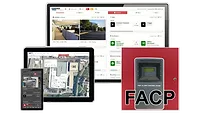
The Fire Communicator replaces legacy POTS fire communications with dual-path signaling that works with both new and existing fire alarm control panels. Businesses can modernize fire monitoring without the cost and disruption of replacing current infrastructure, creating a more affordable path to updated fire communications while gaining real-time alerts and centralized visibility through Alarm.com services.
ADC‑FC100 provides the customer interface experience that Alarm.com created in the intrusion space over 20 years ago. “It provides the customer an interface to awareness of what’s going on with their fire system: getting alerts based on what’s happening, reports, history, etc.,” Lohe said. “They can also interact with the other components of their system. If you have video and access and fire all together, there are these workflows that are possible now. The customer or the central station could be seeing the video that corresponds with the fire alarm, could be unlocking the doors for first responders, could be turning off the HVAC that might be blowing air through the building and exacerbating the fire. It’s really about connecting everything, so the various security aspects become more valuable than the individual pieces.”
Looking for quick answers on security topics? Try Ask SDM, our new smart AI search tool. Ask SDM →
For service providers, this approach simplifies operations with one portal, one technician app and one bill across all security categories. Businesses benefit from a more consistent experience with centralized alerts, reporting and history for intrusion, access control, video and fire monitoring.
“More than 20 years ago, Alarm.com transformed residential intrusion by combining reliable signal communication with a modern cloud platform and connected user experience,” said Dan Kerzner, president of platforms business, Alarm.com. “The Fire Communicator applies that same model to commercial fire, giving service providers a simpler way to manage installations, monitoring, and customer accounts while helping businesses bring fire monitoring into the same day-to-day workflows they already use for the rest of their security system.”
The Grand Slam
“The conversation, historically, was about selling a product,” Lohse said. “Now that we have all four pillars, the conversation can be a little bit more around how our partners can we take everything off their clients’ plate and manage it all for them, which is a bit of different different narrative.”
Rather than the “triple play” of video, access and intrusion, Alarm.com partners can approach clients with the “grand slam” of those categories and fire. “The hope is that, in doing so, our partners increase their product attach rate for new customers,” Lohse said. “What we’ve also seen, so far, is that many partners are going back to their existing Alarm.com customers, many of whom have been on a you know platform for 10-plus years, and basically ripping and replacing whatever else is there to unify the system.”
This contributes to customer retention. End users no longer have two different offerings in order to have fire in their security systems, nor do they have two different vendors servicing that account. “That could be an opening, competitively, for that other vendor to try to creep into whatever core service they’re providing,” Lohse said. “From a business perspective, it’s about driving additional bundle sales and increasing customer retention.”
Looking for a reprint of this article?
From high-res PDFs to custom plaques, order your copy today!