BLOG: Do You Know the 5 Hidden Ways to Go Green With Video Surveillance?
|
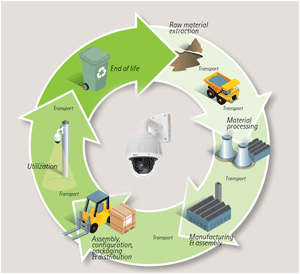
| Here is a simple drawing that helps depict an LCA of a network camera. |
Is the physical security industry doing its part to reduce our environmental impact on the world? Being green is all about using fewer raw materials and expending less energy. Thanks to new technology and innovation, you might be surprised to know that the network video industry is doing this without much of a concerted effort to “go green.” Here are five not-so-obvious ways the industry is reducing its carbon footprint today:
Using Greener Cabling…or None at All
Did you know that coax cable uses more material per foot to produce when compared to Ethernet? Those who have carried 100-plus feet of coax slung over their shoulder will attest to just how substantial it is. But is it not only raw material where Ethernet has the advantage.
By leveraging power over Ethernet (PoE) devices, only one cable is needed to do the work of multiple power and communications cables, including transmitting power, video, audio and any I/O commands to and from the network camera. Additionally, the PoE+ standard (802.3at) can carry the heater, blower and pan/tilt/zoom functions necessary for PTZ cameras. In an analog world, you would need a separate cable for each function.
Or how about eliminating the data cable altogether? Improvements in wireless technology — namely the 802.11 suite — makes it possible to transmit high-quality video surveillance wirelessly. As 4G networks continue to rise, capabilities of video over wireless will only improve. It’s important to note two things, however, when examining the greenness of wireless. First, you’ll still need a power cable for the access point, so technically not all cable is eliminated. Second, wireless technology may consume more power than wired — so consider an environmental impact analysis before selecting a communication method.
|
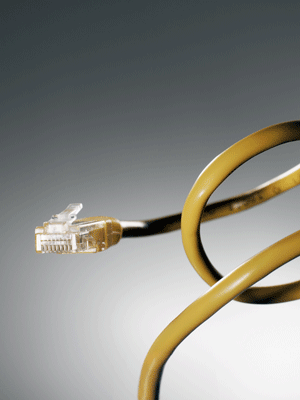
| An Ethernet cable close up. |
Selecting Greener Cameras
If you typically opt for IP video over analog, then you’ve already taken one step toward greener cameras. Network cameras deliver more functionality yet generally use the same amount of energy to operate. Features like higher resolution, motion detection, and two-way audio eliminate the need to install and maintain separate, energy consuming systems.
As for network cameras themselves, power drawn comparison between cameras changes based on the chips inside. Application specific integrated circuit (ASIC) chips are typically smaller and consume less power than general-purpose processors and digital signal processors (DSPs). Also note that some cameras use co-processors, which, since there are two, use more power as well as more raw materials.
Looking for quick answers on security topics? Try Ask SDM, our new smart AI search tool. Ask SDM →
Turning Out the Lights With Thermal
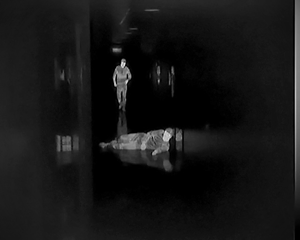
Thermal technology — the method of detecting heat signatures of the scene to create an image — has
|
| A screen shot from a thermal camera, which can be used to detect people in a hallway in the pitch darkness. |
been around for decades in government and military applications. Today, thanks to a decrease in material and production costs, integrators have the option of using a few thermal network cameras as part of the overall surveillance solution.
With thermal, installations no longer require artificial lighting at night to detect and protect. This has the potential to reduce energy consumption greatly in nighttime hours, which essentially is half a 24-hour day.
For example, it’s considered a best practice in the retail market to leave on lights at night to deter thieves. With an IP network, retailers can connect thermal cameras to monitor the store’s entrance points, and then leverage the cameras’ I/O ports to automatically turn on the lights when motion is detected. With the lights on, it’s now the job of the system’s HDTV and megapixel cameras to take identification video.
Cutting Out the Storage Fat
Any installation — from the small camera count convenience store to the international airport with its own video server room — can benefit from the innovations in storage and compression to shrink the carbon footprint.
Energy efficient servers with high-efficiency power supplies are commonplace today. Virtualization enables the machines to run more efficiently, which means less energy draw while providing the option to cut back on inactive hardware. And more high-tech, efficient data centers can be found around the country.
Still, the best way to stay green with storage is to use as few resources as possible. Advanced H.264 compression reduces files sizes and data streams by as much as 50 percent compared to MPEG-4 and as much as 80 percent compared to Motion JPEG. Also, users can select to record on alarm-based events (motion detection, audio detection, I/O port rules, etc.) to store only action video. Both compression and intelligent recording will reduce the amount of hard disk space required for the system, saving on energy consumption and capital expenses.
Considering Life Cycle Analysis
A life cycle analysis (LCA) is used to identify ways in which a product impacts the environment throughout its entire life cycle. Topics that might be examined in an LCA study include raw material extraction, manufacturing, transportation (i.e. shipping), product use, and end of life.
These studies, for example, can be used to determine the total amount of CO2 produced by a camera during its lifetime, the amount of electrical energy used by the device over a certain period, and how long before the product is expected to last in working order — or in other words, how long until it’s thrown out.
LCA results then allow a manufacturer to make decisions and implement improvements to reduce the environmental impact of future product designs and processes.
Fortunately for our environment, many green decisions being made today throughout the business world are done to save another type of green: money. Surveillance is no different. Using PoE means less installation time; using H.264 compression and intelligent video cuts back on storage needs; and installing thermal cameras might help overcome challenging lighting conditions. Sometimes opting to be environmentally friendly is born from a good business decision — and that’s not necessarily a bad thing.