SDM Industry Voices
Next-Gen Wi-Fi HaLow Poised to Power Tomorrow’s Wireless Security Cameras
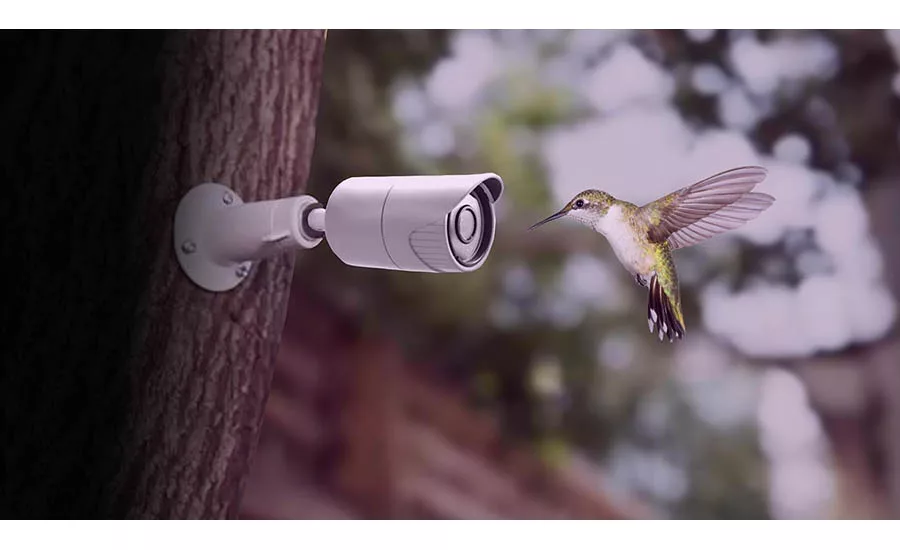
Say “HaLow” to Wi-Fi that can reach farther and last longer.
IMAGE COURTESY OF MORSE MICRO
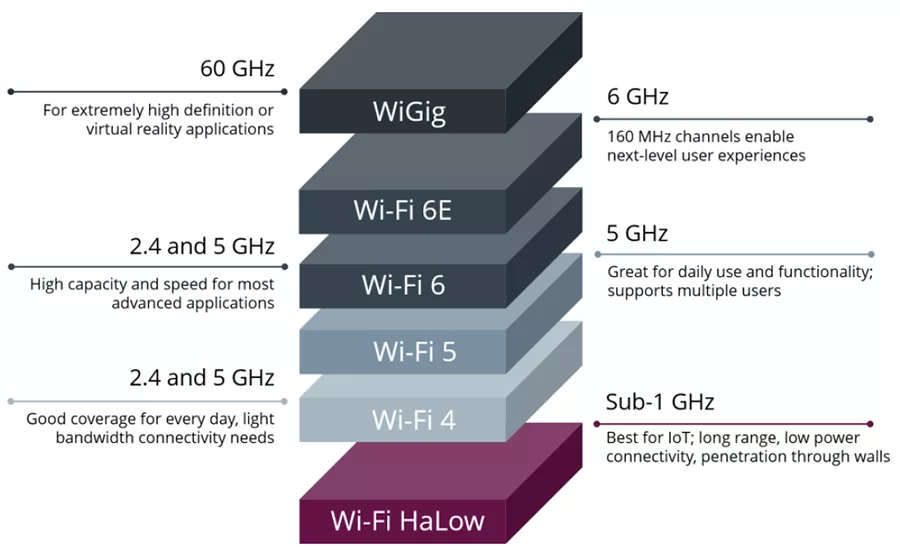
Wi-Fi spans several frequency bands and meets a variety of connectivity challenges.
GRAPHIC BY WI-FI ALLIANCE
The growth in wireless security cameras has increased the demand for makers of commercial and consumer cameras. According to MarketsandMarkets, “The global video surveillance market size is expected to grow from $45.5 billion in 2020 to $74.6 billion by 2025. Increasing concerns about public safety and security, growing adoption of IP cameras, and rising demand for wireless and spy cameras are the factors driving the growth of the video surveillance industry.”
With this growth in mind, Wi-Fi cameras have simplified the deployment and setup of these video surveillance systems. However, traditional Wi-Fi technology does not adequately fulfill the need to reach farther distances, penetrate obstacles better and operate longer on batteries without adding substantial cost and complexity to the network.
A new kind of Wi-Fi is needed to meet all those needs in a secure and simple infrastructure.
Delivering Reach & Coverage
Consumers expect their wireless cameras will work out-of-the-box, but no home or office is the same. The layout of every building is different, where walls and objects cause reflections or absorption of signals. The distance from the desired camera location to the Wi-Fi router may dictate whether there is enough bandwidth to support a clear picture, and there is no guarantee that sufficient Wi-Fi coverage inside the home will extend beyond brick, stone or stucco walls where security cameras may need to be placed. An average of 1 to 5 Mbps throughput is typically required, depending on the desired resolution and data compressions algorithms used for video. Some cameras require far less bandwidth if they pre-process images with artificial intelligence (AI) technology, and then only send segments of interesting activity.
To compensate for these drawbacks, many manufacturers must provide power supplies or bigger batteries, as well as additional proprietary repeater or hub boxes to relay the signal, adding cost and complexity. For some long distance applications, traditional 2.4GHz Wi-Fi simply cannot reach.
Standardized by IEEE as 802.11ah, “Wi-Fi HaLow”, as named by the Wi-Fi Alliance, is a low power, long-range wireless standard which has the advantage of operating in the license-exempt sub-1 GHz radio frequency range — much lower than traditional Wi-Fi (the highly congested 2.4 GHz band in Wi-Fi 4, and the shorter reach 5 GHz and 6 GHz bands in Wi-Fi 5/6 and Wi-Fi 6E, respectively).
Wi-Fi HaLow also uses narrower channels than traditional Wi-Fi. The combination of Wi-Fi HaLow’s lower frequency and narrower channels provides a combined benefit of reaching up to 10 times farther than Wi-Fi, at the same transmitter power levels. Wi-Fi HaLow cameras continue to send video where traditional Wi-Fi cameras lose their connections.
Looking for quick answers on security topics? Try Ask SDM, our new smart AI search tool. Ask SDM →
Another natural benefit of Wi-Fi HaLow’s operation in sub-1 GHz bands is that the radio waves penetrate through objects and building materials better than 2.4 GHz Wi-Fi (and significantly better than the higher 5 GHz and 6 GHz bands). This improves the reliability of the connection from the camera to the access point, which can compensate for a variety of floor plans and architectures. The effects of precipitation in outdoor applications are also reduced. The 2.4 GHz energy used by traditional Wi-Fi is readily absorbed by objects and liquids (which is why microwave ovens also use 2.4 GHz to heat food).
Lower Power, Better Efficiency
Wi-Fi HaLow is the first 802.11 technology to include new power saving modes, which reduce energy consumption. These combined features offer the benefit of extending the battery life of wireless cameras with Wi-Fi HaLow technology from 10 to 200 times longer than traditional Wi-Fi, depending on the use of the camera. Wi-Fi HaLow maintains the same benefit of Wi-Fi in that it automatically works at faster, more energy-efficient data rates when the device is closer to the access point.
A traditional wireless camera must typically wake to transmit approximately three times per second to stay associated with its access point. If it does not stay connected, the camera is disassociated from the access point. This often requires the device to go through a lengthy re-association procedure when it wakes, which consumes even more energy.
In contrast, wireless security cameras utilizing Wi-Fi HaLow technology can sleep for long periods of time without being disassociated from the access point. The mechanism is built into the standard, so there is no need for separate proprietary schemes to implement the solution. The Wi-Fi HaLow standard includes provisions to sleep for hours, days and even weeks until triggered by a sensor, further improving battery life.
By increasing the distances that can be reached by Wi-Fi HaLow technology, larger areas can be covered without having to resort to cellular data modem connections and their recurring costs. Analogous to traditional Wi-Fi, a Wi-Fi HaLow network infrastructure can be installed as a simple addition to the customer’s IP network. No repeaters or complex Wi-Fi Mesh solutions are required, and no cellular modem charges are required. This means an organization’s CIO does not need to negotiate a separate carrier service agreement for what should be part of the enterprise’s premise network.
This also applies for quasi-mobile applications. Consider the example of a new construction site which requires full-time video security. In this case, instead of purchasing four or five cameras using cellular modems with large batteries and recurring monthly data plan charges, the company could deploy multiple low-power Wi-Fi HaLow cameras and use a single low-cost LTE gateway for the uplink to the cloud. Another example would be that of campus security officers with body cameras. They could respond to calls within a fixed location, with images sent to a nearby access point or mobile Wi-Fi HaLow hotspot in a vehicle.
This technology could also extend to drones, which need high-bandwidth connections for video and control signals to a base station. Directional antennas commonly used by drone systems would apply to 802.11ah frequencies (902-928 MHz in North America), and would increase connection distances beyond the nominal 1 km reach.
While conventional Wi-Fi is the most ubiquitous wireless communications protocol in use today, the rapid growth of the IoT has forced a rethinking of Wi-Fi, revealing technological gaps and what role it needs to play in an all-encompassing connected world.