AMAG Helps Port of Corpus Christi Meet Access Control Compliance
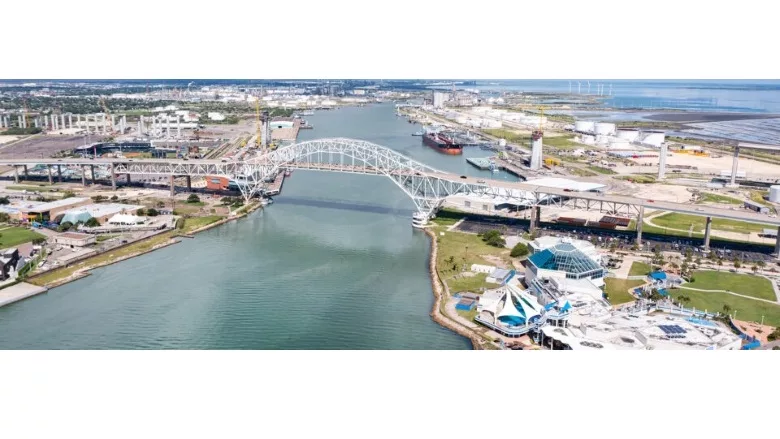
Image courtesy of AMAG Technology.
Imagine going to work every day and overseeing security for a facility that covers nearly 36 miles in two counties, with multiple entry points used daily by hundreds of people in government, military, and private sectors. That’s what Stephen Wendt and his team does every day — and in part, it’s why they rely on AMAG Technology’s Symmetry access control system to help them sleep at night.
Wendt is security systems administrator for the Port of Corpus Christi (POCC). Located in Corpus Christi, Texas, the port is a vital American crude-oil-export gateway, reportedly the world’s third largest. It is also America’s third-largest port in overall volume or waterway tonnage.
In addition to crude oil, POCC handles natural gas, grain, wind energy components, and a range of other cargo. It is a vast terminal with huge docks and berths, plus a newly dredged deepwater channel big enough to handle very large crude carriers (VLCCs) capable of carrying two million barrels of oil. So a day at POCC means a lot of activity.
Wendt described the layout: “We have the channel itself, which goes back roughly eight miles. And we have facilities along both sides, up and down. Then we have a couple of buildings downtown, about a mile from the port … we have our Command Center there. The port itself covers about six miles, with several industry customers operating multiple private terminals and docks. All in all, we have 36 miles of facility … so big, it’s in two counties. We coordinate with about seven different federal, state, and city agencies, city PD, county sheriffs, fire departments, Homeland Security, the Coast Guard. … We have our own terminal police and fire departments as well.”
Access control for all this space and all these people is only part of the story.
“Because we’re one of the largest ports in the country, one of our larger customers is the military,” Wendt explained. “So, we have a lot of military equipment. …. As such, we work closely with the Coast Guard to make sure we follow MARSEC mandates.”
MARSEC (Maritime Security) is a three-tiered system the United States Coast Guard and Canada use to communicate threat levels and plan responses in ports all over North America. In normal operations, MARSEC Level 1 requires screening a percentage of visitors and vehicles. MARSEC Level 2 requires the same level of security as the “High” Level of the Homeland Security Advisory System (HSAS). MARSEC Level 3 corresponds to the HSAS “Severe” threat level.
Looking for quick answers on security topics? Try Ask SDM, our new smart AI search tool. Ask SDM →
So the port’s access control under MARSEC needs to be robust and flexible — with credentialing and access requirements that can be changed almost instantaneously — and in the port’s case, across a roughly 36-mile area of terminals, warehouses, other buildings, shoreline, basins, docks, construction sites, and gates.
The port has a number of gates manned by Allied Universal Security as well as ongoing police security patrols by its own police department. But due to its large area and widely varied users, some access points are monitored remotely with access via port badge or other credentials as required.
One of these credentials is TWIC. Short for the Transportation Worker Identification Credential, TWIC is a federally mandated security measure that requires biometric security credentials for anyone entering secure areas of facilities and vessels. This includes all mariners who hold Coast-Guard-issued credentials or qualification documents. To receive a TWIC, a person must pass a security threat assessment conducted by the Transportation Security Administration (TSA). Once eligible for TWIC, they are issued tamper-resistant credentials that contain their fingerprint and an access code that allows for a positive link between the card and the individual.
When someone without TWIC credentials needs access to a restricted area (this includes any federally regulated terminal or facility in the port), an authorized security team member must escort them.
In light of all these needs, the port chose AMAG Technology for its access control solution based on AMAG’s responsiveness, reliability, and GSA approval — especially in regard to MARSEC compliance. The port worked with Logan, Utah-based integrator Cache Valley Electric — who have a branch in Irving, Texas.
AMAG is the developer of Symmetry HSE (Homeland Security Edition) access control software, which integrates with the U.S. federal government’s highest levels of credential validation and authentication standards, as well as all relevant federal guidelines and policies. Symmetry HSE is approved by the GSA for government physical access control projects as a certified platform that meets all federal guidelines and policies.
AMAG’s experience and proven Symmetry HSE capabilities help the port’s Symmetry system meet its needs today, and flex to continue meeting them as they may change.
Wendt explained, “If the MARSEC level increases due to threat levels, with Symmetry we can increase the security. Say, at MARSEC Level 1, it’s TWIC-only … you just present your TWIC credentials. But if the MARSEC level was to go up, then we’d add additional biometric credentialing, so access would require TWIC plus biometrics.
“We can also turn on the biometrics so only certain people could use an unmanned gate in an ‘in case of emergency’ kind of situation … we would set a gate up to be a biometric gate. This means not anyone could get through there, just someone with a TWIC that’s been validated to go through that particular gate. Symmetry gives us that option. …. We can restrict individual access to specific areas.”
On a day-to-day basis, Wendt said, “We have about 10 entrances where we use Symmetry for trusted entrances. … People who are employees of the port or TWIC badge holders; in one location we’re actually using bio and TWIC. There we are using the FIPS (Federal Information Processing Standards) system to communicate back to the TWIC database to validate that TWIC badges are legitimate. … And our analysts are also watching out 24/7, and constantly monitoring Symmetry’s activity log to see who’s coming in and out so we can address any situation at any time, with the appropriate response.”
Wendt appreciates Symmetry’s proven performance, even in a facility almost half the size of Washington, D.C. He also appreciates the regular communication he receives from Cache Valley Electric with updates and other support. And he plans to continue growing the system; he and his team are also testing several other AMAG integrations.
Wendt said, “I recently got Symmetry certified, and I’ve enjoyed it. It’s a robust system that can do everything we need to do, and then some. We still don’t use it to its full capabilities, which is something I’m working on … to take advantage of its capabilities and maximize our use of it.”
Looking for a reprint of this article?
From high-res PDFs to custom plaques, order your copy today!