The Edge of Access
Where’s the edge? What’s happening at the edge? Who wants the edge? Industry experts weigh-in on edge-based access control.
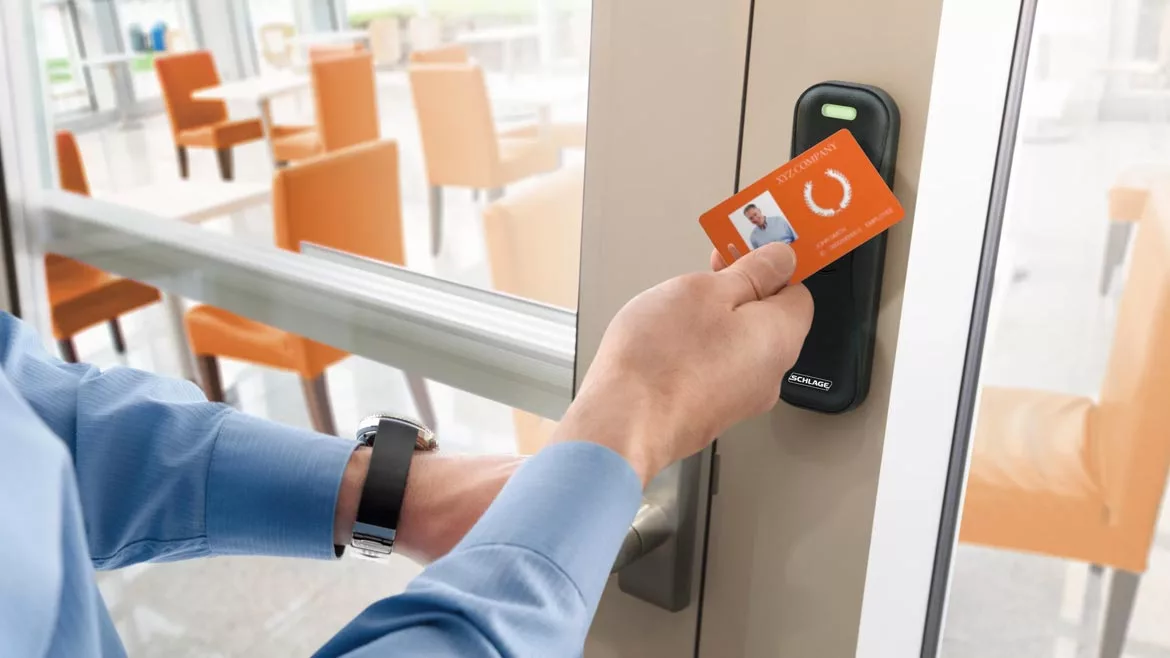
Some solutions even store data-on-the-card. Image courtesy of Allegion
Access control edge devices — from Wi-Fi locks to intelligent PoE controllers — are seeing deployment in the education, healthcare, retail and enterprise verticals. And while the benefits of computing at the edge are apparent — simplified infrastructure, lower installation costs, etc. — security integrators need to understand how to install and maintain these edge-based devices inside of an access control system.
“We are seeing a greater demand from our customers for intelligent devices such as e-locks and reader controllers — which are devices installed on the wall near the door — in tandem with the rise of edge devices,” says Brian Telljohann, director, product management – electronic solutions, Allegion, Carmel, Ind. “Manufacturers are increasingly being asked to offer devices that can make an access control decision at the opening in addition to the existing products that wire up to a traditional door controller. These intelligent devices make the overall solution simpler to install because they can eliminate the need for additional hardware such as door controllers.”
What is Access at the Edge?
Edge-based access control places the decision making of a system at or near the door or lock — within the hardware or the reader — instead of the control panel. Credentials are validated and entry data is stored locally.
“As the cost of technology has decreased, it has enabled intelligent Wi-Fi and even power over ethernet (PoE) access control locks to become edge devices themselves,” says Lester LaPierre, director of business development at ASSA ABLOY Digital Access Solutions, New Haven, Conn. “That means access granted/access denied decisions happen right at the lock/door instead of at a head-end system.
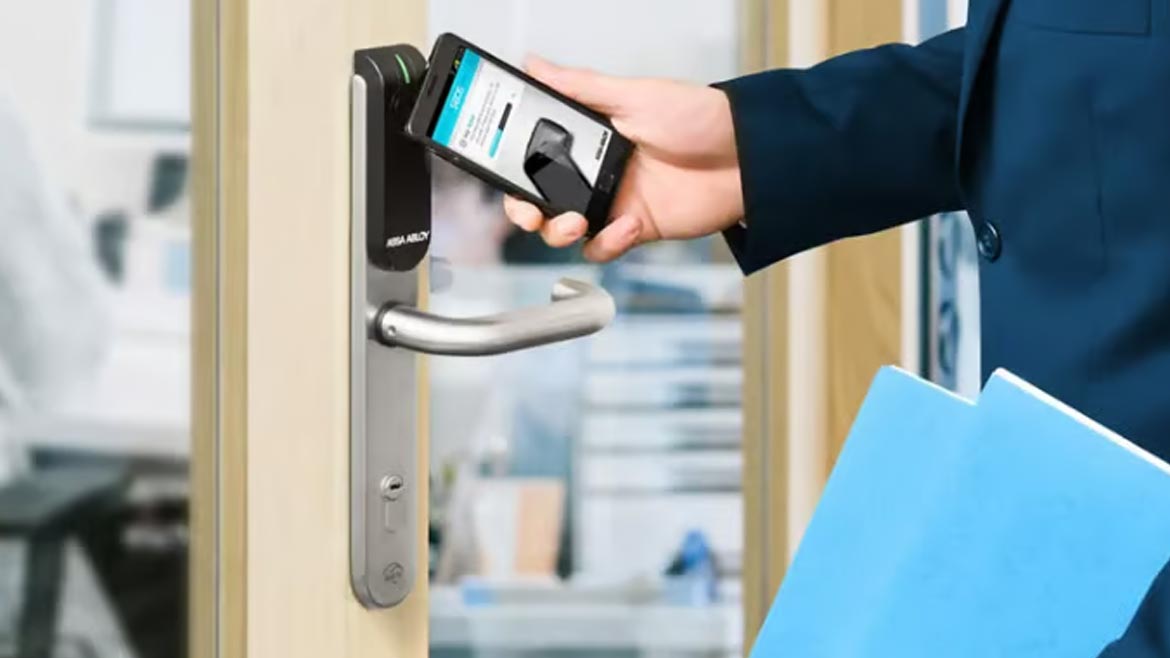
“Going further, up to 10,000 unique credentials with access rights for each are now programmed into the lock’s database,” LaPierre continues. “As card or mobile credentials are presented to the edge device and access decisions are made, the events are added to that specific device’s transaction logs. Then, on a scheduled basis or alarm condition, the edge device communicates with its access control system automatically to upload transaction logs and receive new access rights and system updates.”
The edge approach reduces latency and lowers the burden on a server, LaPierre explains: “One of the questions we always get is, ‘So now we’re going to add 10,000 locks to our Wi-Fi network; what impact is that going to have on the bandwidth? Am I going to prevent our students from being able to stream video or play games?’ The advantage of having decisions made in the Wi-Fi lock is that you’re not burdening the Wi-Fi network. IP locks only transmit a few kilobytes of data per day when you’re logging in for system updates, which can always be scheduled during low-use hours.”
The advantage of having decisions made in the Wi-Fi lock is that you’re not burdening the Wi-Fi network. IP locks only transmit a few kilobytes of data per day when you’re logging in for system updates, which can always be scheduled during low-use hours.

More Than Cost Savings
Edge solutions impact installations by reducing the time commitment and the wiring complexity. These solutions often feature fewer components and are not reliant on a dedicated control panel room or the need for intricately structured cabling.
Looking for quick answers on security topics? Try Ask SDM, our new smart AI search tool. Ask SDM →
“By combining reader interface and door control in one physical device located at the edge, deployments can be more cost-effective and streamlined, especially in distributed environments,” says Jeremy Fromm, security evangelist, Mercury, Long Beach, Calif.
The same applies in a retrofit scenario. “Ease of installation makes them more practical for retrofits as well, which means more openings can be better secured cost-effectively,” Fromm adds. “In places where pulling cable is difficult — like historical buildings or remote areas — edge offers a more practical and less invasive solution.”
LePierre adds, “By leveraging existing Wi-Fi network infrastructure and eliminating access control panels, total cost of ownership is drastically reduced. Secondly, installation time is a fraction of a traditional wired opening enabling massive deployments in a set timeframe.”
This makes edge solutions ideal for multi-site locations or campuses like those in the education and medical verticals. “An example is campus-wide migration to mobile-ready locks at colleges and universities, which would typically require an army of technicians if done using conventional wired solutions.
“This brings up the third advantage, which is ease of coordination,” LaPierre continues. “With no wires to pull or conduit to install, electricians aren’t required. Since there are no control panels and wall readers to mount, installers aren’t necessary either. Lastly, locating scarce wall space for controllers and power supplies in IDF closets is a thing of the past as these components aren’t needed in an edge-enabled deployment.”
Edge-based access control solutions also allow for easier troubleshooting of issues, the experts say. “If there’s an issue, you know exactly where the controller is and which door hardware it’s managing — streamlining diagnostics and service,” Fromm says.
To Migrate or to Integrate?
Some end users may be tempted to migrate entirely to an edge-based deployment. The benefits of the solution could certainly warrant that decision, but there are considerations to factor in.
“Transitioning to edge-based access control brings several benefits, but it also comes with unique challenges organizations should consider,” Fromm says. “Edge controllers often appear more expensive upfront since they’re typically deployed one per door — but this is often offset by savings in wiring, faster installation, and simpler documentation. On the plus side, it’s easier to locate and service edge controllers since they’re installed near the door. However, servicing may require a ladder or temporary blockage of doorways, which can disrupt operations or user experience.”
Fromm continues, “Shifting from centralized to distributed architecture may require updated training for installers, technicians, and facility teams. Overall, the transition requires careful planning; but when done right, edge designs can simplify infrastructure and improve long-term flexibility.”
Compliancy & Compatibility Challenges
Brian Telljohann of Allegion, explores some of the most common challenges organizations face when transitioning from traditional access control to edge-based systems. According to Telljohann, these include IT policy compliance, network compatibility, and system capacity. In general, he says it’s beneficial to include IT leaders early in the decision-making process for a more seamless transition.
Here are Telljohann’s considerations for each concern:
- IT policy compliance — Some organizations’ IT policies prevent IOT and/or access control devices from connecting to the IP network. This can be overcome by involving the IT leaders of the site at the beginning of the decision-making process.
- Network compatibility — Some edge devices have limitations or requirements to join the organization’s IP network. Examples include 2.4GHz frequency band Wi-Fi requirements with limitations on connecting to the 5GHz band. Firewall and cybersecurity requirements can also create friction when getting the solution installed and working. This can be overcome by involving the IT leaders of the site at the beginning of the decision-making process.
- System capacity — For very large installations there are limitations to how many credentials and/or users can be stored locally at the opening and the edge device. If the customer’s needs exceed these limitations, traditional access systems are typically the better option.
Some edge devices can be “standalone,” while others can be connected — or networked — to the larger system. “Standalone edge devices offer a complete package installed right at the door, eliminating the need to connect to the control panel,” Telljohann says. “This makes them very easy to install and program. However, standalone products are difficult to scale to larger buildings as an administrator must physically visit each door to change access rights. IP-networked devices are recommended for larger installations. Networked devices require an extra level of integration during installation to connect the device to an IP network; however there are many advantages. These advantages include the ability to centrally administer and manage the access control needs of the building, make remote updates to the opening, and enable a full building lockdown.”
Fromm concurs: “Standalone is fine for single offices or residential buildings. But for larger organizations, networked edge delivers scalability and integration.”
While edge devices may continue to proliferate an ecosystem, they’re not necessarily replacing traditional access control systems. Integrators can work with end users on a hybrid strategy that combines wireless systems with edge-based locks to traditional panels to find the right solution for them.
“Whether it’s data-on-card, intelligent Wi-Fi, PoE, or even real-time wireless and traditional wired openings, a mix of all these solutions can work together to create a fully integrated access control system that meets customer needs and budgets,” LaPierre says.Where’s the Edge Going?
As technology improves, it’s clear that the device itself is becoming more intelligent. This move to the edge is reflective of end-user demand for more. “Overall, edge is becoming more widespread where flexibility, space savings, and IT alignment are priorities,” Fromm says.
One way that the industry can meet this expectation is by increasing the flexibility or openness of solutions. “Intelligent controllers not only shift intelligence closer to the door but are also supported by an open platform for embedded application development,” Fromm says. “The latest controllers with these capabilities support third-party app integration and enable custom business logic to run directly on the controller. As a result, software providers and integrators can seamlessly combine access control technologies, elevator control, building automation, IoT applications and third-party solutions into a unified, centralized infrastructure.”
He continues, “Mercury Security recently announced this capability for one of its controllers. It increases flexibility by eliminating vendor lock-in and providing the freedom to choose the right solution for specific customer requirements while future-proofing investments. Capabilities like these will be important to consider when making the cost and implementation decisions related to moving from centralized systems to edge devices.”
Data-on-Card?
When discussing what constitutes a standalone device or what defines a hybrid deployment, Lester LaPierre, of ASSA ABLOY Digital Access Solutions, mentioned what he calls “data-on-card” solutions. In his words, “When you ask about stand-alone edge devices, I’m assuming you’re referring to data-on-card technology,” he says. “In that case, we do offer ‘data-on-card’ solutions, where the credential is essentially the brain and encoding access rights happens on the card, fob, or even a mobile phone. This is how our multi-family solution works.
“The credential carries the system data such as user rights and lock audit trails,” LaPierre continues. “Access rights are updated when a credential holder presents their card, fob, or phone to a reader either at a building entrance such as a perimeter opening or elevator access control point. These updater points are also where transaction logs would also be uploaded. It’s all cloud-based which means there are no servers to deal with. Cloud-hosted solutions like our digital platform and our small business application are examples of applications where data-on-card are helping EAC become more attractively priced and scalable across a wider variety of organizations.”
Looking for a reprint of this article?
From high-res PDFs to custom plaques, order your copy today!