Monitoring
Accuracy, Efficiency & AI in Video Monitoring
The ins-and-outs of AI’s effect on video monitoring accuracy and efficiency.
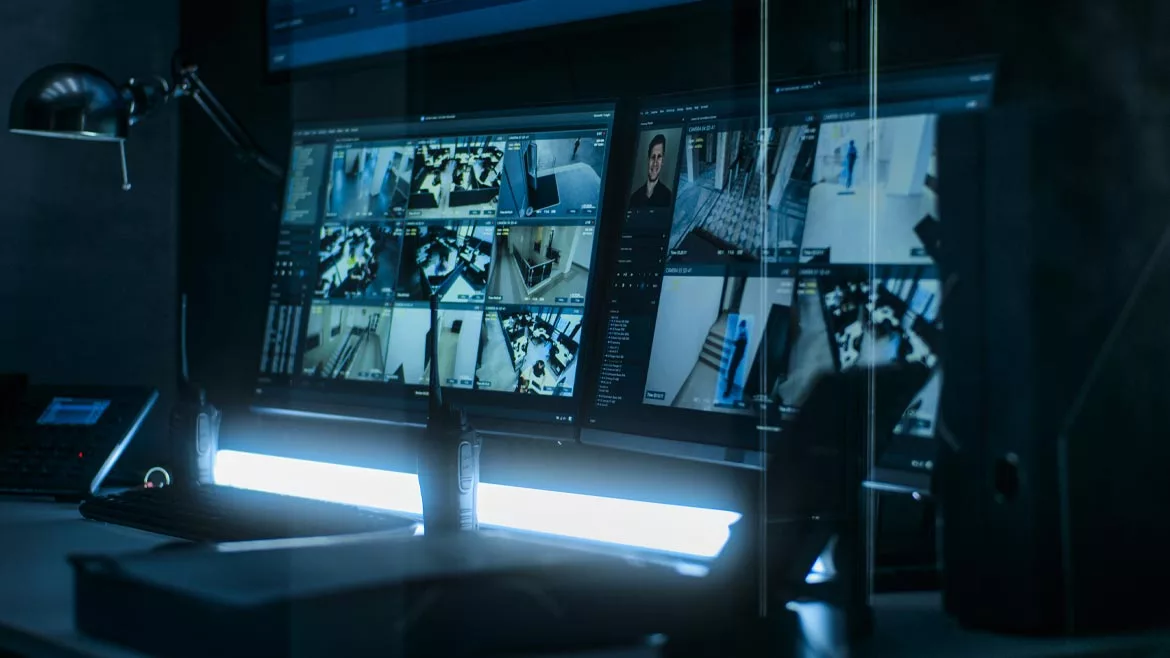
EvgeniyShkolenko / iStock / Getty Images Plus / via Getty Images
From false alarm reduction to the automation of time-consuming tasks, AI is reshaping how monitoring centers operate, how security integrators provide their services, and what end users expect from their security solutions. Live video monitoring has become more scalable and more intelligent, enabling security companies to boost efficiency, enhance their incident response, and find new opportunities for revenue. Ahead, experts give insight into what AI capabilities their organization is leveraging and how AI has affected their operations.


Advancing Accuracy
The backbone of AI’s effect on monitoring is increased accuracy. “The biggest change has been the accuracy of the detection and the elimination of what we call background noise or false positives,” says Scott Blakeman, vice president, client success and security solutions, Elite ISI, Los Angeles. “In the infancy of remote guarding, it was based on what we call video verification and motion detection. There would be motion sensors — which are really old technology — on site along with cameras and the motion sensors would detect motion and then you would have an operator and try to figure out what’s going on. Is that a person? Is it a vehicle? Is it the wind blowing tree limbs? Is it a cat? What created the alert? And then the operator would take action based upon that.”
Blakeman continues, “What’s happened now is that we’ve programmed the AI to only be looking for people and vehicles in places where they shouldn’t be or even more importantly when they’re in that area longer than they should be there. What that’s done is eliminated all of those false positives.”
Jason Caldwell, director of marketing and guard force accounts, Immix, Charlotte, N.C., shares a similar sentiment: “While Immix does not operate an actual station, our platform is used by many of the largest, mid-size and smaller stations around the globe and AI has impacted each of them in a positive way,” he says. “The most obvious area of impact has been that of accuracy of detection for video systems, which translates to reduction in false and nuisance alarms. This streamlines operations and offers cost benefits, which often allow our partners to create efficiencies and provide new services that may have previously been difficult to deliver due to labor being focused on very high alarm volume. The advent of AI has allowed companies to add more cameras to their monitoring portfolio and drive new revenue streams at a high growth rate without having to incur much in the way of added cost to them.”
Of course, the top priority of all monitoring professionals is that a timely response happens when a threat is present. False alarms are a nuisance when safety is at stake. But in the age of text notifications, those pocket vibrations can become white noise to end users. The more accurate the threat detection, the less notifications the end user has to experience — thus reducing their ambivalence to the sensation.
“What we’ve seen with some of the over-the-counter type video products that are out there — doorbells and such — is that users become immune to the sensation of that trigger,” says Rob Bado, vice president of sales and marketing, Post Alarm, Arcadia, Calif. “My doorbell goes off 18 times a day because my wife gets 18 Amazon deliveries a day. Then you’re desensitized. Our goal is to always maintain that customer’s alert and aware mindset. If they do get a push notification, we want them to know it is genuine.”
“We’re able to discern a threat from a greater distance from a home or business which extends the amount of time we have to respond to an event and allows for a judgment call to be made before someone can physically reach your home or business.”


And the AI continues to be more accurate over time as it continues to learn from the videos it sees. “Perhaps the best benefit of using AI is the fact that it becomes more accurate over time,” says Ryan McElderry, senior vice president, operations, Pro-Vigil, San Antonio, Texas. “Every month we ingest 70 million hours of video into our AI models to train the system so it can better determine suspicious activity. Because we’re always training our AI, customers are receiving a continuously upgraded service. This is allowing us to begin leveraging vast amounts of data to add predictive elements to our monitoring functions, which would be a game changer for our solutions.”
Looking for quick answers on security topics? Try Ask SDM, our new smart AI search tool. Ask SDM →
Enhancing Efficiency
This type of reduction of nuisance alarms means that operators are able to focus their time more efficiently — the second most oft-cited benefit to the ever increasing power of AI. “What AI is doing is allowing our operator’s time to be optimized,” Bado says. “With AI, our new approach is proactive. In preventative monitoring time is of the essence. The analytics play such a huge role in allowing our operators to really focus their objective on true events. It’s not a tree blowing in the wind. It’s not a delivery truck driving by. It’s not a false positive. When that operator receives that video, it is someone in a protected area that should not be there per the established protocols for each account.”
Between the reduction of the false alarm and the automation of previously manual tasks, it allows operators to focus on their strengths and skills. “Through the use of AI, there are many solutions and functions that can now be automated for the operator so that they are able to focus on their core competencies,” Caldwell says. “Things like audio, video patrols and other analysis no longer need a human in the loop for every event. This allows operators to focus on those events that truly need their attention and intervention. The latest trend we intend to deploy through our platform is that of having an AI agent pick up and handle an alarm event from beginning to end. This is already happening on a limited scale, and we hope to bring this solution to a much wider market.”
McElderry adds, “AI has allowed our team to scale efficiently. Instead of watching idle screens, AI alerts monitoring staff only when something needs attention, letting operators monitor more cameras at once. AI allows us to identify the most pressing physical security threats with greater accuracy, respond faster, and in most cases, resolve the situation with crime deterrents before law enforcement ever has to get involved. AI is a force multiplier.”
Caldwell emphasizes that this does not translate to a reduction in operators. “Reduction in alarm count and the need for operators to perform some of the more mundane tasks required of the job translates to fewer bodies needed to handle excessive events,” he says. “This often does not mean a reduction in headcount, but rather a reallocation of those resources to other, higher-margin, services such as remote concierge or virtual gate attendant, which tend to be more personal services that bring in larger revenues on a smaller number of sites.”
Ultimately, this means a higher quality of service, Bado says. “I think one of the key elements that can’t be ignored is what it’s doing is delivering a much higher caliber of service and much more timely service to our customer base,” he says. “It’s delivering a preventative measure where we can then begin that two-way conversation to prevent a potential crime. I think it’s a win-win — we’re not processing tons of false signals and the customer’s getting a better quality of service because we’re able to get to them quickly and effectively.”
As an example of what AI tech is being deployed, Caldwell says, “Some of the AI features that have proven most effective for us include: specific object classification (person, vehicle, weapon etc.); accurate and specific threat detection (behavior, aggression, smoke/fire, fall detection etc.); false/nuisance alarm reduction; automated video guard patrols (AI-enabled video patrols that only raise the patrol to an operator if an anomaly or violation is detected); face matching technology (ability for an operator to take a snapshot of a perpetrator and drop it into a database that can, in seconds, tell you with 98 percent accuracy who the person is and if they have a criminal record); visual camera health checks/notifications (automated daily checks of all monitored cameras that will notify of any that are distorted in any way — blur, tilt, black, offline, tamper etc.); and AI agent alarm handling/response.”
Automated Talk-Downs & Behavior Analytics
There are examples of automated responses that are AI-enabled like time-of-day scripting, tailored messages or even adding regional accents to that messaging. Some experts say that they have had success with these features and others have opted to keep a human-touch to these features.
Manufacturer’s Perspective
SDM spoke with Brad McMullen, president, security products and solutions (3XLOGIC, PACOM, Sonitrol) at Securitas Technology, Uniontown, Ohio, about the effect that AI is having on monitoring from the manufacturer’s perspective. Ahead, McMullen answers a few questions about how AI has shaped the design of 3xLOGIC’s solutions.
SDM: How are you designing your systems/solutions to support monitoring centers using AI?
McMullen: At 3xLOGIC, our VIGIL VMS is designed to support monitoring centers by shifting the burden of AI processing to the camera edge. 3xLOGIC Edge-Based Deep Learning cameras are equipped with object-based person and vehicle detection to accurately identify and classify events, so they only send targeted notifications to monitoring stations. This edge support eliminates the need for monitoring centers to deploy or manage their own AI systems which, in turn, reduces complexity, cost, and false alarms. Monitoring center operators will only receive relevant actionable events, so response times can be shortened.
SDM: What specific AI features have proven most effective in real-world monitoring operations?
McMullen: The most effective AI feature has been edge-based deep learning classification of objects — especially the ability to distinguish between people and vehicles, but also through filtering out irrelevant motion activity. This dramatically reduces false alarms and ensures that monitoring center operators focus only on true events that require their attention.
SDM: How important is localized AI (adjusting alerts by time of day, geography, type of site) to your product roadmap?
McMullen: The ability to set schedules, object or vehicle classes, sensitivity or confidence of detections allows users to tailor their protection to their needs, filtering out normal activities that don’t require a response to effectively capture those events that are legitimate anomalies.”
SDM: What do you believe will be the biggest AI-enabled breakthrough in video monitoring in the near-future?
McMullen: I expect natural language search of video footage to be the biggest AI-enabled breakthrough in video monitoring in the near future. Being able to ask a system to “show me when a person loitered in the parking lot for more than 20 seconds after 3a.m.” will make search faster, easier and more efficient.”
“As an example, a voice down would say, ‘Attention to the individual in the black hoody wearing blue jeans, with white tennis shoes with the backpack. You’re trespassing. You’re being recorded. Leave or we will call law enforcement,’” Blakeman says. “We’ve always said it’s much more effective when it’s personalized. People can tell when it’s just canned audio. That doesn’t get their attention the same way as when they hear a personalized message and go, ‘Oh no. They’re talking about me.’ The big jump there right now is the AI voice-down. We’ve all seen on the internet how AI is able to just about sound like anybody — to have natural inflection in their voice. That really will be the next level. At this point, we are still using humans because there’s a certain amount — in our opinion — of nuance to our trained operators observing particular behaviors.”
Todd Shuff, vice president of operations, National Monitoring Center, Irving, Texas, says, “We’re just starting to explore customization features, and we’re excited about what they can do. Right now, NexusVoice is more focused on automating the technical side of alarm testing, but we see a lot of potential in more personalized interactions. We see the benefits and think that thoughtful communication could really enhance the customer experience down the road.”
Caldwell says Immix is deploying many of these AI-enabled solutions. “All of these features play a role in helping our Immix partners better their remote guarding and monitoring services delivery,” he says. “Some more than others, but the more features that can enable more bespoke services without creating more labor for the actual manpower in the station is what is driving real change in monitoring center operations.”
Another big advancement in AI — one that Elite ISI is paying close attention to — is behavioral analytics. “We are looking at those and have started integrating some of them into our platform,” Blakeman says. “The ones that are out there now can detect crowds gathering. Let’s just say for whatever reason you’re in a park, and you’ve got one individual that’s standing in one area. Along with that, you see different people from different areas at different times are coming up to this person. Maybe not all at the same time, but this person is stationary and other people keep going up to them. Probably a good indication that there's a drug deal or something going on. It could be prostitution. That’s an example of analytic behavior detection that can be set. Another huge request that we received — especially from the law enforcement agencies that we partner with — is the ability to detect street takeovers or side shows. Being able to detect cars doing donuts and people are screeching all over the place. Being able to detect those kinds of incidents.”
Another use case example is being able to tell whether someone is still on the property or not. “Let’s say somebody walks down the driveway and walks past camera one or two and works their way around — the software that we’re using will actually tell us by giving us a percentage of how likely the person is still on the property,” says Anthony Franco, vice president of technology, Post Alarm. “Just based on the way that they’re moving and that it hasn’t seen them exit the property, there are ways that we utilize that as well through the software in our central station that will tell us how likely it is somebody that someone is still on the premises.”
At the end of the day, the success of these preventative solutions are what security professionals and end users care about — and AI makes these solutions more successful at preventing incidents. “We’re able to discern a threat from a greater distance from a home or business, which extends the amount of time we have to respond to an event and allows for a judgment call to be made before someone can physically reach your home or business,” says Rob Post, co-owner, Post Alarm. “The early detection of threats also enables coordinated notification and response, as our monitoring agents can simultaneously notify law enforcement, private security, patrol officers, and the homeowner. This gives the homeowner time to get to safety and provides responders with intelligence about the situation they are responding to, including physical descriptions of any persons involved and their movements around the property.”
Post-Incident Forensics
Following an event, AI can help operators to gather relevant information about the incident. This information can help monitoring centers deliver a more actionable report to the proper authorities. “AI is tracking that incident all the way through,” says Rob Bado, Post Alarm. “AI continues to play a key role post-incident, whatever the results may have been. If a suspect flees the location before the arrival of authorities, what did AI capture? Did we capture their vehicle? Did we capture their license plate off of that vehicle? We are now delivering a key package of evidence to law enforcement that’s actionable that they can then continue on with, even though we may not have made an on-scene apprehension.”
Bado continues, “AI will pick up if it’s a repeat vehicle. They’ll be able to look in to see how many times its detected that vehicle description or that vehicle license plate. It will look to see how many times it has been to the property, prior. Can they be tied to other incidents? There’s a whole forensic side to it. Cameras originally started off being forensic, and now we’re moving them into a proactive and preventative direction, but I think that forensic still continues to play a critical role in the successful defense of businesses and homes.”
Ryan McElderry of Pro-Vigil, adds, “Generating incident summaries with video [helps] customers get fast, clear updates on what occurred. At Pro-Vigil, we have started using Generative AI to produce incident summaries of what happened after the fact: What occurred? What action was taken? What time did it take place? etc. What used to be a highly manual task requiring forensics staff to watch video and record these details has now been automated allowing us to pass on vital incident information to customers more quickly. We’re excited to explore additional uses of GenAI that can help streamline additional aspects of business operations, not just in monitoring alone.”
Looking for a reprint of this article?
From high-res PDFs to custom plaques, order your copy today!