Thinking Outside the Box About CO & Smoke Detectors
Fire and life safety codes determine critical CO and smoke detector functionality — and that’s a good thing. But products can be even better when manufacturers think beyond code requirements.
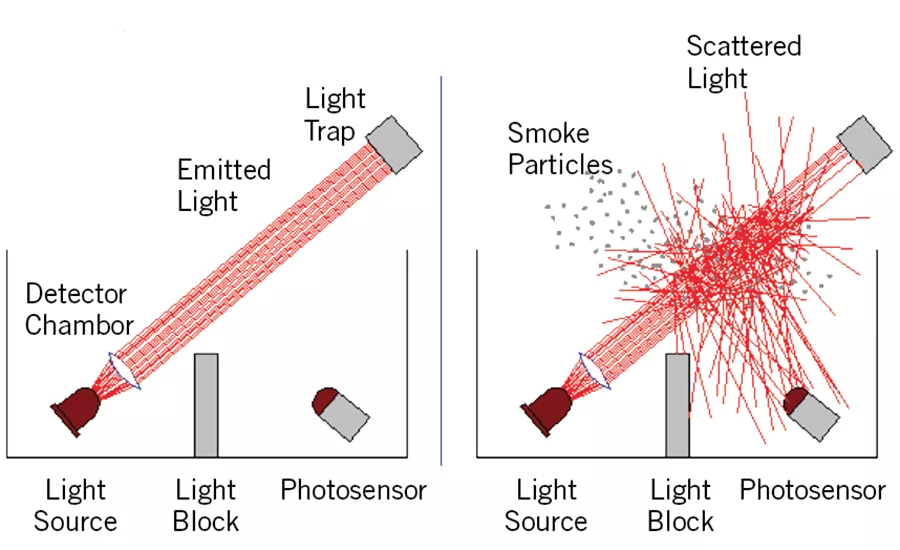
GRAPHIC COURTESTY OF POTTER ELECTRIC SIGNAL COMPANY
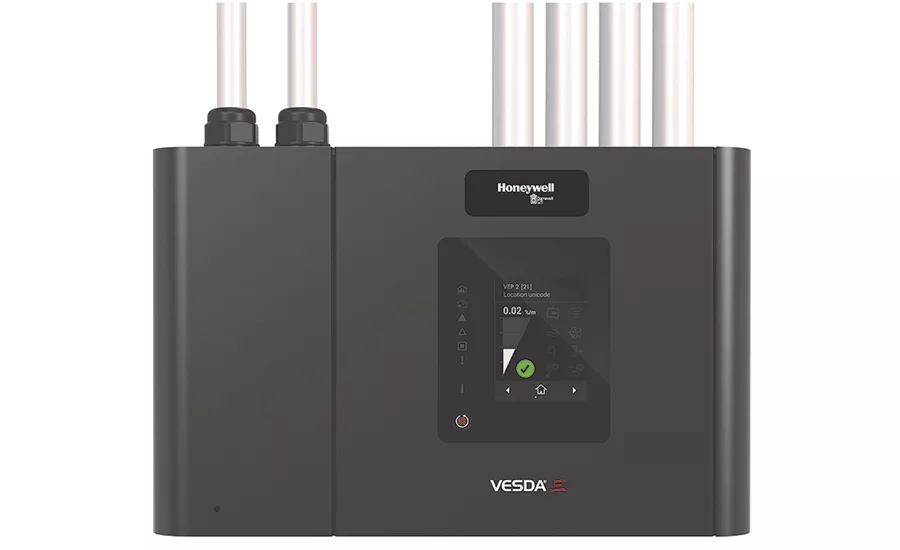
Aspirating smoke detection systems can provide early warning of potential fires.
PHOTO COURTESY OF HONEYWELL
The use of smoke and CO detectors in customer installations is driven, in large part, by fire protection and life safety codes, which also drive the specifications for the detectors that manufacturers build. But sometimes manufacturers introduce product innovations that provide benefits beyond simply meeting code requirements. Here are some recent examples:
Longer-Life CO Detectors
More often today authorities are requiring CO detectors, which are designed to detect dangerous levels of carbon monoxide generated by heating systems or other sources.
Traditionally, the downside of CO detectors was their lifespan. As Tony Moore, national trainer for St. Louis-based manufacturer Potter Electric Signal, explains, these devices typically have what is commonly called a “water tank” as part of the design. The water tank doesn’t really contain water, but rather electrolyte — and over time, the electrolyte is consumed.
Potter’s new offering uses humidity in the air in place of the water tank, which means detector life is now based on the lifespan of the catalyst that it also contains — an approach that extends detector life, Moore explains.
A Dealer’s Take on CO & Smoke Detection
Customers may be able to meet code requirements with stand-alone smoke and CO alarms that are not part of the customer’s monitored security system. But having these devices can help speed emergency response, particularly when customers are not on site at the time the emergency occurs.
“We always recommend monitored detectors as an option,” observes Steve Sopkin, president of Mijac Alarm, a Rancho Cucamonga, Calif.-based security dealer.
Like many dealers, Mijac Alarm relies largely on photoelectric smoke detectors. While ionization smoke detectors are another option, those devices are more false-alarm prone and have a shorter lifespan, Sopkin explains.
California laws require CO protection in all new homes and as part of any home inspection when owners sell their homes — and considering that smoke detectors also are required, Sopkin generally installs combination devices that include both technologies.
Sopkin notes that Mijac Alarm occasionally uses beam systems. He recalls using this option in an installation where installers would have had to use a lift to reach the ceiling where traditional smoke detectors are installed. Mijac hasn’t used aspirating systems, but Sopkin says they “seem like a very interesting product.”
Such systems previously were so costly they were only used in “clean rooms” — corporate computer rooms where detecting fires as early as possible was extremely critical, Sopkin notes. But as he explains, manufacturers recently figured out how to make them less expensive, opening up the possibility that such systems might be used more broadly.
He cautions, however, that some security dealers are “dinosaurs” who “like what they know and it may take a while for newer products to catch on.”
Stand-Alone CO Detectors
Because codes typically require both CO detectors and smoke detectors, manufacturers often offer combination units that include both functions. Recently, however, some manufacturers have been rethinking that approach because they have been getting pushback from clientele who don’t want to have to replace the entire smoke and CO detection unit when the CO detector reaches its maximum lifespan.
In response, Potter and some other manufacturers are introducing stand-alone addressable CO detectors as an alternative to combination units, Moore notes.
Aspirating System Advances
When customers must protect rooms used for critical or high-revenue activities such as magnetic resonance imaging or other costly medical tests, fire and CO code requirements can be a financial burden, as they may require shut-down of those facilities for the required annual smoke detector test, explains Richard Taylor, director of product marketing for Advanced Detection for Honeywell Advanced Detection of Melbourne, Australia.
He notes, however, that Honeywell now offers an aspirating smoke detector that enables annual tests to be conducted without the need to vacate the protected area. The aspirating smoke detector uses 40 tubes that go to rooms in a protected location, explains Taylor. The system collects air samples and generates an alert when samples fall outside of approved levels.
Looking for quick answers on security topics? Try Ask SDM, our new smart AI search tool. Ask SDM →
In comparison with some traditional smoke detectors, this approach also can help detect fires earlier, Taylor observes. That means the system should appeal to customers who are interested in protecting assets, not just meeting codes, he observes.
Some customers also may be interested in the offering as a means of avoiding vandalism, says Sue Sadler, vice president and general manager for Honeywell Xtralis of Atlanta, as the detectors can be completely concealed.
Gearing Up for the ‘Hamburger Test’

The latest version of National Fire Protection Association (NFPA) standards aims to reduce false alarms caused when smoke detectors generate an alarm even though there is no fire. Detectors also will be required to detect fires more quickly, now that more homes use modern building materials, such as polyurethane foam, that burn more quickly than more traditional materials.
False alarms not only are a nuisance, they also can be life threatening because homeowners who experience frequent false alarms may ignore an alarm when there really is a fire — and cooking smoke is one of the biggest causes of false alarms. In developing the test for immunity to cooking-fire false alarms, Underwriters Laboratories (UL) measured smoke particles generated by burning hamburgers and the resultant test, which manufacturers will have to pass, is sometimes referred to as the “hamburger test.”
To meet these standards manufacturers “have to create analytics inside the detector,” explains Sue Sadler, vice president and general manager for Honeywell Xtralis.
Manufacturers responding to SDM’s request for information for this article say they will be prepared to meet the new standards.
For example, Suzanne Turner, marketing and communications director for Mebane, N.C.-based manufacturer Kidde/Edwards, a unit of UTC Climate, Controls & Security, says, “We are working closely with UL to test and comply with the new UL 268 Standard for Smoke Detector Systems, 7th edition and UL 217 Standard for Smoke Alarms, 8th edition, by 2020. In response to the new standard, Edwards and Kidde will produce detectors and alarms that are even more responsive to smoke and fire than alarms available today. They will also be more effective at nuisance alarms. These continued improvements may ultimately save more lives.”
More Reliable Beam Systems
Manufacturers also are working on improving the performance of beam-style smoke detection systems designed for use in large areas, observes Taylor.
As of a few years ago, “beams were becoming extinct because of frustrations [with nuisance alarms],” says Sadler. More recently, manufacturers such as Honeywell have added intelligence to their beam offerings with the goal of minimizing nuisance alarms. As a result, beam systems are now seeing faster sales growth than traditional smoke alarm detectors that use photoelectric or ionization technology, Sadler notes. Aspirating detectors also are seeing above-average growth, according to Sadler.
Outside the Box
When dealers install CO and smoke detectors, meeting codes is likely top of mind. But dealers also should keep other factors in mind in planning their installations, including potential added benefits they can offer customers by using technology based on outside-the-box thinking.
More Online
For more on smoke and CO detection, visit SDM’s website where you’ll find the following articles:
“State of the Market: Fire Alarms”
www.SDMmag.com/state-of-the-market-fire-alarms-2018
“Was Smoke Alarm Packaging Misleading?”
www.SDMmag.com/was-smoke-alarm-packaging-misleading
“UL Opens Lab, Research Leads to Smarter Smoke Detectors, New Standards”
“See What’s New in Smoke and CO Detection Technology”
Looking for a reprint of this article?
From high-res PDFs to custom plaques, order your copy today!