What You Need to Know About the New Smoke Detector Standards
New UL smoke detector requirements scheduled to go into effect next year are designed to enhance the ability to detect different types of fires, and minimize nuisance alarms
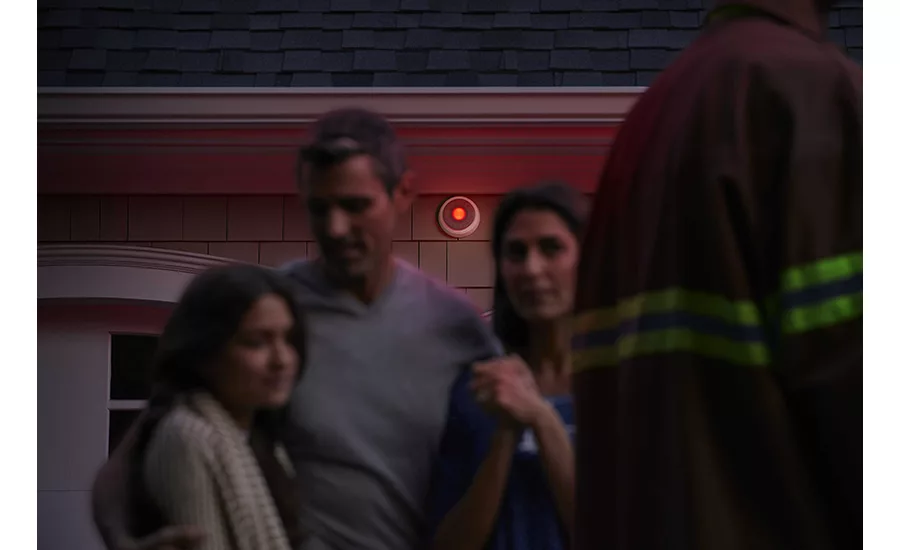
Earlier detection of a fire means earlier response — a key goal of the new UL 268 standard.
IMAGE COURTESY OF Resideo

Depending on the smoke detector model, Gentex is using either two optical sensors or multiple other technologies to meet new requirements.
IMAGE COURTESY OF Gentex
The latest version of the UL standard for smoke detectors is designed to help ensure that devices can both detect a wider variety of fires, and avoid generating a nuisance alarm when there is not an emergency. Many manufacturers are making key changes to their smoke detectors in order to meet the new requirements, and, as Brian Boisse, senior engineering manager for fire system manufacturer Mircom, explains, they will be prohibited from manufacturing devices that don’t meet the new requirements after June 30, 2021.
Beyond Version 7
Wireless smoke detectors have become increasingly popular for residential installations in recent years, notes Dave Christian, director of business development for Gentex Corporation.
More stringent supervision requirements are under consideration for a future version of the UL 268 smoke detector standard. Those responsible for these decisions are considering imposing a shorter time limit for a wireless smoke detector to report a fault, Christian says.
For now, though, there is no target release date for the next version of the standard.
New Requirements
The new requirements apply to standalone smoke detectors, or smoke alarms, as well as smoke detectors which are designed to be used as part of a complete life safety system. UL standard 217 applies to smoke alarms and UL standard 268 applies to the smoke detector system devices SDM readers most commonly install. The specific designation of the new 268 standard is Version 7.
Ultimately, where and how soon a dealer must install new devices that meet the standards will depend on which version of the National Fire Protection Association (NFPA) 72 standard an individual’s jurisdiction has adopted. That standard is typically updated every three years, but some jurisdictions take years to adopt the latest version.
According to SDM Columnist Roy Pollack, the current version of NFPA 72 doesn’t require smoke detectors to meet UL 268 Version 7. The next version of the NFPA standard will carry the year 2022 designation and committees are still in the process of deciding whether to require Version 7 detectors in the standard, observes Pollack, who works as the director of training and compliance for Comcast/Xfinity Home.
Fire Code Requirement Drives Opportunity
One fire code requirement is driving opportunity for dealers whose clients include hotels, nursing homes or other commercial locations that have sleeping quarters.
The 2010 and 2013 versions of the NFPA 72 standard introduced a requirement for new installations in those commercial locations that took effect in January 2014. New installations now require low-frequency sounding devices that use 520 Hz alert tones. The goal is to more easily awaken people who are hard of hearing or impaired by alcohol.
As Craig Summers of Potter Electric Signal explains, the “old way” of doing smoke detection in a hotel was to install standalone smoke detection devices in each sleeping room, but the new requirements are driving hotels to opt for complete fire systems.
With these systems, it’s easier to tell which room is in alarm, because sensors in modern systems report individually to the control panel. According to Summers, interest in the new approach has “mushroomed.”
Although Vaughan, Ontario-based Mircom doesn’t make smoke detectors, the company does offer systems that work with those detectors, and Boisse is quite knowledgeable about smoke detectors through his involvement in industry standards development.
One key new key requirement from Version 7 that Boisse points out is immunity from cooking nuisance alarms. Also known as the “hamburger test,” this requires smoke detectors to not generate an alarm signal from cooking nuisances that may create smoke signatures.
Another new requirement is the detection of fires involving polyurethane, a type of stuffing used in modern furniture. Two separate tests are required for this — one involving flaming polyurethane and the other involving smoldering polyurethane.
Looking for quick answers on security topics? Try Ask SDM, our new smart AI search tool. Ask SDM →
“With the increase in synthetic materials used within building spaces, fires simply burn and move faster than ever before, often with low smoke levels, and detectors need to be held to higher standards,” says Kris Cahill, offering management lead for Honeywell Building Technologies.
The flaming polyurethane test replaces a previous test that sought to confirm that a detector could identify a liquid heptane fire characterized by black smoke, Boisse notes.
Tests that were required for UL 268 Version 6 that will still be required under Version 7 include a burning paper test, a smoldering wood test and a test that involves flaming wood piled in a crib and a heater that generates smoke.
The new version of UL 268 requires all smoke detectors to be tested at a UL-approved laboratory. At press time in August, the majority of devices on the market still had not received final approval but were somewhere in the redesign and testing process, which is taking longer than anticipated because of the COVID-19 crisis.
“There’s a mad rush to get to UL and get through it,” says Craig Summers — vice president of sales for the fire and security division of St. Louis-based manufacturer Potter Electric Signal.
Passing the New Tests
Manufacturers are required to submit a description to UL of how their smoke detectors meet these testing requirements, Boisse explains.
Redesigning products to meet the new testing requirements typically involves changing the algorithm used to detect alarms, he adds. Some manufacturers may opt to put multiple sensors inside the device, and use logic to determine the specific conditions each sensor must detect to generate an alarm.
Photoelectric smoke detectors that use multiple wavelengths are one way to pass Revision 7 testing by adding further capabilities of determining smoke signatures.
“Usually multiple wavelengths are infrared and blue, which are at opposite ends of typical LED spectrums,” says Boisse. “[These different wavelengths] behave differently with different particle sizes and refractive indexes. This can help to determine smoke particle makeup as well as avoid false alarms from other nuisance sources such as water vapor, steam or aerosols.”
Zeeland, Mich.-based smoke detector manufacturer Gentex Corporation was most of the way through the Version 7 testing process when we talked to Dave Christian, Gentex director of business development, in August.
Gentex offers several different types of smoke detectors, including some that will meet Version 7 requirements by using two optical sensors, and others that will use multiple other technologies.
At press time, Honeywell also was in the process of obtaining Version 7 approval for some of its some detectors, while others had already received approval. Cahill says that Honeywell will offer both single sensor photoelectric detectors and multi-criteria detectors capable of meeting the new standards to lower false alarms and increase response time.
Want to know if a smoke detector has received UL 268 Version 7 approval? UL maintains a searchable database of approved products on the UL Product IQ website, www.ul.com/apps/product-iq.
Advances in Notification
Not all developments involving smoke detectors are code-driven. Some are the result of innovative thinking on the manufacturer’s part.
For example, smoke detectors are one of several types of devices from Resideo that have some innovative notification capabilities.
Devices with the new capabilities all have built-in sounders, and as Mark O’Keefe, Resideo senior product marketing manager, explains, if one device in the system goes into alarm, it triggers other devices throughout the system that have the new notification capability to sound their alarms.
Resideo calls this capability “One Go All Go” and, according to O’Keefe, the company has been adding the capability to more and more devices, including its combination smoke and carbon monoxide detector.
Dealers have embraced One Go All Go capability, O’Keefe notes.
“They can talk to customers and they’re able to sell more devices,” he says. A customer may want a combination detector for a child’s room, the master bedroom, downstairs and the basement.
Resideo’s combination smoke and carbon monoxide detector is one of several devices from the company that also has Alexa smart speaker capability built in. When an alarm is triggered, the Alexa technology sounds an appropriate alert.
Looking for a reprint of this article?
From high-res PDFs to custom plaques, order your copy today!