SDMmag logo
search
Go to Ask SDM AI
cart
facebook twitter linkedin youtube
  • Sign In
  • Create Account
  • Sign Out
  • My Account
SDMmag logo
  • NEWS
  • PRODUCTS
  • TOPICS
    • Access Control & Identification
    • Integration & Network Solutions
    • Life Safety & Fire Alarm
    • Monitoring
    • Smart Home
    • Trends & Industry Issues
    • Video Solutions
  • COLUMNS
    • Digital Shuffle
    • Editor's Angle
    • Insider News & Business
    • Integration Spotlight
    • Marketing Madmen
    • Security & the Law
    • Security Comings & Goings
    • Security Networkings
    • Technology @ Work
    • Technology Solutions & Skills
    • SIA Waypoints
    • Cybersecurity Chronicle
  • EXCLUSIVES
    • Annual Industry Forecast
    • Dealer of the Year
    • Project of the Year
    • SDM 100
    • State of the Market Series
    • Systems Integrator of the Year
    • Top Systems Integrator Report
    • TMA Excellence Awards
  • BLOG
  • MEDIA
    • Videos
    • Podcasts
    • Polls
    • White Papers
  • EVENTS
    • Industry Calendar
    • Webinars
  • MORE
    • Classified Ads
    • Newsletters
    • SDM Store
    • State of Security eBook
    • Sponsored Insights
  • BUYERS GUIDE
    • Buyers Guide
    • Take a Tour
  • EMAG
    • eMagazine
    • Archive Issues
    • Monitoring Today
    • Advertise
  • SIGN UP!
Life Safety & Fire AlarmStandards, Regulations & LegislationColumnsSecurity & the Law

Security & the Law

What Constitutes Confidential Information?


PRELIMINARY INJUNCTION
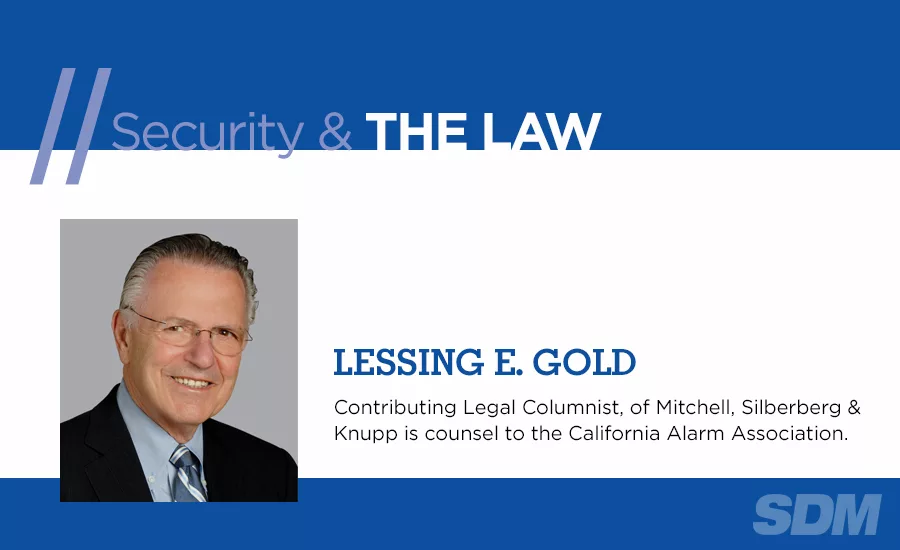
By Lessing E. Gold, Contributing writer
Security  Law 2019
February 3, 2020

A case involving a request for a preliminary injunction was recently heard in the United States District Court in Nebraska involving a question of what constitutes confidential information. An employee of a fire/ life safety company executed an “Acknowledgment and Receipt of Employee Handbook” in 2015, which defined confidential information as “information which is not generally known or readily ascertainable by the general public through proper means.”  

In September of 2018, the employee’s job responsibilities changed, giving the employee regular access to the employer’s network drive that allegedly contained confidential information and trade secrets. The employee was issued a company laptop, tablet, iPad and smartphone to complete the tasks assigned to him. In March 2019, the employee resigned and began working for another fire company. On his last day he returned the devices and submitted evidence that he destroyed USB devices potentially containing the employer’s information.

After his resignation the employee began soliciting his former employer’s customers. More than 40 customers switched to the new employer. The former employer conducted a forensic analysis of the employee’s electronic devices, revealing that eight USB devices had connected to the employee’s devices (which contained confidential customer information) between January and March of 2019. The employer filed action in April 2019 and filed a motion for a temporary restraining order and preliminary injunction in May. On May 13, the court denied the employer’s temporary restraining order because he was not able to show that the employee was in possession of, or had disclosed, any confidential information. Nevertheless, the parties were allowed to conduct limited discovery before the hearing on the employer’s motion for preliminary injunction.

Discovery included a forensic analysis of several of the new employer’s computers, revealing that in March 2019, the employee sent an email to one of the new employer’s employees with several attachments, including one called “New estimate for.xlsx” (the “New Estimate Form”). The previous employer alleged that the New Estimate Form was confidential because it included that employer’s costs, profit margins, exclusive pricing and other information that could be used to undercut the employer’s bids.  

At deposition, the employee admitted he forwarded the New Estimate Form to the new employer and that the form was on one of the USB devices he destroyed on his last day of work and he did not recall how he had access to the form after he left the previous employer.

The primary question when issuing a preliminary injunction is whether the balance of equities so favors the movant that justice requires the court to intervene to preserve the status quo until the merits are determined. The court looked at the threat to each of the parties’ rights that would result from granting or denying the injunction. 

The court indicated that the information in the New Estimate Form could be used to gain a competitive advantage. The evidence also showed that the employee possessed the New Estimate Form and shared it with the new employer’s employees. However, the court said the evidence did not demonstrate a threat of irreparable harm to the employer, other than the data contained in the New Estimate Form.  

Looking for quick answers on security topics? Try Ask SDM, our new smart AI search tool. Ask SDM →

The court therefore enjoined the employee from using the data in the New Estimate Form as the balance of harm weighs in favor of a preliminary injunction.  

The employer’s Motion for a Preliminary Injunction was granted: “During the pendency of this action and until its final hearing and determination, Employee, and any persons or entities acting in concert with him or on his behalf, are enjoined from directly or indirectly using, disclosing, or transmitting any data contained in the New Estimate Form or any information contained therein or derived therefrom.” 


READERS ASK

Q:  When can you sue a municipality, the fire department or the police for their negligence?

A: Normally, a municipality and its employees are protected by the doctrine of sovereign immunity. To get around sovereign immunity, there must ordinarily be a special relationship. Courts have held that a special relationship exists: 1. when the municipality violates a statutory duty enacted for the benefit of a particular class of person; 2. when it voluntarily assumes a duty that generates justifiable reliance by the person who benefits from the duty; or 3. when it assumes positive direction and control in the face of a known, blatant, and dangerous safety violation.


KEYWORDS: Fire safety life safety security dealer security industry

Share This Story

Looking for a reprint of this article?
From high-res PDFs to custom plaques, order your copy today!


Lessing E. Gold of Mitchell, Silberberg & Knupp is counsel to the California Alarm Association and a contributing legal columnist. He can be reached at sdm@bnpmedia.com.

Recommended Content

JOIN TODAY
to unlock your recommendations.

Already have an account? Sign In

  • SDM 100

    SDM 100: Top 100 Security Dealers of 2026

    The top 100 security dealers navigated a complex...
    SDM 100 Report
    By: Karyn Hodgson
  • Security camera

    State of the Market: Video Surveillance

    As video surveillance shifts from siloed systems to...
    State of the Market Series
    By: Brianna Wilson
  • 2026 Industry Forecast

    SDM 2026 INDUSTRY FORECAST

    Rapid technology advances meet shifting economic...
    Annual Industry Forecast
    By: Karyn Hodgson
Manage My Account
  • SDM Newsletters
  • Online Registration
  • eMagazine Subscriptions
  • Subscription Customer Service
  • Manage My Preferences

More Videos

Sponsored Content

Sponsored Content is a special paid section where industry companies provide high quality, objective, non-commercial content around topics of interest to the SDM audience. All Sponsored Content is supplied by the advertising company and any opinions expressed in this article are those of the author and not necessarily reflect the views of SDM or its parent company, BNP Media. Interested in participating in our Sponsored Content section? Contact your local rep!

close
  • Doctor examining child patient with mother present in medical clinic
    Sponsored byHID

    The Human Side of Hospital Security: How Modern Visitor Management Protects People First

Popular Stories

Video surveillance camera

Why Video Health Monitoring Is a ‘No Brainer’

ESA Board of Directors Q2 26 Elections

Electronic Security Association Announces 2026 Board of Directors Election Results

TMA & SDM Logos

Becklar, Elite & Puget Win 2026 TMA/SDM Monitoring Center Excellence Awards

SDM Dealer of the Year 2026 Promotion

Poll

What’s the most promising trend in the industry?

What’s the most promising trend in the industry?
View Results Poll Archive

Products

Physical Security Assessment Handbook An Insider’s Guide to Securing a Business

Physical Security Assessment Handbook An Insider’s Guide to Securing a Business

See More Products
SDM 100 2026 Rankings

Related Articles

  • Security Law

    Court Decision Sheds Light on Duty to Protect Personal Information

    See More
  • Security Law

    What to Know About Fast-Changing State Data Privacy Laws

    See More
  • Security  Law 2019

    What Is Illegal Search & Seizure in Dog Shooting Case

    See More
×

Be in the forefront of security intelligence when you receive SDM.

Join over 10,000+ professionals when you subscribe today.

SIGN UP TODAY!
  • RESOURCES
    • Advertise
    • Contact Us
    • Directories
    • Store
    • Want More
  • SIGN UP TODAY
    • Create Account
    • eMagazine
    • Newsletter
    • Customer Service
    • Manage Preferences
  • SERVICES
    • Marketing Services
    • Reprints
    • Market Research
    • List Rental
    • Survey/Respondent Access
  • STAY CONNECTED
    • LinkedIn
    • Facebook
    • YouTube
    • X (Twitter)
  • PRIVACY
    • PRIVACY POLICY
    • TERMS & CONDITIONS
    • DO NOT SELL MY PERSONAL INFORMATION
    • PRIVACY REQUEST
    • ACCESSIBILITY

Copyright ©2026. All Rights Reserved BNP Media, Inc. and BNP Media II, LLC.

Design, CMS, Hosting & Web Development :: ePublishing