Video Surveillance
Pushing AI Into the Spotlight
Pandemic requirements and mature technology make now the perfect time for integrators to get comfortable with artificial intelligence.
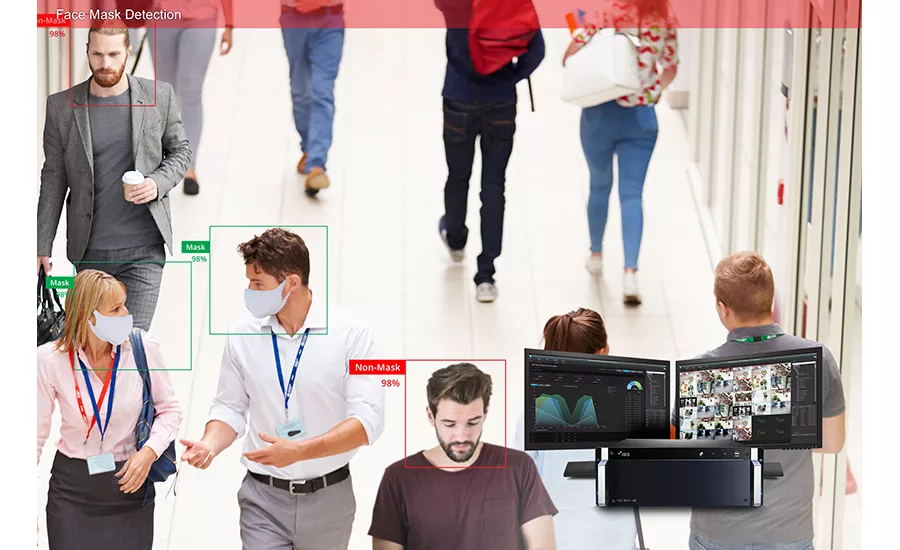
Face mask detection is one of the areas where AI has shone during the COVID-19 pandemic, thanks to solutions that are able to learn and adapt to emerging trends and needs.
IMAGE COURTESY OF IDIS
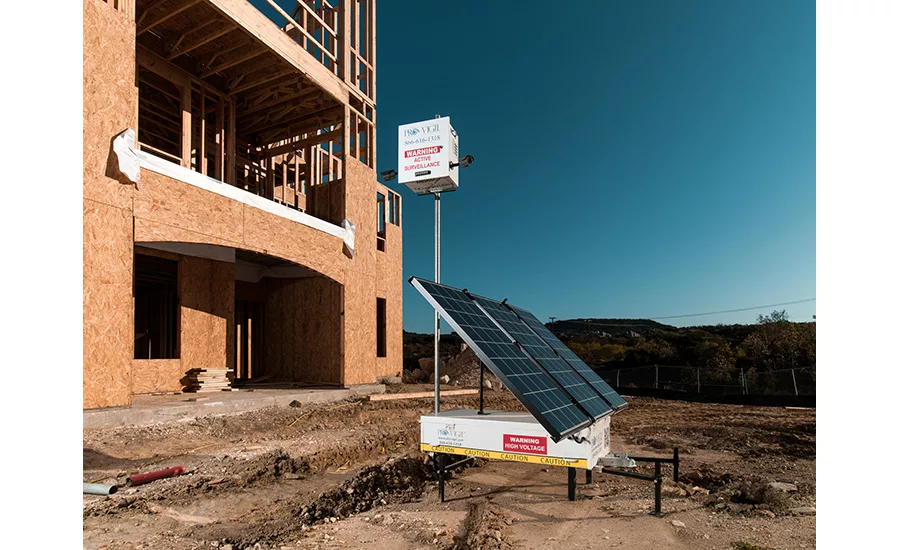
With gatherings limited and many companies moving to remote work environments as a result of the pandemic, the ability to monitor locations remotely with AI-enabled solutions has become more critical and has driven wider adoption of the technology.
IMAGE COURTESY OF PRO-VIGIL
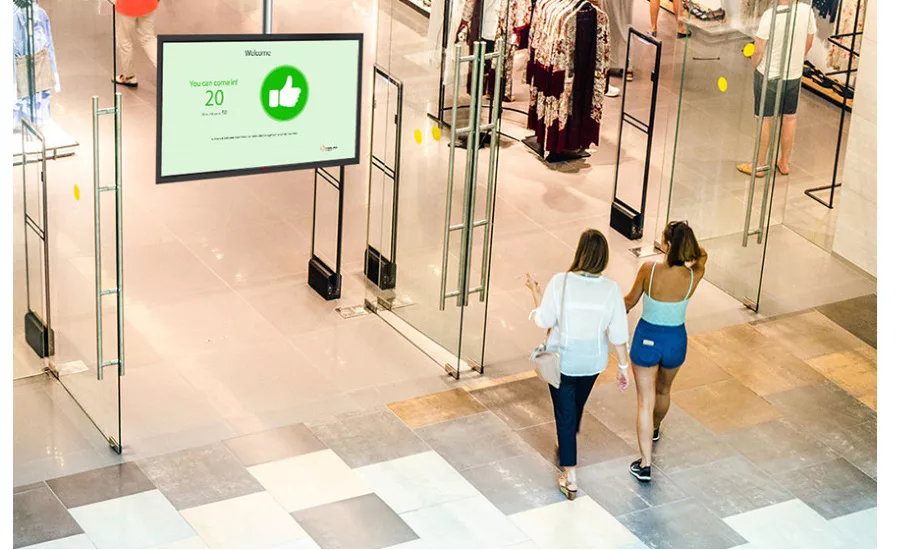
Video analytics and AI solutions have been helpful in allowing businesses to monitor and control occupancy related to limits imposed by local or state governments with the ability to quickly adjust the solution as those limits change.
IMAGE COURTESY OF HANWHA TECHWIN AMERICA
AFTER SEVERAL YEARS OF GROWTH AND EXPANSION in the security industry, particularly in the realm of video surveillance, artificial intelligence (AI) has taken a major leap in the last year, both in terms of the maturity of the technology and deployment.
“In the past year, that’s really when we’ve seen AI become much more mainstream,” says Aaron Saks, product and technical manager, Hanwha Techwin America, Teaneck, N.J. “Prior to a year or so ago, it would have been a specialized product. It would have needed big servers, big processors, all of that. Whereas now, AI is being put into more standard products and is being pushed on the edge, where it’s in a camera.”
The main driver behind this trend is simply the fact that the technology has grown more dependable as it has evolved.
“As the solutions have become more accurate, the trust has gone up,” says Srinath Kalluri, founder and CEO, Oyla, San Carlos, Calif. “[They] have been promising a lot from the AI for many, many years, and it has kind of fallen flat on its face in the past. But over the last year, year and a half, it has really started to now get trusted more and more as [being able] to make successful deployments.”
While overall familiarity and comfort with the technology has driven some of the growth, another key factor has been the global pandemic that has wreaked havoc on nearly every aspect of life since early 2020.
“It’s tough to talk about the last year and a half without talking about COVID-19, but I think the pandemic showed us that data-driven solutions are the future,” says Paul Garms, director of regional marketing, North America, Bosch Security and Safety Systems, Fairport, N.Y. “AI will become more important to facilitate those solutions. Frankly, in many cases, we saw that customers already had some sort of infrastructure to support these types of solutions, and that just an additional AI software piece could be added to extract that information.”
Trying to Cool Down a Hot Issue
For whatever reason, the wearing of a mask — something intended to slow the spread of COVID-19 — has become a politically charged issue. As such, it has become a difficult thing for store owners to enforce, especially when an employee is responsible for approaching those who enter without a mask, says Reza Rasool of Real Networks.
“Early on in the pandemic, one of the areas we put emphasis on was developing a simple AI solution for mask detection, and we gave it free to the market,” he says.
The SAFR solution is implemented in kiosk form using either a phone or tablet, and detects whether people walking by are wearing a mask. The solution can then issue an audio alert to thank customers for wearing a mask or to tell someone to stop and put on a mask before entering the premises.
“That allows machine learning to do mask enforcement,” he says. “Or you could operate the app in monitoring mode to count the number of people walking by and monitor mask compliance because you want to generate a report. We aggregate all of that data from these terminals into a heat map, so you can see the level of mask compliance in the neighborhood.”
Opportunity in the Age of COVID-19
Because of its maturity, many looked to AI early on as a tool for monitoring and enforcing the various mandates and restrictions designed to prevent the spread of the novel coronavirus.
Looking for quick answers on security topics? Try Ask SDM, our new smart AI search tool. Ask SDM →
“When COVID-19 hit, right away, people wanted to be able to detect if someone was not wearing a face mask — enter AI,” Saks says. “Once you have that platform in place, the processing power and the deep learning capability, we’re able to update an AI product and tell it what we’re looking for now.
“For example, face mask is a subcategory of a person and a subcategory of a face. Is that attribute there? And we were able to pivot very quickly to add that capability. I think what we're going to start seeing is companies being able to shift and react a lot quicker and develop customized solutions,” he adds.
“I think we’re at the point now where we’re going to have the ability for cameras to become smarter, and even autonomous,” says Reza Rasool, CTO, Real Networks, parent company of SAFR, Seattle, Wash. “In fact, we’ve now reached the point where the full SAFR stack can run inside a camera. That’s not only detection; it’s recognition, plus the database and identities can be inside the camera. This means the camera can operate autonomously and control a door or do whatever a camera needs to do locally, without having to have a back room full of processing, or even be connected in real time to the cloud.”
By early to middle of 2020, it was evident that heads of security and systems integrators were realizing the value of deep learning-based analytics, and Jason Burrows, regional sales director, IDIS America, Austin, Texas, expects that trend to continue through 2021 and beyond.
“With many companies working remotely now, some organizations are now configuring previously unused onboard analytics to alert security managers about intrusions or other incidents while they’re away from the control room,” he says. “They’re looking to leverage the benefits of AI’s accuracy and reliability as well as glean more business intelligence.”
Combined with people counting and heat mapping analytics, AI can easily work with existing cameras to provide valuable information not only on occupancy but also on social distancing and cleaning practices, which have become more critical in the last year-plus.
“When you think about the cleanliness of work environments, we can see which areas have the highest degree of focus, where people are spending more time congregating in those areas for more time,” says Nigel Waterton, chief revenue officer, Arcules, Irvine, Calif. “So maybe we need to spend more time cleaning those and disinfecting those areas, so it reduces areas of transmission.”
Training AI for Creative Uses
Two or three years ago, one of the hot topics in security was “big data.” Today that data gathered from disparate sources is being applied to train AI solutions to look for specific things and perform specific actions in response to various events and situations. What’s helped this along is the ability to offload that processing to the camera, rather than having to transmit it to the backend or cloud for analysis, says Hanwha Techwin America’s Aaron Saks.
“What we’re seeing is more and more devices. We’ve got companies putting in vape detection sensors in schools, and you have sensors and alarm systems. The idea is being able to tie them together to intelligently look for changes,” he says. “I’ve even heard that some hard drive manufacturers are adding some AI algorithms to look for failures in the drive or to store metadata about the video in a different part of the drive.”
Open solutions that allow installed cameras and other technologies are going to be key to finding even more uses for AI that haven’t even been thought of yet.
“The last thing you want is to have to put in a specialized camera for a specific function or sensor, as opposed to being able to load in software that has that intelligence built into it,” Saks says. “There are a lot of developers writing apps for new use cases, so when looking at products you have to ask whether it supports adding third party software or adding additional features down the road.”
Video & Beyond
While AI has been used across a range of security technologies, it has in large part been used mainly for video surveillance so far.
“Video is definitely front and center, especially in this industry,” says Sean Lawlor, lead data scientist, Genetec, Montreal. “It’s a great source of unstructured data, but it really takes a human to make sense of it; just having video recordings is kind of useless, generally.”
Unfortunately, the volume of information generated by video makes it difficult to extract relevant data that can help improve security. Video analytics, which to some extent are the forebears of AI, help, but the technologies behind AI do a much better job, particularly over time.
“With machine vision, we can understand what’s happening in the video, and the nature of the neural networks is that they get better and better and more accurate as more data is processed,” says Brian Baker, vice president, Americas, Calipsa, Ashburn, Va. “The neural networks that are really learning engines that sit underneath AI are getting better and getting more accurate. We’re classifying people better. We’re classifying vehicles better. It makes any one of a number of technologies smarter — anything from video to … business intelligence because it can parse through so much more data than the human can.”
In the age of the pandemic, “touchless” has become an important consideration for any technology that is deployed, particularly in traditionally high-volume locations.
“People don’t want to touch a communal surface like a fingerprint reader at the airport to get to the Fast Pass, or put their face up against an iris reader where somebody else has just been moments before,” Rasool says. “I can’t think of anything scarier when you’re trying to keep social distance and then you subject yourself to that sort of surface.”
As a result, access control and intercom-type products based on facial recognition and other AI-enabled solutions have emerged.
“COVID-19 has heightened the need for awareness, both for security purposes and safety,” says Brian Lohse, general manager, Alarm.com, Fairfax, Va. “Research shows a 60 percent increase in home deliveries during the pandemic, turning our front doors into even greater hotbeds of activity. The AI on our video doorbell makes home deliveries and visits safer for all with its touch-free capability.”
Additionally, other security technologies, ranging from more traditional to emerging solutions, are also ripe for AI deployments, Baker says.
“AI is being used across all areas of security, from virtual guarding to drones,” he says. “You’ll now see drones using AI, whether with first responders for law enforcement, or just general drone security monitoring. We’re seeing access control, crowd management, body cam footage processing in law enforcement ... it’s everywhere.”
Advice for Integrators Working With AI (Or Thinking About It)
Whether you’re working with AI currently, preparing to work with it or sitting back and watching how the technology develops, there are a lot of things to keep in mind. To help you wrap your head around AI, SDM asked industry insiders what advice they would give integrators about these solutions.
“Be the first integrator in your region to make a firm business commitment to learn about and offer new AI solutions and capabilities. It will pay dividends. This is the future of physical security as we continue to converge with business intelligence and IT applications. New AI-driven solutions and technologies present the perfect vehicle to expand and grow business. Jump on this fast moving train now while it’s in front of you, or you may find yourself on a later train that takes you out of town.” — Bill Brennan, president, Panasonic i-PRO, Houston.
“No technology is a magic box. One of the challenges is that in the past people have sold AI as a magic box. AI also comes in lots of different flavors. It also has to be deployed correctly. Understanding customers’ problems and deploying the appropriate solution for that problem is a very key part of it. We do not consider any of these things magic boxes though.” — Srinath Kalluri, Oyla.
“I would advise integrators to be careful. Everyone is using the word AI, but you have to really dig into what it means so you can apply the technology effectively. It’s important to be clear on what the customer’s expectations are and what you’re trying to achieve before identifying the right AI for the job.” — Jeremy White, Pro-Vigil.
AI Today & Tomorrow
Education and training on AI is going to be critical to ensure continued adoption and successful deployment. The biggest challenge, says Jammy DeSousa, senior product manager, security products, building technologies and solutions, Johnson Controls, Milwaukee, is that some users — and some security integrators — don’t understand the requirements for AI applications.
“Each AI engine should be pre-trained and for a purpose-built application, such as AI that has been purpose-built for a retail application or AI that has been purpose-built for people counting,” he says. “The opportunity is now, and integrators should consider adding AI to their portfolio of services to create safe and secure workplaces for their customers.”
It’s never a good time to have a pandemic, and as unfortunate as the emergence and spread of COVID-19 has been, AI has improved businesses’ ability to respond, Garms says.
“All the AI technology has facilitated some of the solutions,” he says. “Had this happened 10 years ago, we wouldn’t necessarily have had these analytics available to facilitate it. So in that respect, I think we’ve benefited from where we are in terms of AI and other video [technology].”
According to a survey conducted by San Antonio-based Pro-Vigil, 20 percent of respondents reported an increase in physical security incidents since the start of the pandemic, and one-third believe that 2021 will bring another increase in these types of incidents. While the future of COVID-19 is uncertain, the performance of AI in the last year provides hope that the technology is ready to deliver on its full promise and help address these concerns.
“AI is still in its infancy, which is good news for a lot of security integrators because it means you haven’t missed the boat,” says Jeremy White, founder, Pro-Vigil. “Some of the best AI was delivered in 2020. Integrators now have an opportunity to present their customers with AI solutions that match their specific wants, needs and concerns.”
Looking for a reprint of this article?
From high-res PDFs to custom plaques, order your copy today!