Countless Service Calls the Result of Poor Cable Handling and Terminations
“Birth, School, Work, Death.” – One great line from the Godfathers.
During one on my expeditions in the family truckster with my daughter, she pointed out that a group of students on a Chicago street corner were wearing the same clothing — i.e., white shirts and black pants or skirts.
This brought me back to my high school days and the uniforms I wore at low-end jobs in restaurants and gas stations back in the 1970s. I always hated to wear them; for some reason I truly detested wearing a baseball-style cap at the Amoco station on the Northwest Tollway in Chicago, where I labored for four successive summers and Christmas breaks during high school and college. As soon as the boss left for the day the hat got tossed into my 1969 Ford Galaxie’s back seat. This was during the days when your gasoline had to be delivered to your vehicle by a trained and uniformed attendant in Illinois…no self-service. So I alternately froze or baked in the Chicago outdoors, all the time making big-boy money thanks to the Teamsters Union Local 705. Of course I blew the money, but that’s another story.
The concept of putting employees in uniforms is to provide a similar look to each employee, with no alternative colors or fabrics being worn. Customers can visually locate employees and engage them for business purposes. In a similar manner network devices such as switches and IP cameras need uniform connectivity for proper functionality. If the cable isn’t right, the devices cannot communicate.
What’s important in our industry as IP continues its inevitable march into our systems is the uniformity of the UTP cable and connectors that are typically used to connect IP cameras and devices to network switches. We aren’t just banging 12VDC down a wire pair or opening/closing a circuit like we did with older analog systems. Now we need and expect our cables to carry high-bandwidth IP video along with providing PoE to remote devices. So the cables and connectors need to be uniformly installed and terminated.
I believe there have been countless service calls resulting from poor cable handling and terminations. The following are common problems that can happen when technicians are working with UTP Cat5e/Cat6 cables, and some tips for avoiding them.
Complete Reversal of the Conductors
Looking for quick answers on security topics? Try Ask SDM, our new smart AI search tool. Ask SDM →
In most cases RJ45 plugs should be wired to the EIA/TIA 568-B conductor code.
The most common mistake is the complete reversal of the conductors. The easiest way to avoid this error is to compare the newly installed RJ45 plug to a known-good one, such as a purchased patch cord. The connector bodies are clear for a reason; technicians should verify the proper locations of the conductors before applying the finishing crimp. Technicians should make a habit of always holding the connector in the same orientation; I go with the flat side up and the spring clip down. If a connector’s conductors have been reversed and the crimp has been applied, that connector needs to be cut off and replaced.
Excessive Untwisting of the Pairs During Termination
When installing RJ45 jacks it is a common tendency to untwist too much of the pairs, as this makes the individual conductors easier to handle and terminate.
Most manufacturers recommend an absolute minimum of the twisting be undone when terminating UTP, whether it’s the male RJ45 or the female jacks. Ideally the untwisted conductors should exist only within the connector and not extend past the crimping bar/end of the connector body. Leaving untwisted pairs outside the RJ45 jack will increase crosstalk between the pairs and degrade performance.
Nicking the Conductors
When removing the jacket of a UTP Cat5e/Cat6 cable it is tempting to use a set of diagonal cutters or other metallic tool to “grip and strip” the outer jacket. Using this method can cause the “skinning” of the inner jackets of the conductors and/or the nicking or cutting of the thin 24 gauge solid copper conductors. A nicked conductor may well break if flexed or exposed to temperature extremes.
The answer: don’t use side cutters. There are two proper ways to remove the outer jacket of a Cat5e/Cat6 cable. The first is to use the pull string which is included within most cables. Use cable scissors to make a small (1/8 to 1/4-in.) notch cut in the outer jacket, locate the pull string in the freshly cut notch, and gently pull. The outer jacket will split open. Once enough of the inner pairs are exposed, cut of the excess jacket and proceed with the termination.
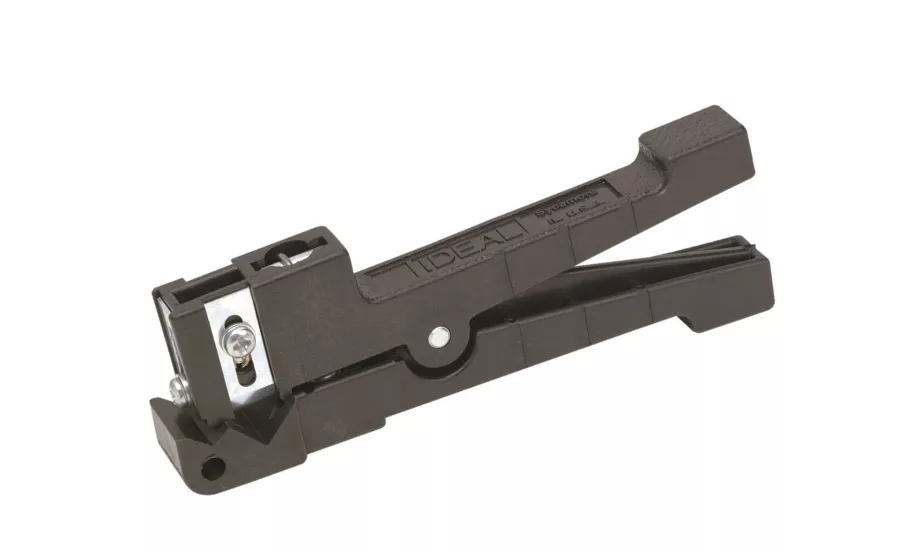
The other method for jacket removal is to use a specific jacket removal tool, such as the Ideal 45-165.
This tool has three blades which are adjustable for the depth they will cut, and it is designed to “score” the cable jacket, not cut all the way through it. The trick when using this method is that the tool is spring-loaded to clamp onto the outer jacket of the cable. First, adjust the chosen blade to the proper depth of cut, something like 1/8-in. Determine how much outer jacket you want to remove and place the tool at that length, letting the spring clamp the cable. Rotate the tool two to three times all the way around the cable and remove the tool. Using hands only (no tools) gently work the cable jacket at the score line until it separates and can be gently pulled off the cable.
Tie Wrap Bundling of UTP cables
Technicians need to be careful when securing UTP cables with tie wraps. There are two issues to be aware of. First, tie wraps that are excessively tight (perhaps tightened with a gun) will compress the internal connectors, increasing crosstalk and interference between the pairs. The second issue is the bundling of multiple UTP cables with tie wraps, which can also increase interference issues. This problem can also occur when using beam clamps and/or J hooks to secure bundles of cables. When using tie wraps the basic rule is that the cable(s) should be loose under the tie wrap, and the technician should be able to slide the cable(s) back and forth under the tie wrap or within the hanging apparatus. One way to assure this is to place a pencil or similar sized rod along with the cable under the tie wrap to be tightened. Tighten the tie wrap and pull out the pencil; the cable is now secured without excessive tie wrap pressure.
Excessive Pull Strength and Rough Handling
UTP Cat5e/Cat6 cables are complex and fragile cable types compared with the 22-4, 18-2 and coax types of cables that have historically been used in our industry. Technicians need to be careful during cable installation that the “pull strength rating” of the cable isn’t exceeded. In most cases typical Cat5e/Cat6 cable has maximum pull strength of 25 pounds, which can be easily exceeded if technicians are not careful. During a cable installation if a technician senses that the cable is binding or otherwise being pulled with excessive strength, the pull should be stopped, if possible, and the binding problem resolved, either by re-routing the cable using cable pulling lube in conduits or by some other method.
Cat5e/Cat6 cables are designed to carry high-bandwidth Ethernet and network communications. Every part of the cable from the individual conductors to the outside jacket is specially designed to provide maximum communication performance. Rough handling of a category cable by repeated bending at a single point, skinning off the outer jacket and other manhandling can result in a cable that either has broken internal conductors or poor performance after installation.
If we do it right, terminated cables should provide maximum performance for the foreseeable future. Just like the Blue Oyster Cult records I bought with my gas station cash. And I still have a record player.
A moment of silence for the departed Gary Richrath of REO Speedwagon, one of the Midwest’s greatest guitar slingers of the past century. Keep pushin’ on…
Looking for a reprint of this article?
From high-res PDFs to custom plaques, order your copy today!