SDM Exclusive
SDM 2025 Dealer of the Year: Charting Their Own Path
December 1, 2025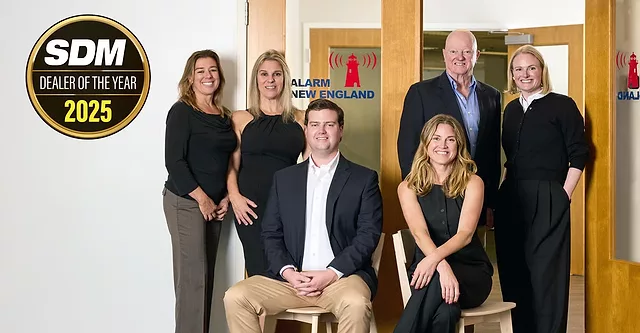
SDM Exclusive
SDM 2025 Dealer of the Year: Charting Their Own Path
December 1, 2025The Alarm New England family and leadership team (from left: Dena Domey, Connie Mastoras, James Curtiss, Alexandra Thompson, Doug Curtiss, Sierra Curtiss).
When a 53-year-old security dealer reached the inevitable succession planning stage, the company founder and his three adult children chose a somewhat unconventional solution.
Founded in Connecticut in 1972 by Doug Curtiss, Sonitrol New England, and its residential/SMB division, Alarm New England, had grown to five offices across Connecticut, Massachusetts and Rhode Island, and ranked No. 32 on the 2024 SDM 100, with $1,133,870 in RMR. Like many similar alarm companies, this family business had a second generation ready and willing to take over, a solid reputation in the industry, and a great company culture — the type of business a company like Pye-Barker looks to acquire, which is exactly what happened.
But unlike many similar transactions, the Curtiss family decided to keep its non-Sonitrol business and transform it into something the next generation could rebuild even stronger. With a new Entrepreneurial Operating System (EOS), which was the driving force behind this decision, a new CRM, a new headquarters facility and a new outlook, Alarm New England has found its niche.
Today, under the leadership of Alexandra Thompson (Doug Curtiss’s daughter), this now mostly women-led team is an established company with a start-up feel. By hyper-focusing on selling its preferred cloud-based platform to residential and small commercial customers, embracing its four core values (make the world a better place; get stuff done; do the right thing; and be humbly confident), and implementing a highly successful lead-gen campaign, Alarm New England has more than made up for any lost revenue from the sale of its large commercial business, and is poised to grow its RMR by double digits this year. Read on to learn more about why this company is SDM’s choice for the 2025 Dealer of the Year.
Podcast With Alexandra Thompson
In this podcast, SDM speaks with 2025 Dealer of the Year Alarm New England’s president, Alexandra Thompson, about her path to second generation leadership, the impact of the sale of their Sonitrol division to Pye-Barker, and their new path in the residential and SMB market.
Legacy of Success
Doug Curtiss says he would “rather be lucky than smart.” And luck was how he started in the security business. “I come from a family of bankers,” he says. “My father and grandfather both spent 35 years at the same bank. I thought I was going to be a banker. But, when I was graduating from college, I wasn’t very interested in those banks, and they weren’t interested in me. I had a double major in political science and economics. I was ready to take on the world, but I didn’t have a job.”
The night before graduation in 1970, Curtiss happened to attend a gathering at a professor’s house and saw his roommate’s father standing outside by the trunk of his car, playing a recording for fellow parents. That father was Russ MacDonnell Sr., and he was playing the now well-known “Roger, we got ’em” recording of a break-in being thwarted by the then-new Sonitrol audio detection technology. “He asked me what I was doing after college,” Curtiss recalls. “I said, ‘I don’t have a job yet,’ and he said, ‘If you show up at my office at 9:00 a.m. Monday morning in Stamford, you can work with our installation techs. I will pay you minimum wage, and you can live in my basement.’”
This fortuitous meeting was the start of a long career for Curtiss in the alarm industry. Just a few years later, he opened his own Sonitrol franchise with three employees and four customers.
“The reason we survived as a new business was that Sonitrol was like a religion: you ate it, breathed it and talked to everyone you could, even at your son’s graduation,” Curtiss says. “It kept us very focused on a single proposition for customers, which was verification and apprehension — a single message you could repeat over and over again and not get distracted by other things.”
Looking for quick answers on security topics? Try Ask SDM, our new smart AI search tool. Ask SDM →
Looking for a reprint of this article?
From high-res PDFs to custom plaques, order your copy today!
By the early 1980s, the Sonitrol business was doing very well, and some of his customers were starting to ask Curtiss if he could also secure their homes. Since Sonitrol is strictly a commercial enterprise, Curtiss decided to form a residential arm of the business called Alarm New England.
For the next 40 years or so, both businesses kept growing. Curtiss himself was very involved in the Sonitrol world, serving two terms as president of the Sonitrol National Dealers Association, and becoming one of four founding members of Partnership for Priority Verified Alarm Response (PPVAR).
In 2019, after 47 years of operating its own UL-listed central station, the company made the decision to outsource to a third-party company. Curtiss’s former roommate, Russ MacDonnell Jr., had gone on to co-found Rapid Response Monitoring Services, bringing the connection full circle as Alarm New England chose Rapid to be its central station partner.
This transition wasn’t as smooth as Curtiss and his daughter, Alexandra Thompson — who had, by this time, joined the business — had hoped. “When we transitioned to Rapid, for the first 90 days, we would have customers call and complain about these new passwords they were being asked for,” Curtiss recalls. It turns out, customers were used to familiar central station employees knowing them by name and just resetting the alarms for them.
They weren’t complaining about Rapid’s services, though. They were complaining because now they were being held to higher standards, Thompson says. “We underestimated how disturbing the transition would be to our customers. Doug made this decision, and it was the right decision because we couldn’t focus on innovating and making the company better if we were also running a central station. But the customers were upset.
“We went from getting a normal amount of calls to hundreds of phone calls a day asking, ‘Why are you calling me this way? Why aren’t you taking my password?’ They were upset because we hadn’t been holding them to the standards we should have been,” Thompson says.
The transition had exposed weaknesses in their own customer service approach. Thompson and Curtiss took it as a sign to rebuild those parts of the organization. “We started rebuilding customer service teams and rewrote processes,” Thompson says. “Over the next couple of years, we touched most parts of the business to innovate and improve how we do things.” Today, the company employs around nine dedicated customer experience professionals that answer 96% of calls in person in under two minutes.
The transition to Rapid Response also proved to be another of those “better lucky than smart” situations, Curtiss says. “A year later, COVID hit, and thank God we went to Rapid,” he says. “They had the scale and the people to do 100% in-office monitoring.” That is something Curtiss strongly believes in, and it would have been difficult to impossible on their own, he says. “[Working from home] doesn’t pass the ‘if the customer knew’ test,” he adds.
The monitoring outsource experience wasn’t the first time the company had taken a hard look at its business operations. The ‘if the customer knew’ test is something Curtiss realized much earlier in the late 1980s, when the company did a voice-of-the-customer survey. “We had been engineering the company from the inside out, doing what made sense for us,” he recalls. “During the recession in 1988, we hired a firm to send out a survey to about 1,000 customers, mostly commercial, but some residential as well. We asked a whole bunch of questions about what we meant to them. I expected them to say, ‘You call the police quickly if we have a break-in.’ But the answers surprised the heck out of me.
“The first big one was, ‘If we call your office, we want a live human to pick up, not voicemail.’ The second was, ‘If you schedule a technician, we want them to show up when they say they will.’ And the third was, ‘We want them to have the tools to fix it right the first time,’” Curtiss recalls.
“We looked at this operation that we were pretty proud of, and we had designed a system where calls would come into the central station, and they would forward to the tech department, where it would go to voicemail,” he says. “We had engineered that from the inside out. It made sense to us, but it was a failure to the customer. And it went downhill from there. We would assign service calls at the beginning of the day, and we found out the technicians would go to the back room and trade off calls, which meant they wouldn’t get there on time. … We realized we were really in the service dispatch business more than the police dispatch business, so we had better get that right. The guiding principle should be, ‘What would the customer say if they really knew what was going on behind the scenes?”
Curtiss concludes, “The outside-in thinking has probably been one of the most important and useful philosophies in our business.”
The reason we survived as a new business was that Sonitrol was like a religion: you ate it, breathed it and talked to everyone you could, even at your son’s graduation. It kept us very focused on a single proposition for customers, which was verification and apprehension — a single message you could repeat over and over again and not get distracted by other things.
DIY Lessons
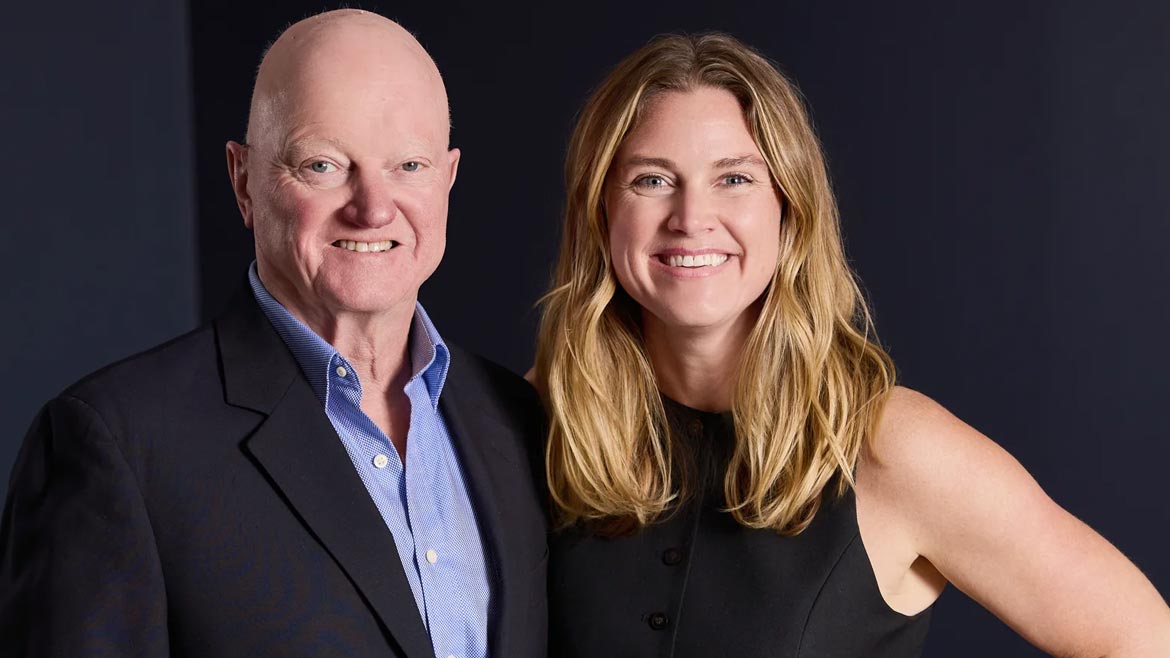
In 2015, Alexandra Thompson got a call from her father, Doug Curtiss, with a business proposition: come back to work for Alarm New England and build your own startup DIY business in Boston.
“Basically, I recruited her back into the business to start a DIY division,” Curtiss says. “It was not a good day for me when Alexandra came to me and said, ‘Dad, I have to move on; this is not enough for me.’ I didn’t plan for that. I watched her make a name for herself outside the industry working for the startup, HubSpot, and also a tech research firm selling $100,000 subscriptions over the phone. I looked at that and said, ‘If you can sell that over the phone, you could do that as a start-up DIY business, separate from Alarm New England.’”
Thompson was intrigued. “At that point, I had been in individual sales for 10 years and was ready for something new,” she says. “I didn’t know if I should go into leadership at HubSpot or do something different.”
Curtiss said he would fund it, but she would be responsible for building a new sales channel for the company centered around DIY sales.
“We worked in downtown Boston and started by walking into a tiny cubicle and figuring out what product we were going to sell,” Thompson recalls. “From there, we started building it out step by step.”
Her first employee was Connie Mastoras, now in charge of operations.
“That standalone sales engine has generated in the past decade $350,000 a month in RMR,” Thompson says. “It was very successful.”
Despite that, they only operated the DIY division for under two years before shutting it down, when they realized more customers were asking them to install it rather than self-installing.
“What we realized was, when we started to offer a professional install option, everyone selected that,” Curtiss recalls. “There are some people that mow their own lawn and others that have a mowing service. We decided the latter was a big enough market for us that we didn’t need to do DIY anymore.”
Like many others in the industry, Curtiss believes that DIY has expanded the alarm market and customer expectations about the features and services.
In addition to being the catalyst for Thompson to come back to the family business, it was also a critical learning experience that is now helping the company in its new venture. “We learned how to sell and support people over the phone and how to remotely troubleshoot our system, which, over time, made us a much better customer service organization,” she says. “It was valuable time spent.”
‘Splitting the Baby’
By the time COVID had receded and business was back to normal, Thompson — who had started in the business out of college, left and moved to Boston for several years, then came back to the fold via a short-lived DIY division — was ready, willing and excited to take over the helm as president.
Thompson’s two siblings, James and Sierra Curtiss, also wanted to be involved in the company, but not in leadership positions. Doug Curtiss wasn’t ready to retire, but knew the time had come to think about what the next 50 years should look like for the company.
Thompson had recently learned about a new EOS through members of her Sonitrol Achievers Group, a small group of top-producing Sonitrol Dealers that includes past SDM Dealers of the Year Bates Security and Kimberlite-Sonitrol. “Jeremy and Brian [Bates] had started running this system about a year prior and had been telling me to read the book, Traction EOS,” Thompson recalls.
So, before a group meeting in the winter of 2023, Thompson flew into Atlanta a day early and spent the entire day reading the book. “My father and I didn’t go to business school; we are learn-on-the-job leaders,” she says. “My entire career prior to working here was inside sales. For me to see so plainly laid out in this book the best practices garnered from big business was incredible. It was like a business-in-a-box. I had a major experience reading that book. I thought, ‘We have to do this. We are running this company on grit and energy all these years, and it is time for us to really put in place some processes and empower our team.’”
Curtiss and Thompson started working with the EOS framework in the spring of 2023, and one of the first things they were asked to evaluate was, “What we want to be the best in the world at,” Thompson says.
“The EOS system is designed specifically for companies our size to be more mature in the way they structure and operate a business,” Curtiss says. “Only partly-tongue-in-cheek, I will say my management style that got me through those first 50 years was to say, ‘Hey, guys, this is a great idea; let’s charge over that hill over there!’ At the scale we had now, we had to adopt something a little more formal as a philosophy.”
In the process of that initial evaluation, it became clear that the two sides of their business required vastly different resources and attention: one, a large-scale integration business (Sonitrol) and the other a residential/SMB business (Alarm New England), Curtiss says.
During this same time frame, Curtiss and Thompson attended a compelling presentation from one of their vendor partners, Alarm.com. “They described a good business as an RMR machine,” Curtiss says. “The front end is scarce resources — time, money, manpower. Feed it into the machine and out comes RMR dollars,” Curtiss explains. “It described something repeatable, transaction-oriented and driven by software. This was a different kind of relationship with the customer, and it needed different things from us than the Sonitrol side of the business.”
The right opportunity to sell the Sonitrol side of the business came the following year. Curtiss describes the November 2024 acquisition by Pye-Barker this way: “Along comes a company, Pye-Barker, and their goal was to consolidate in fire alarm and large commercial. Sonitrol was a great fit for them, and they had acquired other similar companies. Pye-Barker has a unique way of enabling employees through stock ownership to empower them. It was very emotional to part with something I spent 50 years of my life growing. But, on the other hand, Alexandra and my other kids were excelling in the small business and residential marketplace and expressed a preference for that. This would allow us to focus on that and be better at what we do best.”
Thompson adds, “I thought, ‘If I am going to be the leader of this company, [the residential and small commercial] is what I am good at. That is what led to selling Sonitrol to Pye-Barker and to the whole process of ‘splitting the baby.’”
We think there is so much opportunity in this business, and we want to go out there and get it for ourselves. The future is so bright.
The New Faces of Leadership
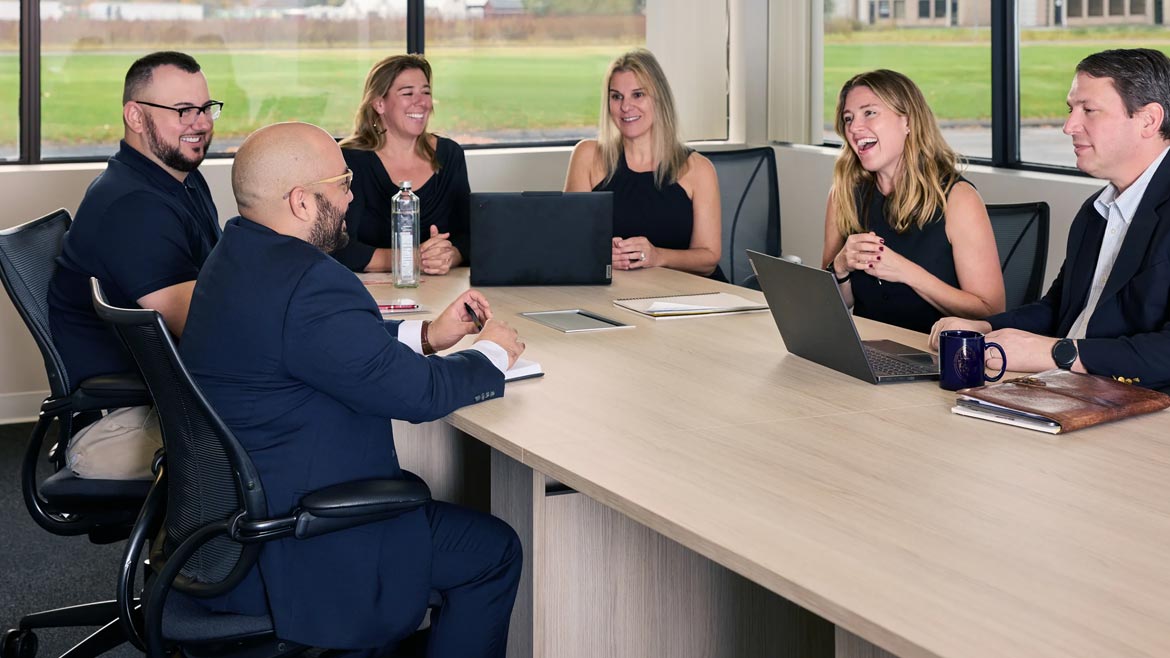
Not every family business is lucky enough to have a next generation willing to step up. Of his three kids, Doug Curtiss has all three involved in the business, with his middle daughter, Alexandra Thompson, now in place as the company president.
Along with Connie Mastoras, who had followed her from the DIY division, and Dena Domey, who joined when the Pye-Barker sale was completed, the three women make up the bulk of the top leadership team, along with founder Doug Curtiss. “I am involved in our management team of four people,” Curtiss says. “We meet weekly for a couple of hours. I am fully engaged but not in charge of what is happening on a daily basis.”
Domey says there are two keys to the leadership style the three women bring to the table. “The first is speed. The three of us work incredibly fast together. There isn’t a lot of overthinking,” she says. “The second is a lot of humility. When we make mistakes, we look at each other and say, ‘Well, we got that wrong,’ and we move on. Being able to be fast and humble at the same time is definitely cool and an experience I haven’t always had.”
Mastoras calls her decision to come to work with Alexandra years ago one of the best decisions she ever made. “The pace and the brainstorming and strategies have been really moving full speed ahead. … I love being on a women-led team,” she says. “Speaking with my daughter’s friends, when they hear what I do, it inspires them. Women can do anything. I love being in this position and do also think it brings new things to the industry.”
Thompson’s goal is to bring more diversity into the company and the industry. “When I went out to hire my No. 2 in our Boston start-up, I didn’t look inside the industry,” she says. “I found someone who had been working at a car dealership, but was really good at her job, and a young woman. All my sales reps are from outside the industry, and they are young.”
She describes a recent experience at an Alarm.com leadership conference, where, in the past, it has looked like the typical security industry makeup, but, this year, they focused on the next generation leaders. “Up on that stage were people in their 20s, 30s and 40s, women, people of color, and I realized that it now looked more like a tech company in Boston [than a typical security company],” she says. “I hope our industry is becoming more diverse. My leadership is three women and Doug, and we are a very successful leadership team.”
Rebuilding & Standardizing
While leadership strongly believed this was the right move at the right time, the process of separating the two companies was not easy. From untangling shared systems like Sedona Office, to saying goodbye to 20 long-time employees and friends, it was a tough time for the company.
“I thought, ‘If we can just get a done deal, it will be smooth sailing,’” Thompson says. “But then we were splitting the company apart, not just walking away. We vastly underestimated how hard that would be. I would do it again to be where we are today, but it was hard to navigate that process. We closed in September of 2024, and it took until June of this year to adjust. We had to rebuild our books from scratch.”
They also had to rebuild their teams, culture and even their office space.
One team member who joined the day the deal closed is Dena Domey, chief financial officer, after her predecessor went to Pye-Barker. “I had met Alexandra the year before, while doing some consulting,” she says. “They weren’t sure at that point if the Sonitrol deal was going to happen, but she told me that, when it did, she would love for me to be CFO.”
Domey, whose background includes healthcare, manufacturing and, most recently, ecommerce meat delivery, is very familiar with the subscription model and was excited by the opportunity. “The transition has been interesting,” she says. “There is significant tenure on the team, which brings this steady feeling. But there is also a startup kind of feel. It’s different leadership, a different market we are focused on. It’s a really cool combination of a secure, stable family business and new, young, start-up energy.”
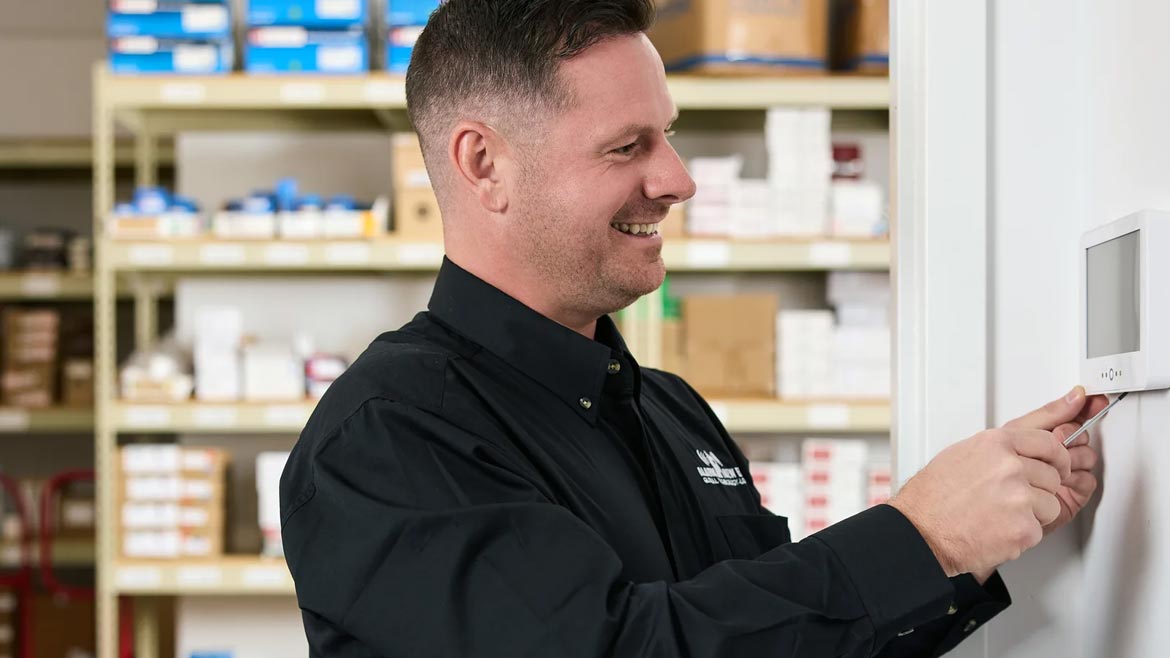
Connie Mastoras, vice president of operations, who has been with the company for nine years, says the three of them — herself, Domey and Thompson — put their heads together on the challenge of what the ‘new’ company processes should look like. “We brainstormed and said, ‘We are going to fix this.’ … This was a very important time,” she says. “If you think about it, it had been 50 years, and we were ripping things apart and going back to basics to figure out how to make it better. … We rebuilt the sales platform, cleaned up inventory, job flows, customer contact and follow-up processes.”
Mastoras was also involved in helping design the new headquarters in Rocky Hill, Conn., which they moved into this year. “Our goal was to make sure the energy was high,” she says. “People spend a lot of time in the office. … We wanted to create this inviting space where people can collaborate and relax. We have a gym. … We have a wonderful break room where people can step away from the phones and sit and brainstorm and innovate. It is a very happy space.”
It was equally important to Thompson to make sure the company culture didn’t suffer. “My goal, first and foremost, is to run a profitable and healthy business with a culture where people enjoy coming to work and where they feel valued,” she says. “I care a lot about the team. … I care about supporting families and offering great benefits, and I care about building our legacy.”
One of the lessons Thompson learned from the EOS was to make sure every member of the team shares the core values, something she compares to a flight of falcons. “I originally said a flock of eagles, but Sierra pointed out they don’t fly in flocks,” she jokes. “But how we built our new culture was through that EOS and figuring out: how do we operate in the world? That is based around our four core values — make the world a better place; get stuff done; do the right thing; and be humbly confident. If you are going to fly with our flock, this is who you are. We are being really clear about these core values as the measure of our success. That is how you build a culture: you define success, give clear expectations around how to operate, and live up to it over time.”
Financially, it was a big lift to shear off the large commercial transactions that typically bring in a lot of up-front cash, Domey says. “We knew it would shake the sales team a little, so we spent time to make sure we were doing things really well,” she says.
Adding to the complexity, in March 2025, Alarm New England also acquired another company, Associated Alarms, bringing 1,900 residential and commercial customers across Cape Cod and Southeastern Massachusetts. As it would turn out, the sales team managed all the changes quite well, growing RMR 13% over last year.
James Curtiss, senior security consultant, is responsible for the outside sales team that is now focusing on the SMB business sector. He credits the implementation of the new CRM from HubSpot as one reason for the company’s success. “In the past, each salesperson maintained their own process, whether that was an excel sheet or whatever,” he says. “This standardized CRM was something Alexandra championed and has rolled out. This has made our process more efficient and helped us extract more RMR out of our leads.”
He adds that the company is not giving up on selling larger commercial to the extent the platform is designed to handle that. “We cleared out the legacy accounts that would be difficult to manage and invested quite a bit in new accounts,” he says. “Now, we are rebuilding our integrated accounts on a new standardized platform. I think the evidence of that is we are investing heavily in marketing strategies to bring in those leads. The pressure is on, and we are going to get cooking. It is more of a rebuild as opposed to veering away.”
This ROI-positive marketing program stems from the company’s brief foray into DIY back in 2015, which taught them that marketing was an essential part of that business model, Doug Curtiss says. “The tools are available today to do a very specific, ‘If we spend X dollars a month of outreach, we get X number of inbound leads and a close ratio of X,’ so you can really determine the ROI of that spend,” he says. “We are building a machine that is sustainable and very predictable, and you don’t have to be Procter & Gamble to do it.”
AT A GLANCE
Alarm New England, Rocky Hill, Conn.
Ownership: The Curtiss Family
Website: www.alarmnewengland.com
Employees: 65
2025 Revenue: $18.5 million (estimated)
2025 RMR: $940,000 (estimated)
Customers: 16,025 (estimated)
2025 SDM 100 Rank: 45
Currently, Alarm New England generates approximately 250 leads per month and maintains a close rate of 30% using this marketing engine.
This program works especially well with the Alarm.com platform Alarm New England has standardized on. Not unlike Sonitrol in the early days, the security-as-a-service (SaaS) platform gives the company a simple, repeatable system and message to take to their customers.
“I believe you do not want to have too diverse a product portfolio,” Thompson says. “It’s hard to be everything to everyone, so, philosophically, I believe in a simplified portfolio and providing incredible service.”
With this SaaS solution, Thompson and her team now feel in a great position to take this platform and run with it. “We think there is so much opportunity in this business, and we want to go out there and get it for ourselves,” she says. “The future is so bright.”
With a simplified target market and product set, a culture and backend process reset, the results speak for themselves.
“When we sold the business, we were at $1.15 million in RMR and went down to $830,000,” Thompson says. “Now, we are already back to $949,000 through organic growth and the acquisition last spring. When we do an 8% rate increase soon, we will be back up to over $1 million within a year.”
The transition has been interesting. There is significant tenure on the team, which brings this steady feeling. But there is also a startup kind of feel. It’s different leadership, a different market we are focused on. It’s a really cool combination of a secure, stable family business and new, young, startup energy.
A New Tack
Now past the difficult transition phase, Alarm New England is going full speed ahead.
Doug Curtiss is excited about the opportunities and about the new direction the company is taking. “We have great partners. Rapid Response and Alarm.com are two companies helping drive innovation in our industry. It is my belief that we are not in the hardware business anymore. We are a software-driven business and that is what brings value to our customers,” he says. “There is more opportunity now in our industry than at any time I have ever seen in this business, and the reason for that is that software-driven features bring significantly more value to a customer.”
One of these new features is a personal safety button from Alarm.com, something Alarm New England latched onto immediately for their customers and is also partnering with a major healthcare system on a new marketing campaign around.
Alarm New England has also been testing targeted “Back to the Base” campaigns aimed at modernizing their existing customer base and getting them off traditional phone lines. These efforts have resulted in a 40% conversion rate on customer outreach to upgrade and a per-customer RMR increase of about 50%.
The company has a new motto to go along with its new “Alarm New England” business approach: Global Technology — Local People. “Our value proposition is we are New England-based and have a family-based culture,” Curtiss says. “We have the same, or better, technology than most, and there is a niche of the market that wants to deal with that kind of value prop.”
For her part, Thompson has a firm grasp on her new leadership role in the company, complete with the realization that it won’t be easy. “If there is one thing I have learned in the past decade, it is that, while our business is an incredible one to be in, it is not an easy one,” she says. “We still face the fundamental challenges any business does: hiring good people, training them, retaining them and measuring and holding them accountable.”
To that end, the next venture on the 2026 roadmap is centered around building out training programs, Thompson says. This could include both internal training programs as partnerships with local high schools or finding people from other low- or high-voltage industries.
“Training leads to retention,” she says. “Whether you are a customer service rep or a technician, when you feel capable of doing your job, you will be happier.”
The company just hired a new head of HR to help with these initiatives.
Speaking of growth, Domey says she doesn’t rule out more acquisitions in the company’s future. “If an organization fits our niche, we have a great partnership with a bank, and we were very successful with our last acquisition,” she says. For the most part, though, she is excited about the possibilities going forward.
“You always hear the alarm industry is dying,” she says. “Our core mission is to keep people safe, regardless of where they are. … Regardless of what the statistics say, we have found a niche here in the Northeast. We are big enough, but not too big, and there is plenty of market share left for us to go get.”
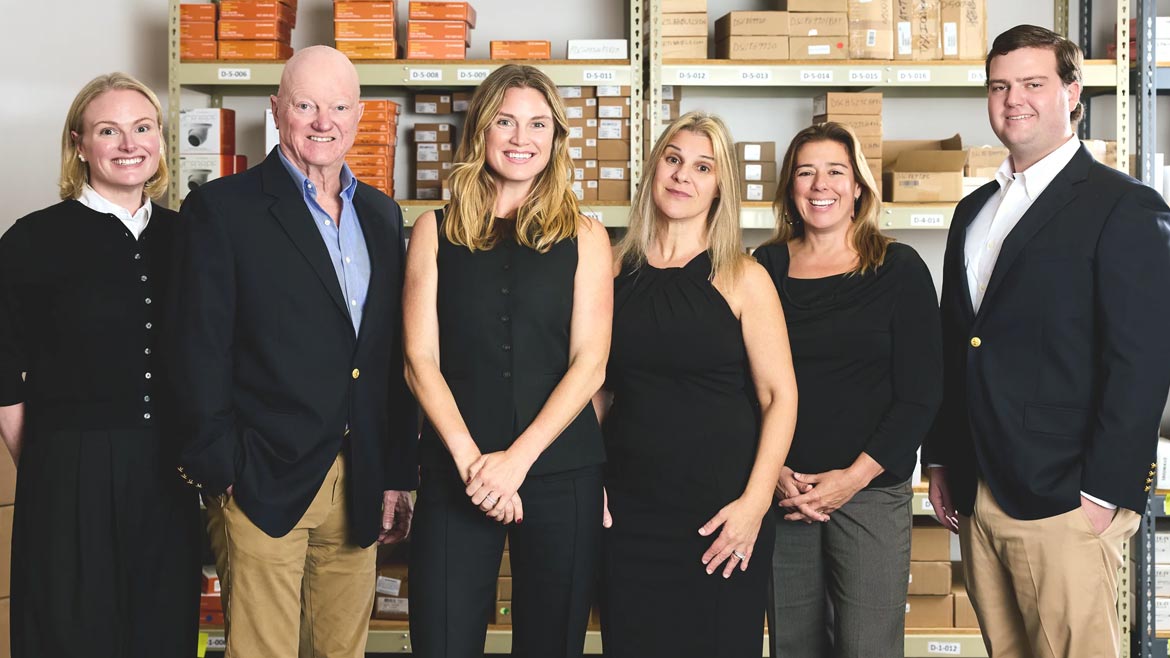
Alarm New England Management Team:
Alexandra Thompson, President
Dena Domey, Chief Financial Officer
Connie Mastoras, Vice President, Operations
Doug Curtiss, Founder & CEO