Life Safety & Fire Alarms
New Dynamics in Signaling Devices
Smart fire alarm notification is now an integral part of a modern life safety system.
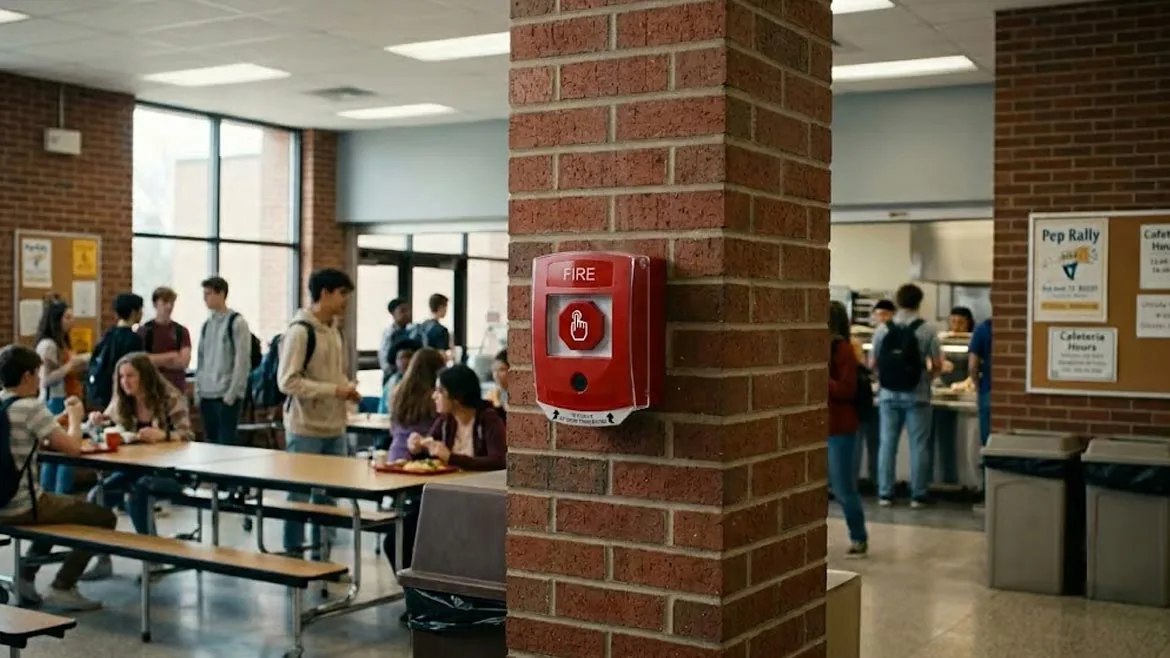
The new GF Fire Alarm Push Button provides device protection and optional integrated IP camera for visual verification of alerts.
A modern building is where fire alarm signaling devices no longer simply flash and blast sounders locally; instead, they’ve become an integral part of an intelligent, connected life safety ecosystem.
These devices continue to move from simple alerting to context-rich, data-driven emergency notification solutions designed to heighten situational awareness for safe egress while promoting an informed, proactive response.
“Signaling, strobe and voice evacuation systems are increasingly centered on the integration into broader life safety solutions, helping support coordination, visibility and emergency response,” says Katie Davis, chief technology officer, commercial fire, Honeywell, Northford, Conn. “We also see growing demand for networked notification appliances and voice/intercom systems that deliver clearer, more targeted messaging across large facilities. Cloud connectivity and remote diagnostics are further assisting organizations in simplifying maintenance and improving system oversight.”
Varied forces are driving innovation in fire alarm signaling and notification appliances. Buildings and campuses have become more complex, requiring clearer, concise messaging. False alarms and alarm fatigue have necessitated more intelligent, predictive data. End users’ expectations for accessibility and intelligibility are rising, while codes shift from basic activation to intelligible messaging even in challenging spaces, like open environments and industrial settings.
“Codes have moved the market from simply asking, ‘Does the alarm activate?’ to, ‘Will the right people receive the right message, in the right way, at the right time?’ That has changed expectations placed on signaling devices and the wider ecosystem around them.”
Key Trends in Notification Appliances
- Pre-recorded voice messaging and migration to live audio response.
- Greater intelligibility and clear audio quality even in challenging environments.
- Unified life safety platforms that combine fire, security and operational systems.
- Easing into AI technology for automation and additional intelligence around specific events or alerts.
Codes: Guardrails That Shape Innovation
NFPA and building code updates continue to influence signaling technology, Davis says. “There is an increased focus on establishing voice evacuation systems that deliver understandable instructions during emergencies. Updated accessibility requirements are also driving improvements in strobe synchronization and adaptive notification strategies.”
NFPA 72, the National Fire Alarm and Signaling Code, has been one of the key drivers of the technology, because it establishes how notification appliances should perform, where they should be located and how they should be installed, tested and maintained. In practical terms that has influenced the design of signaling devices and the accessories that support them, according to Sibtain Naqvi, global head of product management, Safety Technology International (STI), Waterford, Mich.
The next stage, he says, is about going beyond minimum compliance and giving users greater confidence in the event itself: why it happened, whether the alert is genuine and how best to respond.
Looking for quick answers on security topics? Try Ask SDM, our new smart AI search tool. Ask SDM →
“The important point is that codes have moved the market from simply asking, ‘Does the alarm activate?’ to, ‘Will the right people receive the right message, in the right way, at the right time?’” Naqvi says. “That has changed expectations placed on signaling devices and the wider ecosystem around them.
“Code compliance creates the baseline, but false alarms, accidental activation, device misuse and poor situational awareness remain real-world problems for building owners, facility teams and responders,” Naqvi adds.
Visual Verification at the Activation Point
What is changing now is that compliance is increasingly being matched by a demand for better data. Instead of simply getting an alarm activation, there’s more information on what happened and why.
“Customers do not just want systems that meet code; they want solutions that help them understand what is happening,” Naqvi says. “That is where products such as our GF (Global Fire) G3 range are particularly relevant. By combining button functionality with integrated camera capability, G3 supports visual verification and context around an activation point, while being suitable for integration into existing systems.”
Voice evacuation and intelligent communication are some of the latest advancements occurring across the industry with audible guides replacing or supplanting tones. Announcements are customized, zoned or provide staged or phased evacuation where only certain occupants are directed to leave the premises, while others are guided to safe refuge.
“As the industry updates signaling devices, voice guides are being integrated into existing and new technology to assist building occupants in the event of an evacuation,” says Rodger Reiswig, vice president of industry relations, Johnson Controls, Milwaukee.
“These developments were made with occupant safety in mind, particularly for those unfamiliar with a building’s floor plan or with pre-existing evacuation plans. By receiving clear, actionable guidance, occupants can evacuate a building quickly and safely,” Reiswig says. “The industry has also made developments to support occupants of varying needs. “Closed captioning alerts, alongside strobe lights, are being implemented in large venues and spaces for those who may be deaf or hearing impaired.”
Codes and standards provide guidelines to innovating within the demands of the industry.
“NFPA 101, the Life Safety Code, for example, outlines standards for exit access to ensure pathways are safe in the event of an evacuation,” Reiswig continues. “Per this code, commercial facility managers changed their evacuation training plans to ensure new and existing employees were properly trained on the building’s safe exit routes and that regular drills were conducted. To innovate within the guidelines of this standard, fire detection developers integrated voice guides into their products to assist in the event of a drill or emergency evacuation.”
Integrated messaging that incorporates a variety of alerts, including fire, weather emergencies and other detections, like gunshot or dangerous chemicals, are transmitted over a single mass notification platform. The cloud and remote mobile connectivity are also playing a role in enhanced signaling communication. Remote diagnostics and cloud-collected oversight and data is also possible with these smarter, networked notification appliances for unified response across an entire facility or campus.
“While conversations around the integration of AI in fire detection have certainly increased over the past year, there is some hesitancy around messaging implementation given the life safety component of the industry.”
More on Technology Advances
Subject matter experts interviewed for this article share key thoughts on the impact of technology advances in the fire alarm signaling space:
- “A key point in AI is governance. In a fire or life safety application, AI should support the responsible person, operator or emergency responder; it should not remove accountability. If AI is used to assist with message selection or situational analysis, there still needs to be a robust framework around validation, cybersecurity, fail-safe operation, audit trails and human override.” — Sibtain Naqvi, STI
- “We are largely seeing improvements and advancements to technology already in place. Improving existing technology allows the industry to brainstorm big ideas farther down the line and ensures that fire detection is using the best tools possible to keep building occupants safe.” — Rodger Reiswig, Johnson Controls
- “AI is helping advance life safety systems by supporting more dynamic emergency communication. Intelligent messaging capabilities help generate evacuation instructions based on the type or location of an incident, improving situational awareness and active response coordination.” — Katie Davis, Honeywell
What AI Can & Can’t Do Today
Artificial intelligence (AI) is part of the discussion when it comes to modern fire alarm signaling. It’s beginning to be leveraged in various devices, with adoption occurring slowly and cautiously. Today, AI can analyze inputs from fire detection, video, access control and occupancy data to harmonize information for more effective insights. It supports operators and first responders with enhanced situational awareness and enables more dynamic, zone-specific instructions. AI can also be used to generate or select approved message transmissions.
“It’s already beginning to play a role in voice evacuation and intelligent messaging, although, in life safety, we are not talking about AI independently making uncontrolled evacuation decisions,” Naqvi says.
“Where AI becomes interesting is as an additional layer of intelligence around the event,” he adds. “Traditional voice evacuation systems tend to rely on pre-recorded messages, zoned announcements and live paging from authorized personnel. That is still essential. But AI can potentially help by analyzing inputs from multiple systems. There is well-documented commentary on AI in fire safety that points to the value of combining data from cameras, thermal imaging, air-quality sensors, building systems and occupancy information to provide earlier warning and richer situational awareness. Voice evacuation and mass notification systems are already moving in that direction through zonal control, prioritized messaging, live paging and integration with fire alarm and building systems.”
The “live response” element is where AI will most likely add the most value over time. For example, AI could help an operator understand whether an activation appears isolated, or if there is supporting visual or other evidence.
But AI is a tool for decision support and not a decision maker. AI cannot autonomously make evacuation decisions and must operate within codes and AHJ (authority having jurisdiction) requirements.
“While conversations around the integration of AI in fire detection have certainly increased over the past year, there is some hesitancy around messaging implementation given the life safety component of the industry,” says Reiswig of Johnson Controls. “With people’s lives at stake, it is imperative that all technology — not just technology integrated with AI — is accurate, reliable and up to standard. With that in mind, AI has been slower to integrate into the messaging and alerts aspect of life safety systems. This does not mean that fire detection is still in the stone age. It just means that AI implementation will likely take longer than other industries. As an industry, we must be pragmatic about the technology we’re developing to ensure safe environments.”
Looking Ahead: The Next Decade
Fire alarm notification devices are on a pathway to becoming more connected, contextual systems, unifying fire, security, building management and operational platforms. Predictive detection and smarter diagnostics are part of this evolution, with incremental improvements to existing technologies and a focus on reliability, intelligibility and accessibility.
Notification technology is delivering clear communication that directs occupants with certainty for improved active response coordination — leaning into a safer, more informed future in life safety.
Looking for a reprint of this article?
From high-res PDFs to custom plaques, order your copy today!