New Benchmark Report by Interface Systems Reveals What Really Drives Restaurant Security Incidents
Interface Systems, a provider of AI-powered security and expert remote video monitoring for restaurants, retailers and commercial businesses, released its 2026 Restaurant Security Benchmark Report, an annual study based on 1.1 million monitoring events across 9,392 U.S. restaurant locations representing 78 quick-service, fast-casual and casual dining brands.
The report provides operational data at a scale to help restaurant security and operations leaders understand when risk peaks, where it concentrates, which threats escalate fastest, and which intervention strategies prove most effective across thousands of monitored locations.
“Restaurant operators are balancing employee safety, customer experience and operational efficiency across hundreds or even thousands of locations,” said Brent Duncan, CEO, Interface Systems. “This report provides real-world operational data that helps them understand where risk is greatest, when intervention matters most, and how to make more informed security decisions.”
Key Data & Findings
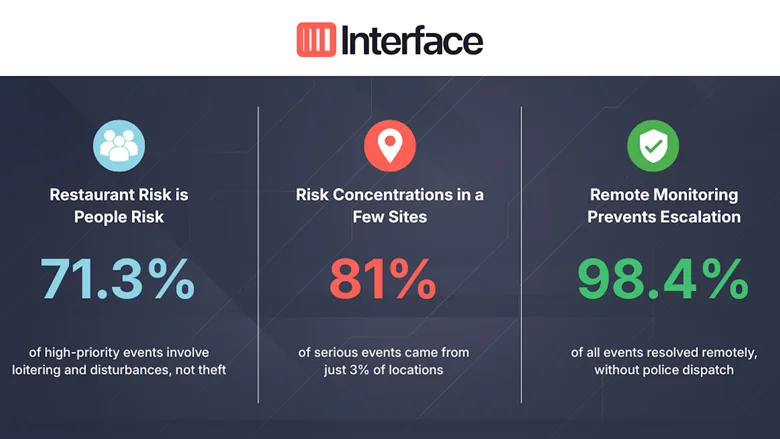
Loiterers and panhandlers (49.8%) and disturbances (21.5%) together account for over 70% of high-priority events. Theft and loss, the dominant threat in retail, barely registers at restaurants. Other threats tracked included battery and assault, burglary, robbery, property damage and medical emergencies.
Risk is highly concentrated in a small set of locations. Three percent of monitored locations generate 81% of all high-priority events, and the top 100 sites alone account for 59%. Uniform security spend across a portfolio overprotects most sites and underprotects the few that carry the risk.
Risk extends across the clock. High-priority events stay elevated around the clock, peaking at 6:00 p.m. during the dinner rush, while roughly 30% occur overnight between 10:00 p.m. and 6:00 a.m. when restaurants run skeleton crews or sit closed. January was the worst month, running 61% above the summer low.
Looking for quick answers on security topics? Try Ask SDM, our new smart AI search tool. Ask SDM →
Interactive remote monitoring resolves most incidents before police response is required. Of 1.1 million events, only 1.6% required a police, fire or medical dispatch. Trained intervention specialists with live video and two-way audio resolved 98.4% remotely.
False alarms remain a significant operational burden. Restaurants generated more than 296,000 false alarms during the reporting period, with nearly half occurring during morning opening procedures. Video verification resolved more than 97% before emergency dispatch, helping operators avoid unnecessary fines while preserving first responder resources.
Employees rely on live support during vulnerable windows. Staff initiated more than 82,000 requests for monitoring assistance over the year, approximately 225 every day, including live monitoring, voice-down interventions and employee escorts during opening, closing and cash-handling activities.
Risk surrounds holidays. Christmas Day recorded the fewest incidents of the year, while Christmas Eve saw three times as many. The day after Presidents Day produced the highest incident volume of any holiday period as restaurants returned to normal operations.
The complete 2026 Restaurant Security Benchmark Report is available now.
The 2026 Restaurant Security Benchmark Report is based on anonymized event metadata collected between June 1, 2025 and May 31, 2026 across 9,392 restaurant locations nationwide. In addition to benchmarking data, the report offers practical guidance to help restaurant operators improve employee safety, reduce operational disruption and align security resources with actual risk.
Looking for a reprint of this article?
From high-res PDFs to custom plaques, order your copy today!