Emergency Communications: Beyond the Blue Box
Today’s emergency intercoms are neither simple nor routine, and the security integrator is finding more ways than ever to incorporate them into a facility’s overall security and emergency planning.
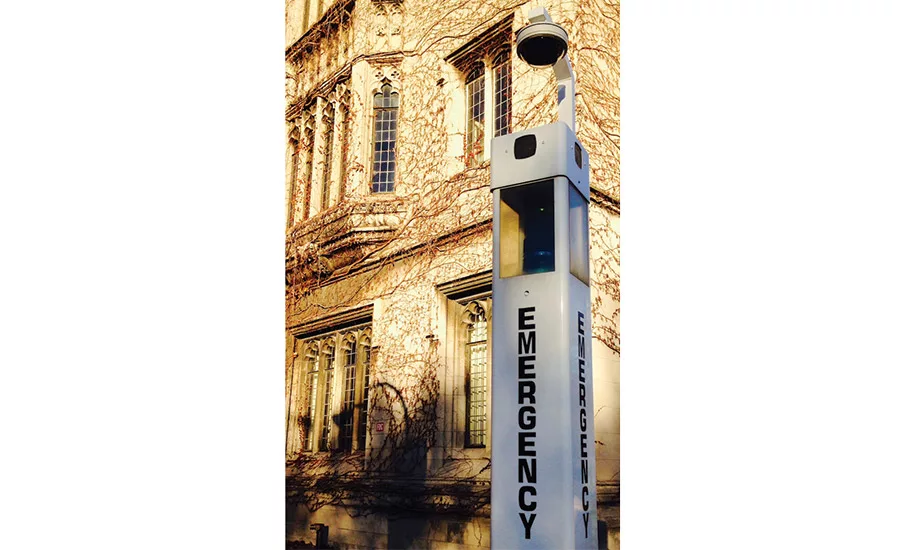
Advent Systems added Arecont cameras and license plate readers to existing emergency intercoms at a major university, expanding their use and value to the customer. PHOTO COURTESY OF ADVENT SYSTEMS
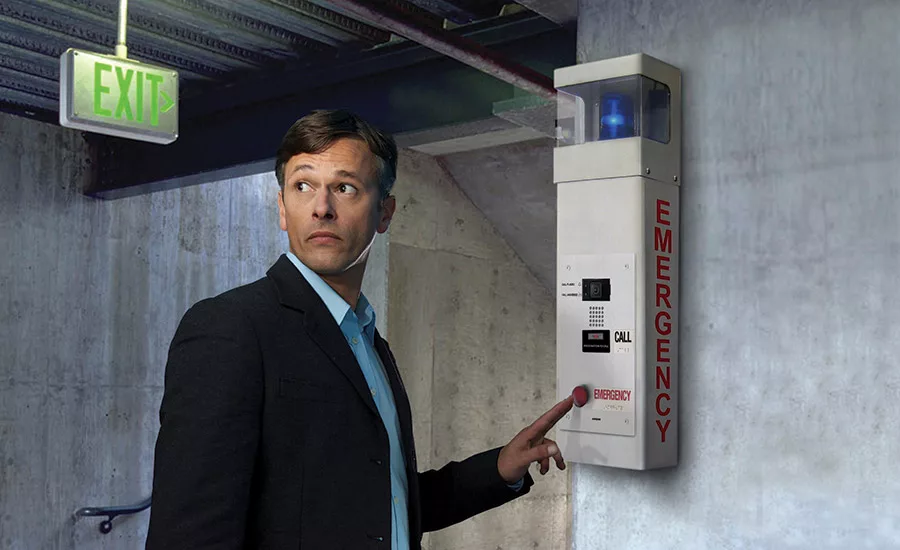
Many emergency intercoms are incorporating more technology in the box, such as a camera, better audio and integration with mass notification systems. PHOTO COURTESY OF CODE BLUE
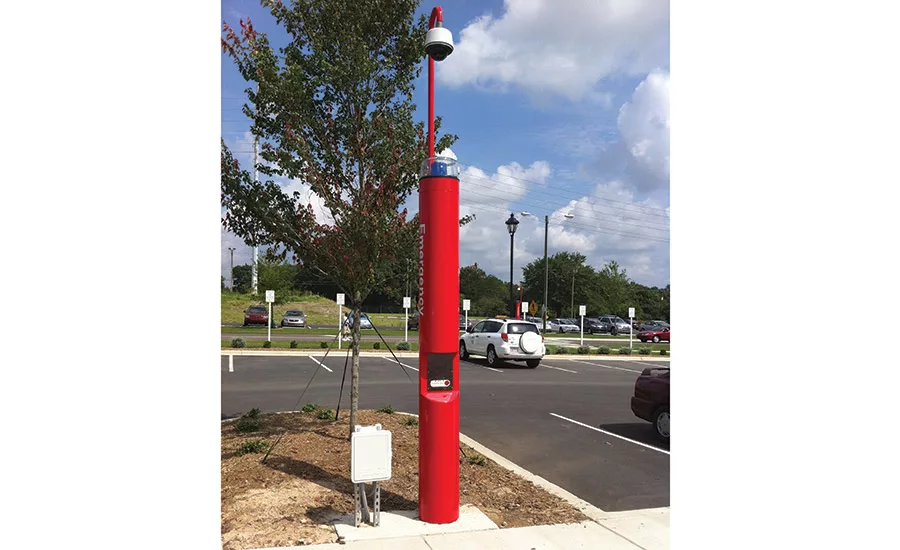
Emergency intercoms, popular devices in campus environments as well as parking garages, are updating their technology and features to meet expanded customer needs. PHOTO COURTESY OF AIPHONE
The emergency intercom is generally pictured as a metal box — frequently red or blue for easy identification — that allows someone in distress to push a button and call for help. But like so many technologies in the security sphere today, these items can be far more complex than they appear.
There is a growing demand for emergency intercoms, says John Skwirblies, senior account executive, Advent Systems Inc., Elmhurst, Ill. For the mostly hospitals, universities and other “campus” type environments or parking garages that are the bread-and-butter of these applications, Skwirblies and others frequently turn to companies that specialize in these units such as Vingtor-Stentofon, Aiphone, Digital Acoustics, Talk-a-Phone and Code Blue, to name a few. And as products have advanced in technology — moving to IP protocols, utilizing wireless technology and offering better audio capabilities — integrators are finding that they are more useful and have more potential. Integrators say they also present increasing touchpoints with the customer, as well opportunities for expansion and integration.
“Everything continues to move to PoE, with remote system management and remote system testing,” says Gannon Switzer, vice president, KST Security, Indianapolis. “LED illumination and big improvements in audio quality have brought tremendous value in recent releases of product.”
But, he says, the more they do, the more important it is to make sure the customer understands what they are getting. There can be bigger differences between products. “Customer expectations must be fully understood and agreed upon, because emergency intercoms vary greatly in capabilities and applicable use. End users can’t assume they all do the same thing and making sure you provide the right solution at the appropriate price is paramount.” There are also more things to be aware of on the integrator end.
COMMUNICATION ISSUES
Emergency intercoms are a communication device. Not surprisingly, this is the first place where changes have taken place. Skwirblies is seeing more and more IP in everything, including emergency phones. While this is great for integration, it can also present challenges.
“Intercom over IP (IoIP) and its integration with access control, video and VoIP for business are key trends we are tracking,” says William Plante, principal consultant, Enterprise Security Risk Group, Aronson Security Group (ASG), Renton, Wash. “One of the challenges in critical security communications is the inability of consultants, integrators and end users to stay current with emerging technology trends. There is a tendency for products to be quoted off data sheets or from an experience they had a number of years ago. Without a proper assessment of risk, threats and vulnerabilities of the organization, which would include operational workflows where communication is critical, your starting point for evaluating communication technology is deficient.”
In addition to IP protocol itself, actual communication at the device is also an important consideration, Plante adds. “We are seeing clients now emphasize the importance of intelligibility in a communication solution. This means you can truly hear, be heard and be understood under any circumstances, including very noisy environments. Communication must be intelligent, precise and coherent and be scalable in sound across a network.”
Looking for quick answers on security topics? Try Ask SDM, our new smart AI search tool. Ask SDM →
Plante and others point to larger emergency trends, including digital signage and mass communication — two scenarios that are beginning to involve emergency intercoms — as key reasons that it is so important to get the communication right the first time.
“Making sure you understand the existing backbone and configuration of the customer network is essential to delivering a successful solution,” Switzer adds.
“Don’t assume anything,” he advises. “Make sure you test the network and do your due diligence. Verify how the customer intends to use the units, what communications format will be implemented, how the system will be monitored and the specific locations, including the direction the unit is facing.”
Switzer found this with a hospital environment he worked in recently. “We updated an existing analog intercom call box to IoIP. Call boxes are one of the more popular systems that are specified and never lab tested for the environment they’re being installed into. The sound was clearly deficient to meet the defined requirements of the hospital.”
DESIGN & INSTALLATION
Beyond how (or how well) the intercoms will communicate, there are other issues that need to be understood in the planning, design and installation phases.
“Since most of the units we install or quote are in remote areas and parking lots, we have a wide range of what is standard, from wall-mounted, to ceiling-mounted to floor-mounted,” Switzer says. “We are often asked to integrate with a variety of access control, telephone and video systems. There are frequently existing systems the customer already owns and we have to play the match game with products and features to achieve the desired outcome.”
One of the biggest issues involves getting power to the unit. “You have to have power,” says Steve Mancione, vice president of sales, Pace Systems Inc., Naperville, Ill. While that may seem obvious, many of the applications for emergency intercoms are remote and not near an IP drop. “There is new technology out there that allows you to run your power and data over a single cable in a low-voltage scenario. It is now more economically feasible to do a lot of that at longer distances.”
But that is not always the case, particularly when you are dealing with IoIP, Skwirblies says. “Analog can run 1,000 feet, but you want to be within 300 feet of the nearest network drop for IP. Sometimes we have to run fiber out to those and convert to IP and vice versa.”
Wireless is another option but there can be hidden “gotchas” with that, Switzer says. “Doing thorough surveys and system testing are a must if you want a successful deployment.”
The physical environment is also a consideration. Many of these are outside units being placed on concrete or grass. “You have to pour a concrete base to put the station on, which involves getting the template ahead of time so the bolts are in the right place,” Skwirblies says.
“We have had several incidents where the concrete was poured correctly but with improper bolt patterns,” Switzer recalls. “In one case the bolt pattern was 45 degrees off so all the bases had to be modified to fit the wrong pattern.”
From start to finish, Plante advises developing a consistent methodology. “Become a process-driven evaluator of critical communications, not an installer of systems. If you follow a deliberate process and really benchmark the systems for sound clarity, interoperability and the ‘ilities’ (such as reliability, scalability, interoperability, availability and maintainability), then you will be successful over time.”
DOING MORE
With newer technology, communications protocols that support IP integrations, better intelligibility and an increase in demand, many integrators find themselves going beyond just the “blue box” when it comes to emergency intercoms.
“At ASG we just completed a paid engagement where we actually tested an advertised integration between Zenitel’s (Vingtor-Stentofon) IP intercom, Motorola radios, and Lenel access control,” Plante says. “We first did this in the ASG testing center at our corporate headquarters and then migrated to a proof-of-concept.
This allowed the client to not only understand the nuances of the integration — confirming true interoperability — but also to alleviate concern over high availability, reliability and scalability.”
Both Switzer and Skwirblies have done projects recently where they incorporated cameras into stand-alone emergency stations.
“We added Arecont cameras and license plate recognition cameras to many of the units that were already installed at a major university in Chicago,” Skwirblies says. The university found that the location of the emergency intercoms was an ideal place to add cameras because many of them were located at intersections where they could get a good visual on cars. “That has been a very good project for us, Skwirblies adds. “All these units were already installed and now we are going back after the fact and adding cameras.”
Mancione says the trend to do more with these units is growing, particularly as the analog systems either fail or no one wants to fix them, but the customer still wants emergency intercoms.
“The trend is to put multiple systems into one installation. We will remove the old analog system and replace it with one that has audio, visual, a rolling screen and maybe a flashing light. We can do all of that with one pull of an IP cable and they have a much better bang for their buck.”
Mancione is also integrating more with digital signage, particularly as that becomes another tool for mass notification systems. “Things are being used a lot differently with audio and visual alerts,” he says. “There are mass notification systems that really focus on texting and email, but those are converging with these personal protection products. We have all these solutions in place, so why not use them?”
Skwirblies says the same university he installed the cameras at is also looking at mass notification and incorporating the units. “Since we already have a lot of IP in there and already have the cameras, we can just add the mass notification.” This will be the first mass notification system his company has done with the emergency intercoms, but it likely won’t be the last, he adds. He says he has gone back to other clients that now have the infrastructure to do something similar and the interest is definitely there.
“We will be doing more and more with [these systems] in the coming years. I see a lot more businesses trying to protect themselves, their employees and guests.”
A Scorecard for Emergency Communications
The Critical Communications market is rapidly evolving in response to global risk conditions and the blending of operational workflow, safety and security needs. It is much like the early market expansion of IP video over analog that began 10 years ago. The disinformation is causing confusion. After speaking with consultants and integrators around the country, we believe it is time to start a conversation on how to truly benchmark and measure a critical (emergency) communication solution before you invest resources and budget. We offer the following in the spirit of challenging all of us in this market to define a level of capability needed for mission-critical communication solutions:
The Critical Communication Scorecard
-
Intelligibility. This is No. 1 for a reason. Your communication must not only be heard, but it must be understood in every situation. You cannot predict the level of noise or disruptive conditions that might occur on your campus or in your buildings. This is a mission-critical element to any communications solution and it must not fail.
-
Interoperability. Your communication tools must work with other enterprise systems including access control, video, and VoIP-based phone systems. This must not just be an API listed on a data sheet. You must see this evidenced by the vendor’s business model and through its investments in securing the trust of the leaders in these areas.
-
The “Ilities.” To be a leader in IP communications, you must know the needs of CIOs and data center IT directors in managing mission-critical systems. They understand the importance of the term “critical.” They are asking for high availability, scalability, reliability and maintainability so that any threat is confronted with a secure and robust communication response at the time of need.
Through this scorecard, Zenitel is emphasizing the need to assess an organization’s risks and then align them with the operational needs of the organization. By doing this, end users will be able to design a benchmark around these three critical elements. — Contributed by Jim Hoffpauir, president of Zenitel USA and the executive leader of the Building Safety and Security Sector.
Looking for a reprint of this article?
From high-res PDFs to custom plaques, order your copy today!