Electric Lock Installation Tips
Knowing which lock to install and what the requirements are for each door is paramount to a secure installation.
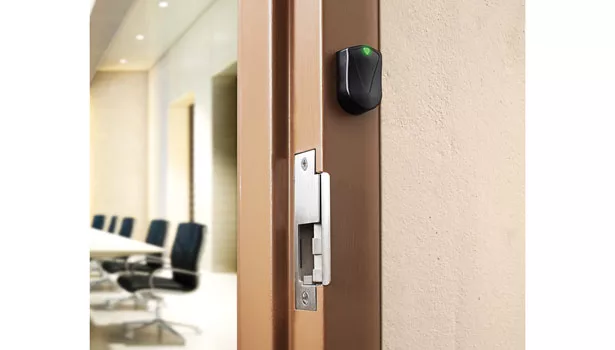
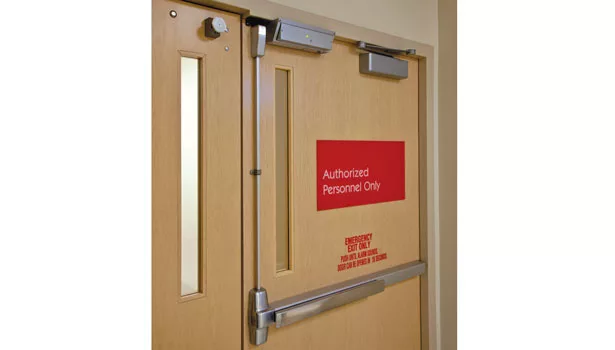
Mag locks are often used on glass doors or double doors that don’t have a frame to cut a strike into.
PHOTO COURTESY OF INGERSOLL RAND SECURITY TECHNOLOGIES
Beauty is More Than Door Deep
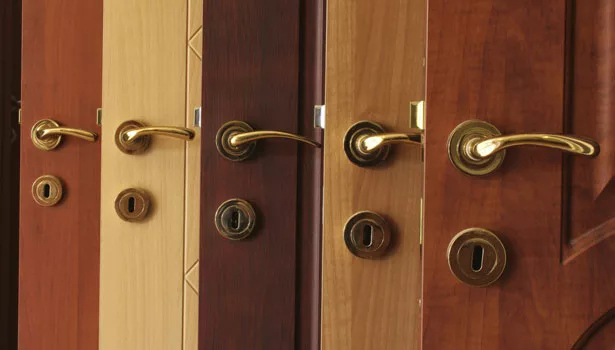
In addition to knowing the physical location and condition of the door, customer expectations are also important. Sometimes customers have aesthetic preferences that will dictate a certain look. That is where paying attention to the details pays off, says integrator Scott Hightower of Remote Protection Systems.
“We do a pre-evaluation and take digital pictures of the existing hardware as well as taking measurements. If there is an existing door hardware situation with a certain style, such as polished brass or bronze, we match it. Aesthetics are important to the end user,” he insists.
Installation time versus aesthetics is an important distinction. “To determine the best hardware option for the application, review what takes precedence: the economics or the aesthetics of the installation?” suggests Bryan Sanderford, national sales manager, Dortronics Systems Inc., Sag Harbor, N.Y. “Strikes are easier to install in hollow metal frames; however, the lower equipment cost of a strike may be offset by installation time if the door frame is solid wood or filled with concrete. Although a mag lock may initially cost more, it is easily surface mounted on hollow metal, solid wood or concrete frames. For high-profile lobby entrances with Herculite glass doors, mag locks can be ordered with extra-long housings and finished to match the door frame material so that it is not distinguishable from the frame. Strikes, on the other hand, are less obtrusive for historic buildings with preservation restrictions.”
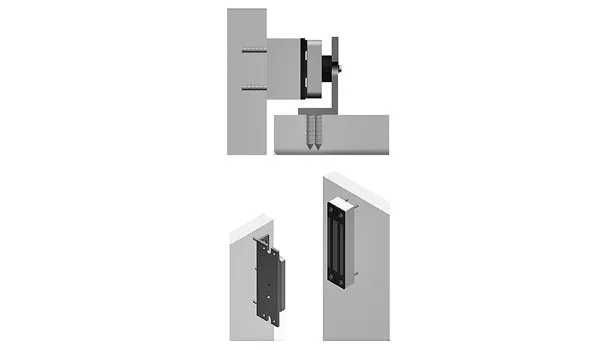
Mag locks are ideal for glass doors and doors that are in less-than-great condition. They need something above the door to drill into, however.
PHOTO COURTESY OF ASSA ABLOY
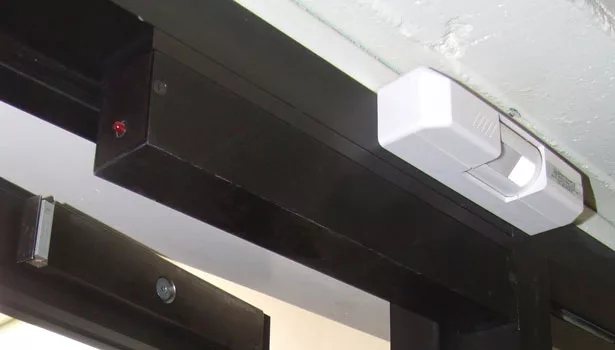
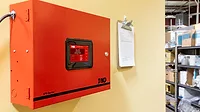
Mag locks require integration with the fire system as well as a separate request-to-exit and presence sensor.
PHOTO COURTESY OF DORTRONICS SYSTEMS INC.
Electric locking options for doors are fairly straightforward. The main types include magnetic locks, electric door strikes, and electrified locksets. But when you look at a door, knowing which of those solutions will work best, is easiest and quickest to install, and will meet the customer’s requirements is an important skill for any integrator.
In addition, whether you install the locks or just specify them and contract out the installation portion, there are key issues, codes, requirements and pitfalls to be aware of. In addition, more and more integrators today are taking on door work themselves, making in-depth knowledge of electric locks and where and how to install them imperative.
“I think integrators are facing a convergence of their own,” says Tamara Hatzinger, director of product management, EMS & OEM Group, ASSA ABLOY, New Haven, Conn. “In the past, integrators often would have contracted with a locksmith to do the installations. Increasingly more integrators are seeing hardware installation as an opportunity and taking that on for themselves. So there is a learning curve there.”
First Look at the Door
No matter what type of lock you think might be needed going into a project, the first step is to take a very detailed look at the door, its surroundings and its ultimate purpose.
Is it a new building or retrofit? Are there certain security or aesthetic goals for that door? Does the customer want a clean look? Do they want it to operate in fail-safe or fail-secure mode? Are the doors wood, metal or glass? Are the door frames wood or filled with concrete? What will the throughput of the door be and will it be subject to more than normal wear or tampering? What is the condition of the door and frame?
“Any kind of electromechanical hardware will be impacted by the condition of the door,” Hatzinger says. “Does the door work? Is the frame square? It can be more difficult to make hardware work when you have circumstances that are less than ideal.”
For each scenario, what to use will often depend on the building construction, says Ron Kandcer, vice president of sales, Matrix Systems Inc., Miamisburg, Ohio. “Look at the door and the frame. Often you will find that the building materials will dictate; for instance, a metal frame with a solid concrete grout-filled frame may have a hollow metal door that you can run a wire to an electrified lever set versus trying to cut out a strike.”
Looking for quick answers on security topics? Try Ask SDM, our new smart AI search tool. Ask SDM →
Much of the time the solution will be obvious. Glass doors with no door frame are often best served by a mag lock, as are damaged or unsymmetrical doors and frames, since the magnet doesn’t care about the condition of the door. A framed door that already has a door strike plate might be an easy switch out for an electrified strike. A new construction scenario might include doors that are pre-wired for electrified locks and hinges.
Electric Locking Choices
Magnetic locks are a popular option and easy to install. They have no moving parts and can’t be attacked from the secure side of the door. But they require knowledge of fire codes and often working closely with the authority having jurisdiction (AHJ).
“A mag lock is a metal plate connected to a magnet, which, when energized is held to a metal plate that secures the door,” Kandcer explains. “When you present an access control card, the system drops power to the magnet, which allows the door to be opened.”
Because of this, mag locks are always fail-safe, unlocking when power is cut instead of keeping the door locked. Mag locks need to be tied to the fire system by code.
“Traditionally the mag lock access control opening takes a good bit of coordination with hardware around it,” says Drew Alexander, product manager, Schlage Electronics, Ingersoll Rand Security Technologies, Carmel, Ind. “If you use it on a means-of-egress door, you have to have a separate request-to-exit bar that is approved by the AHJ. You need a presence sensor and a push button within five feet of the door that allows egress.”
Some integrators avoid mag locks because of code issues. Hatzinger says, however, that the most recent code updates from 2012 are much friendlier to mag locks than in the past. That, combined with manufacturers designing them to be easier to install, more aesthetic and with more integrated components, means that more AHJs and integrators are taking a second look at this option. In situations that would ordinarily call for a mag lock, such as glass doors, the alternatives are limited.
“You would pay out the nose to do some other type of applications,” Alexander says. “Sometimes it could mean replacing the entire opening — door, frame, everything — just to avoid using a mag lock.”
Electric strikes are probably the most common electrified locking option. Electric strikes work by electrifying the lock through the strike plate in the frame. They can be fail- safe or fail-secure and do not require integration with the fire system. Once the knowledge of how to cut them is set, they are generally inexpensive and easy to install. They do, however, require a usable frame in good condition that is easy to cut into.
They often require cutting the door frame to fit the custom size of the lock, a specialized skill set that takes practice. As more and more integrators look to install their own hardware, this is an option they need to become comfortable with.
“Electric strikes really are very easy to install and compatible with virtually any lockset available,” Hatzinger says. “In situations where the hardware is already there, it is probably the fastest and most valuable solution in that scenario.”
ASSA ABLOY offers a brand of electric strikes that are available in a no-cut solution that fits a standard ANSI opening, making installation easy even for integrators not comfortable with cutting. As long as the frame is in good condition, this option will work on any standard door with a frame that is already supplied with a strike plate. They also have a surface-mount electric strike for rim exit devices, Hatzinger adds. These are good solutions for integrators who want to stock just one electric strike and use it in most situations they encounter.
An increasingly common approach in new construction is an electrified lock or lever set.
“You put a round hole through the door from the hinge and run wire to the handle,” Kandcer explains. This option requires an electrified hinge that goes back to the panel. They cannot be used on fire-rated doors, however, which are not allowed to be drilled out. These locks often come pre-installed or at least pre-drilled from the door manufacturer.
“In new construction these are used quite a bit because the manufacturer can pre-core the door and the installer can run the wire before the walls even get put in,” Alexander says. “They are pretty robust. Once you do it, you don’t have to touch it again, and most electromechanical locks have high cycle counts in them.”
In retrofit situations, however, these are more fraught with danger for installers because drilling a door can result in ruining the door — and their profit.
The Good, the Bad & the Ugly
Manufacturers of electric locks have in the past few years made a concerted effort to make things easier for integrators. In addition to no-cut and surface-mount strikes, many of them offer integrated sensor options, both for mag locks and electric locks and strikes.
“On a mag lock there are a few switches available,” Alexander says. “There is a door position switch that will tell you the door is closed. The magnetic bond sensor will tell you that not only is the door closed but locked, and the percentage of bond strength.”
Strikes can come with a latch bolt monitor to indicate the door is closed and the latch bolt is within the strike pocket, Sanderford adds.
“Integrated door status monitoring switches are a desirable option on both strikes and mag locks, saving installation time in not having to mount a separate set of contacts on the door frame,” he says.
“Technology convergence is happening all across access control and this is not any different,” Hatzinger describes. “Bringing together pre-packaged solutions that make it very easy for an integrator to install makes the installation experience consistent across different openings and that is where we are headed as a group. We are trying to improve the integrator experience and make sure they are spending their time on doing things that are core to their business, not trying to figure out how to get equipment installed.”
Scott Hightower, president of Remote Protection Systems, Atlanta, appreciates these approaches. “We try to use locks with integrated status switches built into them. The installation is easier and cleaner,” he describes. “We have also tried certain locks based on a manufacturer’s ‘easier to install’ advertising. If we have budgeted two hours for an installation but end up going four to five [hours] that can impact us financially, so we are always looking for easier to install.”
Nevertheless, easier does not always work, and there are often pitfalls and things to be aware of in choosing and installing electric locks.
Integrated sensors are great, but you need to be aware of what the head end is capable of, Hatzinger says. “Do you have one, or is it a standalone system? If you want to remotely monitor a door-position switch, latch bolt strike or magnetic lock, you need a head end capable of doing that.”
On mag locks especially, but also on other electric locks, holding force is something that needs to be considered carefully. Most manufacturers will publish their holding force for electric strikes, but if an integrator needs a specific holding force for a strike or electric lock, they will need to research these independently and pick the lock that will work.
Mag lock manufacturers offer a range of holding forces, but there are limitations.
“I would base this upon the potential force that could be applied to the door and the material of which the door is manufactured,” says Tony Elrod, national A&E specification manager, Napco Security, Napco Technologies Group, Amityville, N.Y. “If you have an exterior door of heavy-duty steel and there is a potential of great external force being applied, I would use the maximum pounds of holding force I can find. But if you have a poorly constructed aluminum door, there is really no reason to use a locking mechanism that will be stronger than the door itself.”
The same is true for glass doors, Hatzinger says. “Since someone can throw a rock through a glass door, it doesn’t make sense to put a 4,000-pound holding force on that door.”
The conveniences of no-cut and surface-mount strikes are great until you face a door that has a warped frame or other structural problems. “You can make many more adjustments with a strike you cut in yourself,” Hatzinger says. “What you gain in ease of installation, you give up a little in flexibility and ability to adjust for poor door conditions.”
One of the areas integrators who didn’t start in the door hardware field often get tripped up in is the mechanical details such as the finish and lever design, Alexander adds. “They might not know the difference between a cylindrical and a mortise lock and order it incorrectly, for example. They need to be aware of the mechanical details in the locks.”
Scott Schramme, vice president of sales, Continental Access, a division of Napco Technologies Group, agrees. “The big thing is to be very careful to get the proper lock to the door. Integrators may not realize it is a Von Duprin crash bar that requires a specific power supply, or the finish is chrome polish on something that should have been silver.”
Make sure if the lock is fail-safe or fail-secure it goes on the right door and that the hardware supports it on both sides of the door, Hightower says. In addition, some electric locks can be ordered in 12, 24 or dual voltages. “You need to know ahead of time which voltage you will need.”
If a mag lock is being installed, make sure there is something to install it to, Hightower adds. “Sometimes there is just a thin aluminum header above the door and above that is open air, essentially. When we see that, we have to talk to the customer or contractor and have them get up in the ceiling and install something we can attach the lock to. Also, on double glass doors, there needs to be coordination with the installation company. Often a glass door is installed with the installer knowing a mag lock will go there. Once the mag lock is on, the installation company needs to come back to tweak the doors so they will close properly against the lock.”
This article was previously published in the print magazine as "Electric Lock Know-How: What's Yours?"
Wireless & PoE Game Changers
While challenges still exist in choosing and installing the right electric locking hardware on the right door, manufacturers and the industry as a whole are working on developments that may change the game in the near future.
Power over Ethernet is limited right now in terms of current draw and the types of locks it can support, says Drew Alexander of Schlage Electronics, Ingersoll Rand Security Technologies. “Most everyone is trying to get down to the lowest wattage they need. PoE is limited right now by code as to how much amperage can be pushed through those wires. The more a manufacturer can make products that come PoE-enabled, the better things will be for the integrators.”
Tony Elrod of Napco Security Technologies Group adds: “We are seeing the advent of PoE locking mechanisms. However, they are still in their infancy and need improvement in holding power before I believe we will see them widely implemented.”
Wireless is another emerging technology making things better for integrators.
“We are starting to see more and more wireless options going out to a gangway of some kind,” says Scott Schramme, vice president of sales, Continental Access, a division of Napco Technologies Group. It is wireless to the door. It saves on labor. While it may take an installer five to six hours to wire a door, wireless may be an hour.”
ASSA ABLOY has a line that includes different types of door cabinet locks that talk wirelessly to a hub that can be connected to a number of different head ends, says Tamara Hatzinger at ASSA ABLOY. “Integrators don’t have to pull data wire and the locks are battery operated. Doors that in the past might not have justified the expense of pulling that wire can now be controlled wirelessly.”
Looking for a reprint of this article?
From high-res PDFs to custom plaques, order your copy today!