PSA TEC State of the Industry: AI Integration & Workforce Development Take Center Stage
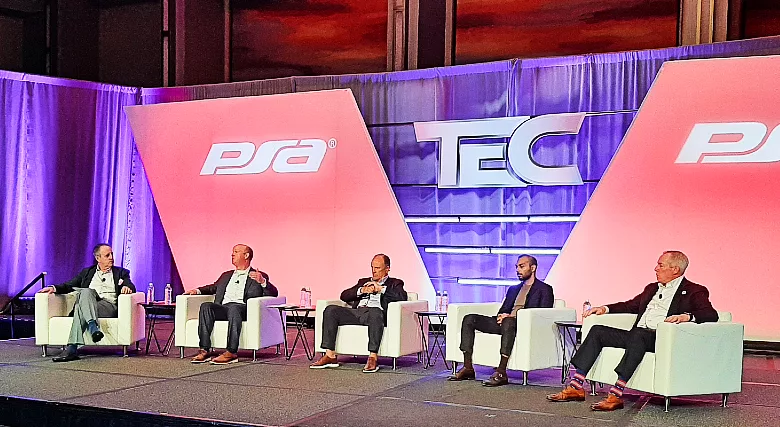
Panelists discuss key trends and challenges in the security industry during the PSA TEC 2024 "State of the Industry" session. From left to right: Matt Barnette, Don Erickson, John Mack, Kumar Sokka and John Nemerofsky.
Image by SDM staff
The PSA TEC State of the Industry panel, held annually as part of PSA Security Network’s premier education conference, serves as a pivotal forum for security professionals to gain critical insights into the industry’s current trends, challenges and future directions.
Attending the 2024 installment in Dallas (May 15), this year’s panel offered the opportunity to hear from leading experts and thought leaders who provided perspectives on the rapidly evolving security landscape. PSA CEO Matt Barnette moderated the session and was joined by Security Industry Association’s Don Erickson, Imperial Capital’s John Mack, LenelS2’s Kumar Sokka and SAGE Integration’s John Nemerofsky.
The session not only explored the industry’s latest advancements and innovations but also addressed pressing issues such as cybersecurity threats, regulatory changes and technological integrations.
The conversation centered around the current state of investment and M&A activity in the security industry, with Mack highlighting the growing interest from private equity firms and recent uptick in M&A activity. Erickson emphasized the importance of balancing innovation with regulation, while Kumar shared his perspective as a relative newcomer to the industry. The panelists also discussed the increasing adoption of artificial intelligence (AI) in security, and the challenges and strategies for attracting and developing talent as key to the industry’s future success.
Following are just some of the main talking points from each panelist.
Mack: Industry trends, private equity investment and market growth
Mack, the executive vice president, co-head of investment banking and head of mergers and acquisitions at Imperial Capital, began his overview of recent M&A activity with an emphatic comment about the current state of the industry.
“I’ve never been more excited about the potential of the industry in the last 20 years than I am today,” he said. “We just have amazing opportunities in front of us. There’s a reason lots of private equity is coming into this industry. There’s a reason we’re experiencing double digit organic growth rates in a lot of the subsectors of the industry.”
Looking for quick answers on security topics? Try Ask SDM, our new smart AI search tool. Ask SDM →
Mack explained M&A are closely linked to the cost of debt capital, as most transactions involve debt. Higher debt costs can hinder M&A activity. However, as people adjust to the current cost of debt, M&A activity is expected to increase. Additionally, there is a significant amount of private equity capital, around $2.5 trillion, waiting to be invested, which will be a major driver of future M&A activity.
“I used to work really hard to get private equity guys to come to the [Security Investor Conference] we hold in December,” he said. “I used to be thrilled if I could get 10 guys to come to that. We had over 80 different firms at the conference this past year.”
The number of private equity-backed security integration and fire/life-safety businesses in the industry today is well over 70 platform companies, all of which want to do M&A, he said.
“These guys are running around trying to find [other integration and fire/life-safety firms] that they can potentially acquire, either as a platform or a tuck in.”
Erickson: AI regulations, police use of facial recognition, and federal investment in AI research
Erickson, CEO of SIA, said the association is working diligently to oppose complete bans on facial recognition while supporting compromise legislation with transparency and accountability measures.
“If you are offering AI-related solutions in any way, I would be very concerned about the proliferation of state bills in particular that will regulate the use of facial recognition (FR), and ultimately AI as a whole. This definitely has a direct impact on sales opportunities,” he cautioned.
Erickson said SIA is very sensitive to the importance of police departments and law enforcement having access to security technology tools, such as facial recognition. Through two years of negotiation, for example, in the state of Maryland, the association recently reached a compromise where law enforcement can use FR for truly heinous violent crimes, but cannot use it for theft.
“On broader AI policy, honestly, it’s really a lawyer’s delight. I mean, some of the terminology being used would make your head spin in terms of legislation calling for definitions of what is a consequential decision; how does that relate to law enforcement, whether or not criminal justice should be an allowable use of AI,” he said. “So, again, we are very sensitive to making sure that there are exemptions permitting the use of FR and related technologies by law enforcement.”
Erickson went to explain that Sen. Chuck Schumer has released a 30-page federal plan that includes about $32 billion is proposed investment activity in AI, principally around R&D.
The manufacturing community and the industry as a whole will be watching the progress of the plan, Erickson said.
“In this political climate, $32 billion sounds like a lot and may seem unattainable but this is bipartisan. I think what you’re going to see on the federal level is incremental approaches. So some funding allocated for R&D by the [presidential] election this year, and the next year with the new Congress, you’ll see further investment,” he continued. “So we expect recurring sources of revenue in R&D monies from the federal government for AI applications.”
Sokka: AI adoption, challenges for integrators, and importance of education
Sokka arrived at LenelS2 in December 2022 having come from outside the security industry. He serves as the global president and general manager, responsible for developing the company’s strategic growth plan and leading various departments including sales, marketing, product management and engineering. He previously held positions at Rockwell Automation, including global GM/head of digital BU and business director, OEM, Asia Pacific. Barnette asked Sokka what he has learned in the last two years since joining LenelS2.
Sokka highlighted the importance of educating the industry on how to adopt new technologies and solve end-user problems.
“We talk a lot about this AI movement, but every customer is on a journey. There’s no one customer that’s going to be able using AI today the same way another one is. I like to look at it from a pyramid standpoint of how technology is evolving. The first level of that is connecting to devices. How do you get information together? And how do you get that data to the cloud? How do you make it more intelligent? How do you use analytics? And then eventually, how can you get prescriptive, meaning AI, where you really get autonomous decisions happening where instead of being reactive, you're being proactive.”
Sokka mentioned when he first joined LenelS2 all the talk about top industry trends mostly centered on the cloud and mobile solutions. “And now the top five [SIA megatrends] are AI. What’s interesting is how fast this industry is actually moving, and the money coming into it and the startups that are coming in and how manufacturers are really trying to drive this change.”
RELATED: Sokka addresses Honeywell’s acquisition of Carrier’s Global Access Solutions Division
Sokka said industry advancement will depend how quickly the entire ecosystem can progress together holistically. “So it means manufacturers partnering with the integrators solving the right problems with their end users,” he continued. “At the end of the day that’s what we’re trying to do. We’re trying to solve problems at the end user.”
Sokka said in the last two years he has observed the adoption of technology is really taking place but not without some hiccups along the way. “People want to get there. But what’s still holding us a little bit behind is how do we get the people to believe in it, adopt it and understand what the value can be, versus just being a trend. And we can’t lose that. A lot of the work that we’re doing is how do we educate? How do we get in front of our end users, with our integrators, to ensure these problems that we want to solve can be solved in multiple ways.”
To make the leap holistically, training and education will be paramount.
“The trends are moving very fast, but we as a group have to get there faster to really drive that adoption,” Sokka said. “Business models are changing, you have to adapt to that as well. We have to there to educate the industry as a whole my perspective.”
Nemerofsky: AI challenges, workforce development and rebranding the industry
Nemerofsky, COO at SAGE Integration, discussed challenges for integrators with AI, including long sales cycles and evaluations by enterprise clients.
“The AI conversation is one that goes on every day now with customers. The challenge is that integrators are still installing [AI-enabled cameras] just like IP cameras. And when you start to take these AI solutions to bigger companies — like a Goldman Sachs or Bloomberg, salesforce.com and Google — they have AI departments that want to evaluate this for 12 to 18 months.”
Another challenge for integrators is with all the upstart AI companies coming into the industry it can be ambiguous for integrators to determine what exactly is their channel to market.
“A lot of these newcomers are trying to be direct to the end user. They realize the challenges with that are the long initiatives to get on boarded with some of these companies,” he said. “You just don’t send them a quote and they buy from you. It takes six months to nine months before being on boarded.”
Nemerofsky continued, “So we want to know their channel to market. And these are in some cases small companies. So now we’re going to run PMP reports on these startup AI companies to make sure they’re going to be around three months from now after you make the sale. Do they have training and certification programs? A lot of times they don’t. So delivery is going to be a little clumsy until we start to pull that closer together and there’s more adoption by the [end user.] I think AI will really start to move quickly through our clients for who we are solving more defined problems. And I think that will be a part of the progression.”
Workforce development can be considered a ‘crisis’
The panel discussed challenges in bringing new talent into the security industry due to outdated perceptions and lack of rebranding efforts.
“Workforce development is absolutely the integrator’s biggest challenge today, trying to bring new talent into the industry,” Nemerofsky said. “Part of it starts with rebranding the industry ... stop calling it the electronic security industry. It makes me feel like I work at Best Buy or something when you say that.”
The industry must continue to develop various initiatives to drive awareness to bring that talent in, the panel all emphasized. Progress is being made, Nemerofsky said, citing SIA’s collaboration with the Electronic Security Association (ESA) in creating the Foundation for Advancing Security Talent (FAST) to promote careers in the industry, among other efforts.
“We need to continue to change some branding, continue to market it out to colleges and universities to get young people active and aware of the industry and that there are opportunities in in ‘SecTech’ for them,” he continued. “I think doing some rebranding of ‘technician’ is important. We rebranded it [at SAGE] years ago; we call that role ‘system engineer.’ And we get a lot more applications for that same job description, but as a system engineer.”
Likely to strain staffing even worse is the rising trend for end users’ expectations that their integration partner will “self-perform” work at all job sites with their own employees and resources, Nemerofsky explained. This places responsibility on the integrator to directly handle and execute the various tasks and components of a project, rather than outsourcing or subcontracting these tasks to third-party vendors or subcontractors.
To help alleviate this strain, PSA integrator members are able to leverage the consortium’s National Deployment Program (NDP), which offers extended coverage, resources and local management to compete on projects previously unattainable. Yet despite the opportunity to tap the geographic reach of fellow PSA members, integrators nevertheless will be strained to self-perform work on some projects, Nemerofsky said.
“It’s difficult to do and in every city. But more and more clients are asking. That’s going to create more challenges for workforce development as we need to hire even more people,” he added.
Erickson echoed Nemerofsky’s concerns, and then emphasized the severity of the industry’s current workforce predicament: “I would put it a little bit stronger terms: It’s actually a real crisis.”
RELATED: Making the Business Case for Diversity, Equity & Inclusion
Erickson explained that SIA recently emailed 100 manufacturer member companies to pose two key questions. The first one asked how bullish they are about current economic conditions in the industry for the remainder of the year. Optimism is on high. On a scale of 1 to 5 (5 being very optimistic), the vast majority of answers came back rated with a 4, along with some 5s.
“But when asked what do you think are the most critical challenges going forward, almost unanimously finding qualified talent was the No. 1 challenge,” Erickson said. “To me it comes down to one simple approach: It is going to take a lot of resources, which is the college outreach piece. We are not penetrating the college campuses enough with the value of working for the industry and all the compelling jobs that are available both on the manufacturing side and the integrator side, and the innovation that’s involved in the security industry.”
To that end, Erickson shared with the audience that PSA and SIA are jointly investing in a college outreach program, with further details to be announced later in the year.
Other takeaways from the workforce development discussion:
One suggestion was that integrators should consider offering internship programs aimed at attracting young talent from targeted high schools and colleges. Additionally, it was recommended that SIA members review and utilize the curriculum developed by SIA for community colleges to help draw students into their workforce pipeline. And, manufacturers were encouraged to form partnerships with local schools and colleges near their headquarters, providing training and project opportunities for students to gain practical experience and skills relevant to the industry.
PSA TEC will next be held in Denver, March 23-27, 2025.
Looking for a reprint of this article?
From high-res PDFs to custom plaques, order your copy today!