Technology Enhances Forensic Search
Trends toward increasingly detailed forensic search capabilities offer quicker and more accurate results for users and integrators.

Forensic search with BVMS is being used in the middle monitor to search for a person appearing across multiple cameras.
Advancements in metadata are benefiting forensic search by dramatically speeding up the process of locating specific objects or events of interest. Steve Burdet, manager of solutions management, Axis Communications, Chelmsford, Mass., says, “We’re also seeing AI play a growing role in making video data more searchable and interactive, allowing users to look for highly nuanced criteria, such as identifying specific brands, clothing types, or behaviors.”
AI also permeates user experience. “AI analytics that not so long ago required significant investment and infrastructure are now nearly ubiquitous across all markets — small to enterprise," explains Matt Lamb, regional marketing manager for Bosch Video Systems, North America, Fairport, N.Y. Lamb says this accessibility is contributing to trends toward “democratization and refinement/expansion of searchability.” Ultimately, the tangible value of this is through the massive time savings users gain from the expansion of AI-generated detail that is forensically searchable, he says.
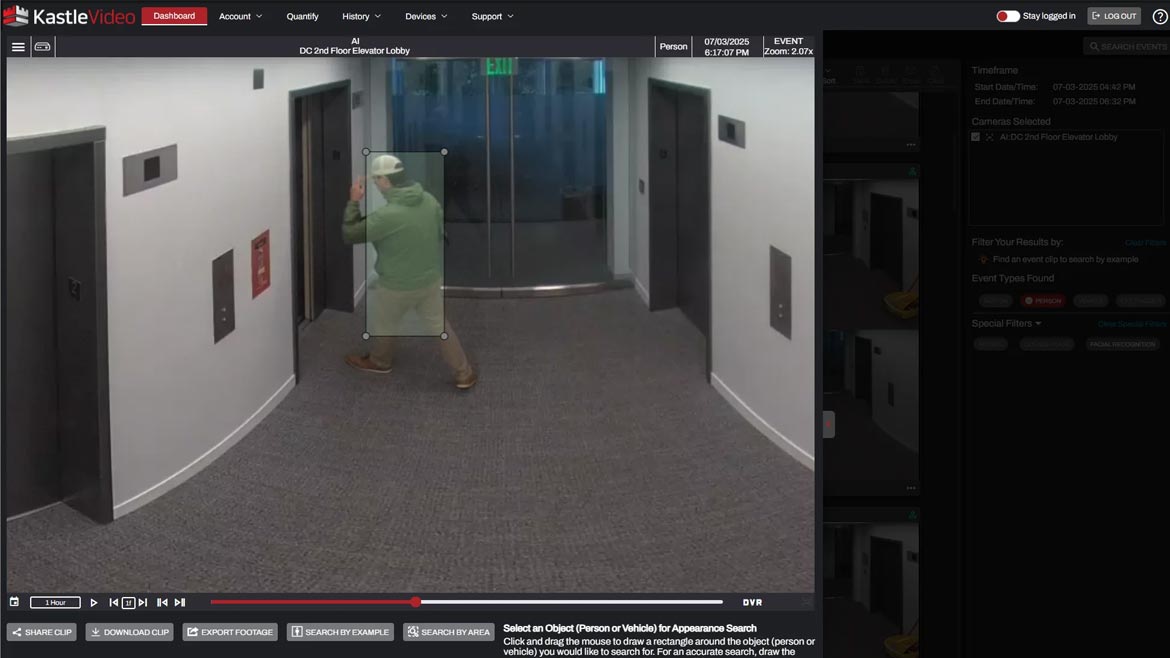
AI analytics that not so long ago required significant investment and infrastructure are now nearly ubiquitous across all markets — small to enterprise.
A Trajectory of Increasing Forensic Capabilities
Aaron Saks, director of sales enablement, Hanwha Vision America, Teaneck, N.J., describes the trajectory that video surveillance technology took as it trends toward more layered metadata, allowing for more granular filtering and searches through video footage. “We started with basic objects: person, vehicle, etc.,” he says. “Higher-end cameras have also introduced attributes such as clothing color, vehicle color, and vehicle type. We then moved into more specialized analytics like license plate recognition, among others.” The trend is clearly heading towards increasingly detailed forensic search capabilities, with more attributes and filters available to narrow down results, he adds.
In addition to the purely forensic benefits of these rising technologies, Burdet says we are seeing a move from purely forensic (after-the-fact) investigation to more proactive capabilities. “Systems are becoming more intelligent in surfacing relevant events in real time or near-real time, enabling quicker alerts and responses when something noteworthy occurs,” he says.
This recognition of behavioral patterns allows companies to be much more efficient with their surveillance and act on information more promptly. “A camera is just a set of eyeballs,” says Darron Parker, executive vice president of sales, IDIS Americas, Coppell, Texas. “Analytics makes the eyeballs smarter.”
As Parker describes, in a particular wing of a building or in an airport, jail, or casino, the system learns what ‘normal’ looks like because it has seen hours upon hours of video. “So, if something outside that norm happens, then the system is smart enough to learn this isn’t normal — I’m going to tell somebody, or, depending on the settings you have, I’m going to tag this video,” he says.
Parker explains that the vast majority of CCTV systems are not live monitored. “So, it can take over a screen and say, ‘Operator, look,’ or it can email or text a copy of the image or tag video so that when an operator logs in, [they] can go through those events and dismiss them or react to them.”
Looking for quick answers on security topics? Try Ask SDM, our new smart AI search tool. Ask SDM →
This ability for operators to react immediately to unusual behavior that can be precision tailored to specific areas, times, or events gives a wide range of organizations the choice to respond immediately to potentially threatening events, thwarting or even preventing criminal activity.
A camera is just a set of eyeballs. Analytics makes the eyeballs smarter.
Advice to Integrators
It is important for integrators to be educated about the products available and the ever-changing technology. Aaron Saks of Hanwha Vision America recommends integrators choose a VMS that fully leverages the AI features they want to use and then become true experts in that system. “Set up a demo environment. Test it by walking through your space wearing a yellow shirt, then see how easily the system can find that footage,” he says. “If you’re using cameras with specialized analytics or functions, verify compatibility with the VMS. Make sure you can search for features like license plates or Re-ID subjects. Know how to archive and protect video for court use.”
Saks adds that it is imperative that integrators don’t just check boxes on spec sheets. “Ensure you understand how to apply these features so you can deliver real value to your clients,” he says.
Steve Burdet of Axis agrees, adding that many VMS’s now include powerful forensic tools as standard features. “Capabilities that used to cost thousands of dollars are often built in at no extra charge,” he says. “Leveraging these advancements can add significant value to your solutions and help clients get more from their investments.”
Forest Liu of ADI | Snap One recommends integrators be acquainted with regulations and local property laws — more so than even the distributors and manufacturers. They should also know what the data retention requirements are. “They need to be thinking about that,” he says. “For example, in the banking industry, they have requirements for the number of days organizations must retain footage.”
Even the basic questions integrators should be asking are changing, says Darron Parker of IDIS. “Before, it was, ‘What are the spaces you’re trying to cover? What’s the most critical?’” he says. “And then you build a coverage plan with CCTV, and you identify where there are end zones, and life goes on.”
With analytics, however, Parker says the questions are now: What sort of events do you want video of? What sort of things would you like to know about when they’re happening, or even be alerted to the potential of their happening? “One of the questions that we like to ask our end user community is: 'What sort of things are occupying your time right now at work?'” he says. “It’s very broad, but that question can lead to some amazing answers because, remember, cameras are just a set of eyes — analytics make the eyes smarter. So how you interact and engage with the end user — that’s changing, and it’s changing rapidly.” Parker believes the industry as a whole isn’t yet prepared for these changes, partly because many are not asking the right questions.
Liu sees the solution coming in through a partnership of sorts between manufacturers, integrators, and end users. “They’re coming to us saying, ‘We need X, we need Y, we’re looking for X, we’re looking for Y,’” he says. “And hearing what our customers want and need helps us, as both manufacturer and distributor in this industry, to create the solutions and products that will help with these installs and projects.”
Kastle’s Nik Gagvani echoes Saks’ warnings. “There is a lot of hype out there,” he says, explaining that a great deal of the value that integrators provide their customers is sorting through that hype and being, in a sense, their consultants and advisors. “There are a lot of spec sheets that claim a whole bunch of things; my advice would be test it. Test it in real security scenarios, not on the bench, and don’t use vendor-provided videos as evidence of something working or solving the problem. Actually put it in in a live environment at your facility and try it out right before you install it at the customer’s site.”
Streamlining Results
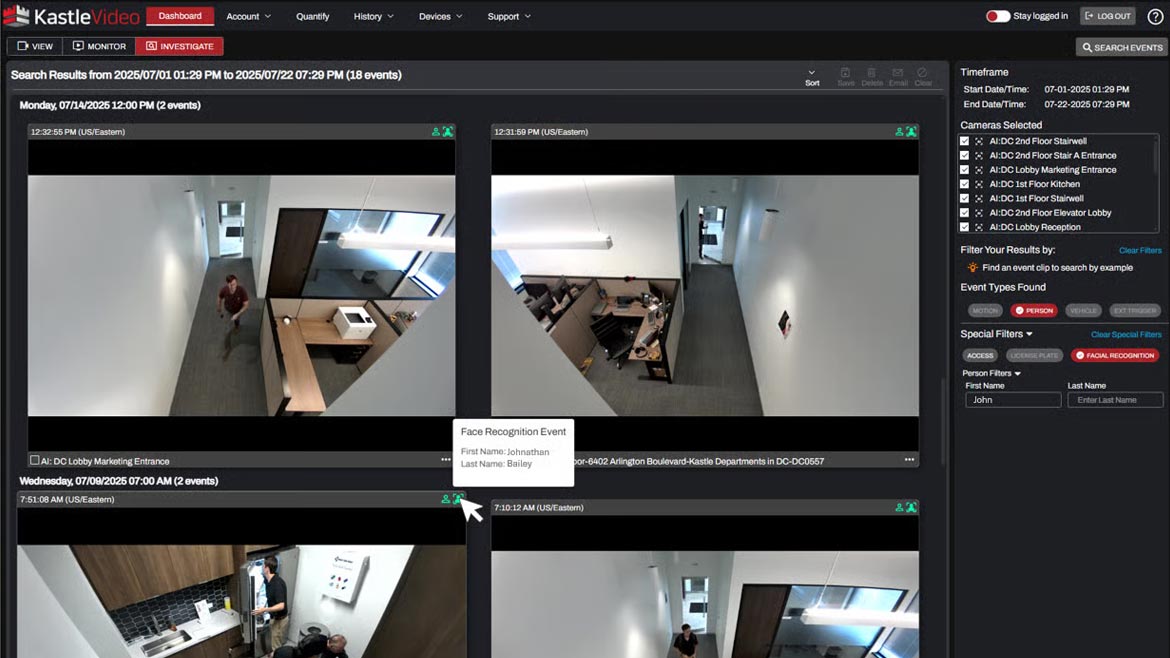
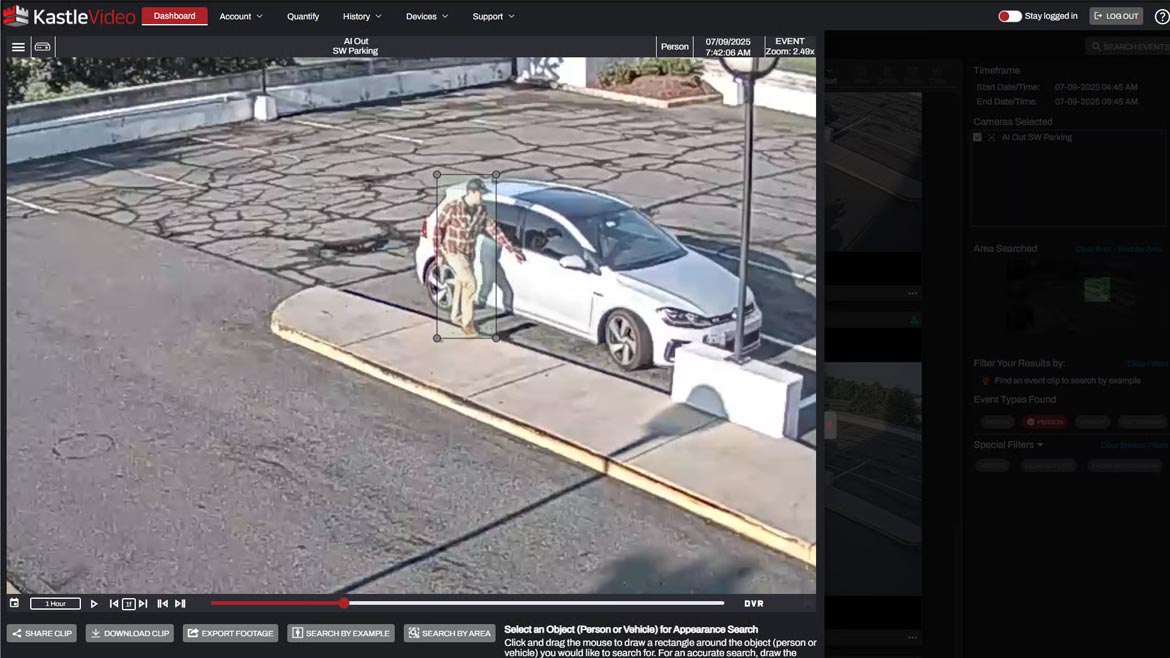
With traditional timeline and thumbnail searches, operators would be deluged with thumbnails, some of which may or may not have had the most pertinent information. Nik Gagvani, general manager of video services, Kastle Systems, Falls Church, Va., explains that an operator can have AI tag several deceptively complex things. “I can say, ‘I don’t care about all these motion tags video on my timeline. I care about a person that was … on the sidewalk next to my building, not on the street.’ [Or, I can say] ‘I don’t care to search for people walking up and down the sidewalk. I care about someone that was there on that sidewalk in the last 12 hours and stayed there for 30 seconds.’” Gagvani says that search engines throw out 90% to 95% of things that aren’t necessary to look at that would have otherwise come up on a motion-based timeline.
Not only is this technology sifting through enormous amounts of footage in just moments, it is, like everything else, getting smaller and more portable, meaning companies might not need the rooms full of servers and equipment they used to, and they can get much more efficient information than before.
“Analytics got smarter; the code got cleaner,” Parker says. This clean data simplified things, offering more speed and stability. He adds, “As that happened, they were able to move the metadata tagging to the edge — i.e., the camera.”
IDIS currently has an Edge AI line of cameras and its recently launched Edge AI Plus line. Parker acknowledges that there are, of course, tradeoffs with moving this technology to the edge, especially when it comes to the most advanced forensic search capabilities or the most advanced proactive monitoring and alerting.
Many things are still moving from the big box to the cameras, says Forest Liu, senior director of product management, surveillance, and security, ADI | Snap One, Melville, N.Y. However, “every year we discuss this topic, there is more and more AI on the edge,” he says. He adds the caveat that there are always some things on the edge that cannot do 100% of what one might want from this technology in terms of peace of mind, safety, or business intelligence.
Something From Nothing: The Myth of Video Enhancement in the Movies
Hollywood has a reputation for playing fast and loose with technology, presenting as reality things that astute viewers might point out as unrealistic or “movie magic.” We asked professionals in the video surveillance field for their evaluations about portrayals of forensic searches as presented on TV and in the movies.
“It’s interesting when you’re watching a movie and you see somebody say, ‘Enhance that image,’ and then they do a reflection off a mirror, and then a reflection off an eyeball iris, and all kinds of wild things,” says Richard Solovyev, product marketing manager, ADI | Snap One. Realistically, he says, most cameras installed residentially or commercially are probably going to be 4K or sub 4K. “So, to be able to go off a reflection of a reflection, that realistically doesn’t happen.”
In some movies, Solovyev says, the surveillance AI seems almost psychic. “However, AI is only as good as the training data that it’s been given,” he says. “It can’t foresee the future. You still need that human element of a person analyzing the data, viewing it and understanding the story of what’s going on in that scene.”
Hans Kahler, chief operating officer, Eagle Eye Networks, Austin, Texas, agrees with the need to take precautions when it comes to AI. “There is a lot of investment and development happening in the rapidly evolving AI space, but we’re really still in the early stages — even the AI that has nothing to do with video surveillance still has a long way to go,” he says. “With that rapid evolution comes new benefits and potential risks. I believe AI should be used as a helper, but it shouldn’t completely replace human decisions or actions.”
Aaron Saks of Hanwha Vision America says Hollywood is way ahead of reality. “Hollywood loves the ‘enhance’ feature, zooming in endlessly and sharpening images beyond realistic limits,” he says. “In the real world, you need a certain number of pixels to identify people, read license plates, and gather details. You can’t magically extract clarity from a blurry image. It’s mostly Hollywood magic.”
Saks says that, although Hollywood movies show every camera doing everything, all the time, “In reality, while we can provide Re-ID, AI forensic search, attribute filtering, and license plate recognition, these features are available only on cameras that support them — and only if the entire VMS supports it end-to-end.”
Most organizations don’t replace all their cameras at once with the latest AI models due to cost constraints and lifecycle considerations. Typically, Saks says, these organizations prioritize. “Choke point cameras may have Re-ID, indoor cameras may use AI, etc.,” he says. “On TV, it looks like you can type in a keyword and instantly search every camera. That may just not be practical for many systems today.”
Steve Burdet of Axis Communications says, “Real-life video forensics is more advanced than ever, but it’s still not as effortless as what you see on TV. Finding a ‘needle in a haystack’ remains a challenge — though modern technology can shrink the haystack or enlarge the needle, so to speak. It still takes time, analysis, and often multiple tools working together.”
In many ways, however, the gaps between Hollywood fictional forensic video capabilities and real life are converging, says Matt Lamb of Bosch Video Systems. “What we usually see on TV is either an exaggeration of capability or depicts an archaic, clunky approach requiring manual human inspection. What you often do not see is the procedure and methodical handling of video, once it is identified as pertinent for an investigation, to ensure compliant usage downstream as evidence.”
As we move towards the exaggerated reality that Hollywood often displays, Kahler believes in a future where language learning models (LLMs), a notable forensic search trend, will grow to be extremely reliable tools. “Eventually, a business owner will be able to ask their security system questions like ‘find instances where customers appeared exasperated in checkout lines,’” he says. “LLMs will also be able to provide context and analysis of search results. VMS manufacturers, AI technology providers, camera manufacturers, and others are working on ways to commercialize LLMs. There are many unknowns, but we do know that cloud-based platforms with an open API are set up for success because they can easily integrate LLM capabilities from many sources.”
Burdet adds, “One of the biggest leaps forward is automation. Today’s systems can filter footage by specific criteria — like location, object type, or behavior — so analysts no longer have to manually scrub through hours of video just hoping to spot something. It dramatically speeds up investigations.”
As for the scenes where a sharp-eyed detective spots something in the footage that no one else could? “That’s less likely these days, unless it was so nuanced or minute that the camera couldn’t understand it or detect the object,” Burdet says. “In most cases, technology now does the heavy lifting.”
Looking for a reprint of this article?
From high-res PDFs to custom plaques, order your copy today!