Barnes Buchanan 2026: Bullish on the Security Industry
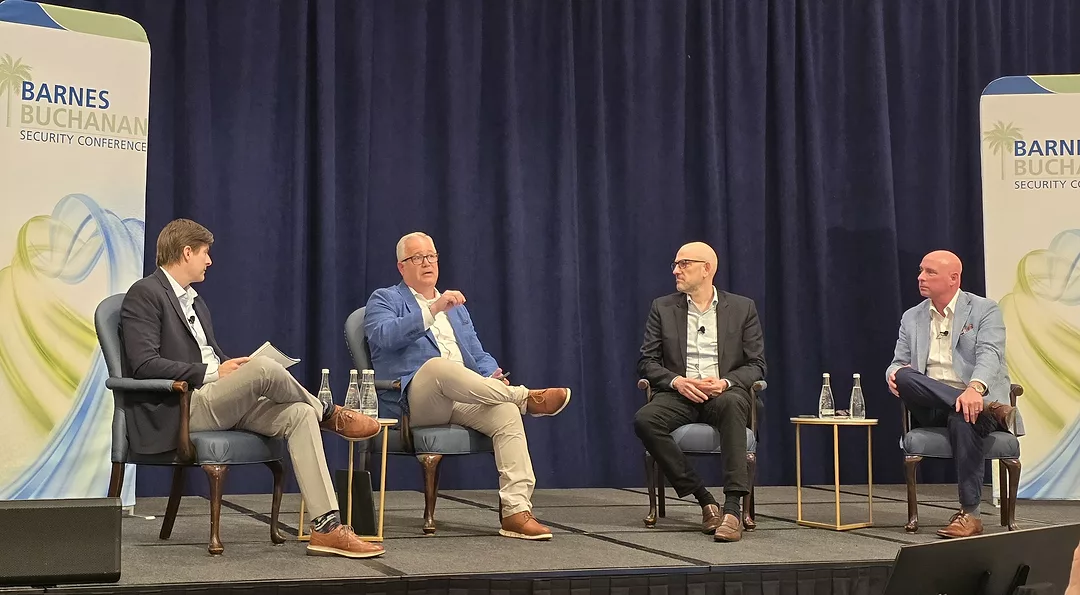
A panel of industry leaders discussed the impact of AI the monitoring industry. From left to right: Rob Jones, Buchanan (moderator); Steve Butkovich, CPI Security; Daniel Oppenheim, Affiliated Monitoring; and Brent Uhl, Guardian Alarm.

At the 2026 Barnes Buchanan conference, co-founder Mike Barnes (right) was presented with a plaque to honor his more than 30 years of involvement in the conference, as it was announced that Barnes Associates would be stepping back from its involvement, with Raymond James taking their place going forward.
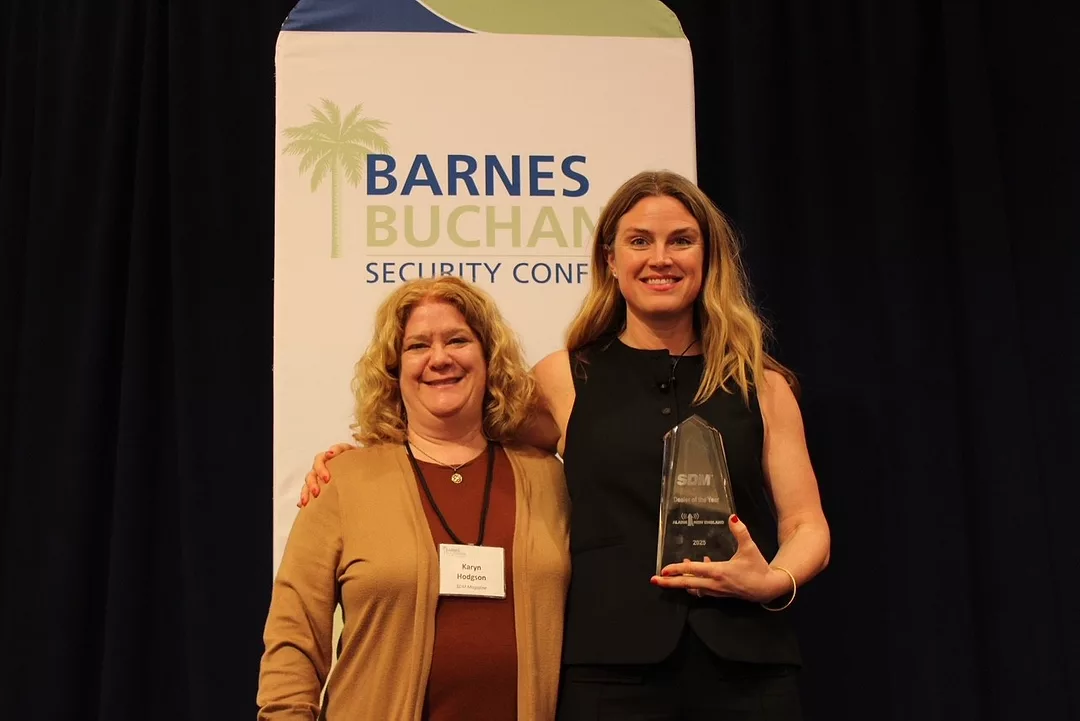
SDM Editor Karyn Hodgson (left) presented the 2025 SDM Dealer of the Year award to Alexandra Thompson (right), president of Alarm New England.
In what we in the journalism world refer to as “burying the lede,” it wasn’t until near the end of this year’s Barnes Buchanan conference, held annually for the past 31 years at the Breakers in West Palm Beach, Fla., that attendees learned this would be the last “Barnes” Buchanan conference. Mike Barnes, the founder of Barnes Associates, an investment banking firm well known in the security industry, is stepping back from his traditional, prominent role in the event starting next year, and Alper Cetingok and the Raymond James group will partner with Buchanan going forward.
Mike Barnes assured attendees that he and the company would still be involved in the conference, and hopefully do some presenting, but not to the extent that he has in the past — which means this year was the last to see his iconic second-day presentation on the security alarm industry trends, overall health and M&A activity.
But before all that was announced, day one of the conference focused on one of the biggest trends in the industry: artificial intelligence.
AI’s Impact on the Security Industry
The first presentation of the event, “AI Risk and Reward: the AI Landscape and What Lies Ahead,” focused on the impact of AI overall. “We are all going through this transformation together,” said Hart Brown, president, AI and transformation, Saxum, a strategic consulting firm. “Technology is moving faster than the general population can understand, and legislation generally lags behind technology. Legislators don’t understand it and don’t want to write something that will be wrong, so nothing is happening.”
This lack of legislative “rules,” means that here in the U.S., “We are all gas and no brakes,” Hart explained, while Europe is more, “All brakes and no gas.” While at the corporate end user front, liability issues are causing some companies to hesitate on implementing the technology. “If a system is making a decision on your behalf or communicating on your behalf, is it an agent of your organization? There are these liability issues and no legislation behind you,” Brown said. And it is only getting more complex the faster AI evolves.
The bigger impact in the short term for AI will be for those companies who are using it internally, for their own efficiency, marketing and metrics. “It’s about turning human capital into compute,” said Harry Valetk, shareholder, Buchanan. “Generative AI is based on probabilities and patterns, and that is where both the questions and the opportunities lie.”
Looking for quick answers on security topics? Try Ask SDM, our new smart AI search tool. Ask SDM →
Brown suggested that AI might help small startups outperform large companies in a very short period of time. “For mature industries that haven’t had to move quickly and innovate for a period of time, they have been able to grow just due to the industry itself,” he said. “We may see small upstarts potentially break through at speed. It is not just hype.”
Next up was a panel specifically addressing how the alarm industry is utilizing AI today and going forward. Steve Butkovich, chief product officer, CPI Security; Daniel Oppenheim, CEO, Affiliated Monitoring; and Brent Uhl, president and CEO, Guardian Alarm (SDM’s 2024 Dealer of the Year), shared their experiences with AI in the session, “From Monitoring to Platform: How AI and Technology Are Changing Operations and Growth.”
Butkovich said, “AI is causing all of us to question how we are running our businesses and how we can monetize AI. This needs to be something intentional.” He shared examples of how CPI is using generative AI to help customers with common questions as well as using AI for video verification for residential customers.
“At its essence, AI can make us more efficient,” Oppenheim said. “We formed an AI workflow committee and use it for training of monitoring specialists. We also built an HR chatbot and other pilot programs.”
Uhl called 2025 a “foundational” year for Guardian Alarm. “Generative AI is pretty much used in every department,” he said. “We have a marketing automation program, AI machine modeling around risk for attrition, and we built an in-house large language model for a tech support group.”
One thing all the AI presenters agreed on is that the ‘human in the loop’ is not going away any time in the near future. “We are not ready for AI to supervise AI,” Brown said.
“We came up with an AI charter and talked through, ‘Here is what AI is and where we use it today,’” Uhl said. “It has to be good for the customer experience and elevate our team members. We told them, ‘You aren’t going to lose your job because of AI; you are going to lose it because you don’t know how to use AI.”
Butkovich added, “The human in the loop portion of this technology is very important right now. We need to make sure AI is doing the things we want correctly. The more we go down the agentic AI road in the future, it will be very critical [to get it right] in life safety applications.”
Oppenheim expressed optimism about where AI is taking the security industry: “It is an exciting opportunity for our industry because it will unleash a lot more things to monitor and more services to offer customers,” he said. “We have found, when it comes to adoption, you have to rethink the [human part]. So many of our processes are human-centered, so if we were doing things with AI, what would those steps be? We need to redesign the way the company works in some ways. There is still a human, but maybe in a different role.”
Uhl gave this advice to other security companies that may feel anxious about AI: “It is easy to get distracted by everything going on. … Keep it simple. Ask, ‘Does it improve the customer experience? Make you more profitable or efficient? All the same levers you are using today, does it help those?’”
Following the panels on AI, three companies gave presentations: RapidFire Safety & Security, KEYTH Systems, and SDM’s 2025 Dealer of the Year, Alarm New England, after which I presented the award to Alexandra Thompson, president of the company.
Alarm Industry Overview
In his Friday morning presentation, Mike Barnes was happy to be the bearer of good news for his final presentation of this type at the conference. “The alarm industry had a really good year last year,” he said. “Anecdotally, we looked at the operating results of hundreds of alarm companies, and what we are seeing now is a lot of energy in the space.”
On a macro level, the security alarm industry grew total revenues at a CAGR of 6% between 2020 and 2025. “The sales and installation as a proportion of total revenue is up from past years,” Barnes said. “A lot of this is from what we see as a couple of different things causing this shift. The first is price; more companies are less willing to fully subsidize the sales and installation of the system. They are charging more up front.” The other, he said, is the size of the systems is also up, with more large commercial installations.
“The sales and installation number indicates that we are likely heading into higher growth,” Barnes said, adding that, for the period of time his company has been tracking the numbers (since 2006), the RMR revenue had never decreased, even during the recession and COVID periods. “That is a sign of resilience in the industry.”
Looking at revenue growth from 2024-2025, Barnes highlighted that installation rates were up a combined 7%.
What is driving this growth? Barnes pointed to specialty segments such as large commercial (12%), video (16%) and smart home (13%) in particular. “When you look at the traditional intrusion and fire systems that comprise the bulk of the industry, that is growing around 3%,” he said.
He also praised the industry for being willing to raise both installation and monitoring prices to reflect inflation, and encouraged companies to keep doing that.
“The fundamental growth drivers remain incredibly strong,” Barnes said. “These systems work, and, if anything, they are getting better. The value proposition is getting stronger. … The segment to keep an eye on is video, video, video.”
Looking at where the industry is moving, changing hands and consolidating, Barnes said, “Where we stand at the end of 2025 is that national players have about 48% of share, regional players (which, he noted, includes much of the SDM 100 list) 11% and local players around 23%.
“What is interesting about this is, if you look at it over time, yes, the industry is consolidating,” he says. “Both local and regional are shrinking. Together, they made up about 50% in 2016 and now they are 34%. Is this inherent? I don’t see anything fundamental that says smaller, capable companies can’t compete with big jumbo national companies.”
Barnes cited companies in the remote video monitoring space as good examples of this. “I think the industry remains ripe. In 10 years, the local percentage will still be down, but I stand by the notion that there is no inherent reason why the industry needs to consolidate. … If anything, video in the near-term supports the smaller, more nimble players that are entrenched in the industry and know how to deliver it.”
Barnes also delved into the operating metrics of security alarm companies, noting that, at the end of 2025, the average dollar in the industry statistically produced 12 cents of billable service revenue. While that may not sound like a lot, he stressed that the number is up, as is the average margin on monitoring and services — which had been on a downward trend since 2017. “The average [margin] is 51.2%,” Barnes explained. “For most of the last decade, the margin was declining. It was 53.9% in 2017, which is still down but now trending back up for the past three years in a row.”
In more good news, the RMR creation multiples are also down, in part due to the better pricing he mentioned earlier. But another factor surprised him: “There is increased efficiency in sales and marketing spend.”
While Barnes himself didn’t make this connection, it is hard not to wonder if AI might be starting to play a role in that efficiency, at least for some companies.
M&A Outlook
As the future partner with Buchanan, Alper Cetingok took a turn at the podium to discuss the view from Wallstreet. “M&A is certainly back and expected to go up,” he said. He also noted the interest in investors in managed services business models.
Other key trends Centingok pointed out included the continued emergence of large consolidator companies entering the space and an overall strong market momentum, with several landmark M&A transactions in the past year.
Barnes later noted, “The story in 2025 is consistently more activity; about 21% of the industry has changed hands in the last four years. That signals a shift, with new money coming in and more consolidations.”
This was somewhat surprising, Barnes noted. “Last year, we thought we were going into a continued moderate but stable acquisition period. … Halfway through 2025, the number of deals soared.”
However, one prediction Barnes said he was correct on was that the market was going to get pickier on which companies to acquire. “The market is frothy,” he explained. “Every deal coming to market has buyers, but the burden is on the seller to show you are a solid company.”
For this year, Barnes does predict continued growth. “I project we will stay on the track we are on now with more transactions. … We are bullish on our valuations; those of you in the space are doing great. Generally, the number of buyers that are capitalized as a percentage of industry players is up.”
Threats & Opportunities
Barnes didn’t see a lot of red flags for the industry, but he did point out a couple of possible threats, as well as opportunities to be aware of.
“The industry is truly in such good shape,” he said. “We are as well equipped as ever and firing on all cylinders. But don’t forget about inflation and its effects. We are still sitting at a higher rate than we have for most people in the industry now. Many companies are on their second generation ownership. Executives in their 40s and 50s did not cut their teeth in a time when inflation was high. They are used to virtually zero inflation. It was a big wake-up call in 2021 with a lot of resistance to the notion that they had to raise prices. They didn’t have a lot of experience on how to do that.”
Fortunately, he said, most have now found their footing and found that they can make it through a 3-4% increase with no pushback. Now interest rates are back down, but Barnes cautioned they are likely to stay in the 3% range for a while.
Noting that the current rate of inflation means what used to cost $1.00 now costs $1.27, Barnes added, “If you haven’t raised your prices by 27%, you are lagging.”
The second threat Barnes identified is attrition. “Are we potentially in an environment where operating metrics might have more volatility than we are used to? There is an increased risk of that and the better your data systems are and the more you can know in real-time how your businesses are operating, the better you will understand when certain metrics move on you.”
While those were the two big threats, Barnes also pointed to remote video monitoring as both an opportunity as well as a possible threat. While there is a lot of information to process, both literally and figuratively to make the most of this opportunity, Barnes is very enthused about the potential. “Why video is such an opportunity is because of the cost and capability around automation, bandwidth, storage and computing power. Plummeting costs and soaring capabilities are playing to the sweet spot of what video can do. Put AI on top of that, and we are poised for massive growth in the space.”
Another opportunity/threat Barnes identified is people, particularly salespeople.
Barnes invited Gretchen Gordon, president of Braveheart Sales Performance, to share some metrics her company has collected. “Most security and fire businesses don’t have a sales problem; they have a systems problem,” she said. “They are too reliant on the hero salesperson.”
Beyond that, many are still selling primarily “smarts and parts,” she added. “Only 8% sell consultatively.” What’s more, when asked about motivation, just one third of salespeople are motivated by traditional compensation such as bonuses, awards and trips. “Almost half are motivated intrinsically,” she said.
What does this mean for security dealers and integrators? “It is a huge opportunity for higher growth,” Barnes said. “The industry’s growth isn’t being governed by some limit. I think the biggest limiter is that we are not leaning into the growth enough.”
While adding that the Barnes Buchanan conference itself (which will continue to be held at the same time and location going forward) will be seeing big changes, Barnes assured attendees he would still be involved, though to what extent is to be determined.
He left with this thought on the information he presented this year: “We see green on the metrics and plenty of room to improve.”
Looking for a reprint of this article?
From high-res PDFs to custom plaques, order your copy today!