Horns & Strobes: Clarifying Code Requirements
Momentmal | Pixabay
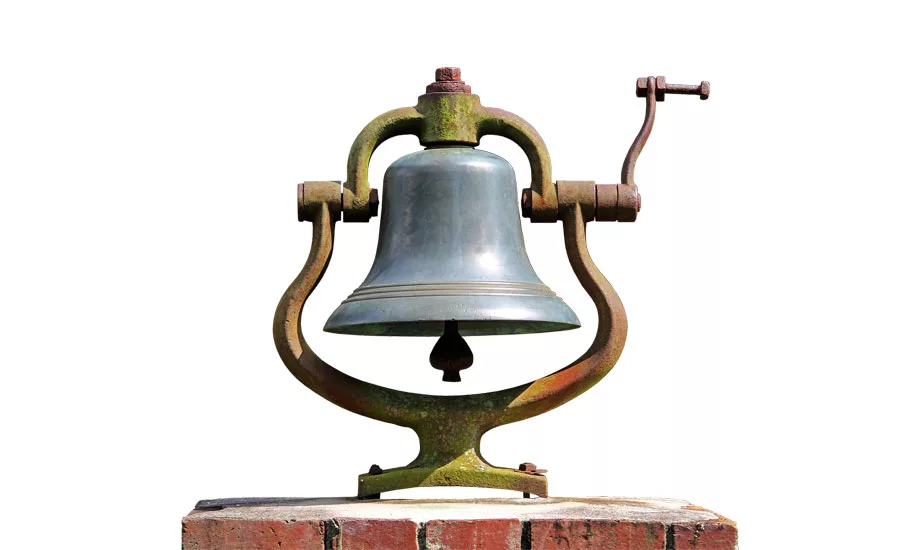
Until the mid 1980s, bells were the common notification appliance for fire alarm systems. They were loud and for the most part, could be heard better than today’s horns.
As fire alarm control units evolved from using relays to using electronic components, horns began to replace bells to notify occupants. This was due to the electrical “noise” generated by the bells. This noise caused problems with electronic circuitry that typically used a low operating voltage. Mechanical horns were used, but these still generated an unsatisfactory level of noise when integrated circuits became common. Manufacturers started producing electronic horns to reduce this problem. Unfortunately, in order to reduce current flow, the electronic horns operated on a higher frequency; thus, sound was not transmitted as well as bells or mechanical horns. So, more horns were needed.
Most fire alarm systems today still use electronic horns. These are typically used when full building notification is required. If only selected portions of a building are to be signaled, emergency voice alarm communication systems (speakers) are used.
There seems to be a lot of confusion about when audible notification appliances are required. Keep in mind that NFPA 72, National Fire Alarm Code, does not require any notification appliances to be installed. They are required by the applicable building, fire or life safety code. For example, horns are not required if a fire alarm system is only installed to monitor a sprinkler system. In that case, horns would only be required if the sprinkler sections of the applicable code required occupant notification. Simply installing a fire alarm system for monitoring purposes does not drive a requirement for occupant notification.
NFPA 72 provides requirements for installation, inspections and testing of the notification appliances. Chapter 7, Notification Appliances, provides the requirements for mounting heights and loudness. NFPA 72 states that audible fire alarm notification appliances used in the public mode (notifying occupants) must be a minimum of 15 dB (decibels) above average ambient sound levels.
It is important to determine what the average ambient sound level will be before installing the horns. It is recommended that this be discussed with the local fire marshal to ensure the installer and AHJ are on the same page. It is quite easy to determine approximately how loud a horn will be once it is installed if you know the rated value of the horn, the type of building construction (drywall, concrete block, glass, etc.), the type of doors that are installed (hollow core or solid) and the distance the horn will be installed from the space where it must be heard.
A good rule of thumb is that you will lose up to 6 dB every time you double the distance from the horn. Audible notification appliances are rated at 10 ft. from the appliance. So, if you had a horn rated at 95 dBA at 10 ft., and you measured the sound level at 20 ft., you could be as low as 89 dBA. You will only lose 6 dB in free air or an anechoic chamber where there is no sound reflection. In a typical building, loss will be more in the range of 3 dB to 4 dB. How much sound you actually will lose is determined by the softness of the materials. If you have an acoustical ceiling and carpets, you will lose more sound than if the walls and ceiling are drywall and the floors are tiled.
Looking for quick answers on security topics? Try Ask SDM, our new smart AI search tool. Ask SDM →
Another factor in determining sound levels in a given location is factoring for sound loss through doors. If a door is open, you will lose 4 dB to 12 dB, depending on the width of the door opening. If you close the door, that loss will increase to 10 dB to 24 dB, depending on whether it is a hollow core door or a solid door. If you seal the openings around the door, that will increase the sound loss to 22 dB to 34 dB. Using this basic information will provide a reasonably close estimation of what the sound level will be at the installed location. (Sources: NIST Handbook 119 – “Quieting: A Practical Guide to Noise Control” and D. A. Robinson, University of Massachusetts, “Sound Transmission Loss From Corridors to Rooms: Implications for Locating Fire Alarm Sounders.”)
The NFPA 72 requirement for sleeping rooms is either a minimum of 75 dBA or 15 dB over the average ambient sound level, whichever is greater. It is important to use a sound level meter to ensure the minimum sound levels have been achieved. NFPA 72 requires sound level meters to meet the requirements of ANSI S1.4a, Specifications for Sound Level Meters, Type 2 requirements. This basically means the meter must be able to be calibrated.
NFPA 72 requires that horns used for evacuation use the three-pulse pattern Standard Audible Emergency Evacuation Signal. Horns also must be synchronized within a notification zone.
Strobe Lights
Visible alarm notification appliances have been in use since the early 1980s. The earliest method was intended to guide occupants to an exit by flashing exit signs. However, smoke could obscure these signs easily, so incandescent lights were installed in the vicinity of the exit signs.
Today, visible alarm notification appliances are installed to notify hearing-impaired occupants of a fire emergency and are not required to be installed at the exits. Strobes began being used in the late 1980s to replace incandescent lights because they were brighter and could be seen better in a smoke-obscured environment. With the introduction of the American’s with Disabilities Act in 1990, the intensity of the strobes increased and the lens became clear instead of a milky white or red.
As with horns, NFPA 72 does not require strobes to be installed; the applicable building, fire or life safety code does. NFPA 72 provides requirements for mounting heights, brightness, location and synchronization. Tables in Chapter 7, Notification Appliances, provides guidance for choosing the proper candela rating for the location for both ceiling- and wall-mounted strobes.
One of the more common mistakes when installing strobe lights is to select the wrong candela rating for the location. For example, you can use a 15 cd (candela) strobe light in a 20 ft. by 20 ft. room. However, it must be mounted at the center of one of the walls. If it is offset, let’s say 5 ft. from one wall, you must measure the distance to the farthest wall and double that distance to determine the correct candela rating. This essentially places the strobe in the middle of a virtual room. So if your strobe is installed 5 ft. from one wall, it will be 15 ft. from the opposite wall. Fifteen doubled is 30, so the correct candela rating would be a minimum of 34 cd instead of 15 cd. Every strobe light manufacturer has templates available based on Figure 7.5.4.3.1 of NFPA 72 to aid in selecting the proper candela rating for the location.
The International Building Code (IBC) now requires shop drawings submitted for Plan Review to have the location and the candela rating indicated on the drawing. This will aid the plan reviewer in determining the correct candela rating, help the contractor determine proper voltage drop calculations and help the installer install the correct strobe light in each location.
Due to the current wording of the ADA Accessibility Guidelines (ADAAG), conflicts exist concerning the minimum candela rating to be used. ADAAG states that the minimum strobe intensity is 75 cd. However, there is another paragraph in the ADA that permits “equivalent facilitation.” This allows you to deviate from a minimum of 75 cd, provided the strobe light accomplishes its intended goal – alerting hearing-impaired individuals of a fire emergency. If you follow the guidelines of NFPA 72, you will comply with ADAAG.
Proposed changes for ADAAG would allow using the installation requirements of NFPA 72 instead of providing its own minimum requirements. This change has been postponed numerous times since introduced in 1996, and was recently postponed again to allow the new administration to review it.
Looking for a reprint of this article?
From high-res PDFs to custom plaques, order your copy today!