SDMmag logo
search
Go to Ask SDM AI
cart
facebook twitter linkedin youtube
  • Sign In
  • Create Account
  • Sign Out
  • My Account
SDMmag logo
  • NEWS
  • PRODUCTS
  • TOPICS
    • Access Control & Identification
    • Integration & Network Solutions
    • Life Safety & Fire Alarm
    • Monitoring
    • Smart Home
    • Trends & Industry Issues
    • Video Solutions
  • COLUMNS
    • Digital Shuffle
    • Editor's Angle
    • Insider News & Business
    • Integration Spotlight
    • Marketing Madmen
    • Security & the Law
    • Security Comings & Goings
    • Security Networkings
    • Technology @ Work
    • Technology Solutions & Skills
    • SIA Waypoints
    • Cybersecurity Chronicle
  • EXCLUSIVES
    • Annual Industry Forecast
    • Dealer of the Year
    • Project of the Year
    • SDM 100
    • State of the Market Series
    • Systems Integrator of the Year
    • Top Systems Integrator Report
    • TMA Excellence Awards
  • BLOG
  • MEDIA
    • Videos
    • Podcasts
    • Polls
    • White Papers
  • EVENTS
    • Industry Calendar
    • Webinars
  • MORE
    • Classified Ads
    • Newsletters
    • SDM Store
    • State of Security eBook
    • Sponsored Insights
  • BUYERS GUIDE
    • Buyers Guide
    • Take a Tour
  • EMAG
    • eMagazine
    • Archive Issues
    • Monitoring Today
    • Advertise
  • SIGN UP!
Intrusion AlarmStandards, Regulations & LegislationSecurity & the Law

Fire Truck Accident Not Alarm Company’s Fault

By Lessing E. Gold, Contributing writer
July 7, 2016

An interesting case just arose in the state of Pennsylvania in a rather complicated set of facts. An employee of the alarm company was testing a smoke detector for a client. The smoke detectors were connected to a clone of the fire alarm panel at one of the alarm company’s clients. The employee did not have permission to clone or use a clone of the client. Because the cloned panel was plugged into an active phone line rather than the test line, the employee’s test of the smoke detector triggered a fire alarm at the client’s premises.

In response to the fire alarm, the city fire department dispatched a fire truck. While en route to the premises, the driver of the fire truck came upon a traffic backlog, near a stoplight. In order to avoid the traffic, the driver crossed the median divide and began driving the wrong direction. When the fire truck crossed the median, the drivers moved over into the right lane to allow the fire truck to pass in the left lane. At the same time, a driver [the decedent] was traveling in the left lane and like others, moved over into the right lane when the fire truck crossed the median. The decedent, however, then pulled back out into the left lane and sped down the left lane in an effort to pass the traffic in the right lane. As he was attempting to merge back into the right lane, the decedent lost control of his vehicle and collided with the fire truck. As a result of the collision the decedent sustained serious injuries and died. 

The plaintiff, the executor of the estate of the deceased, filed two actions arising from the crash, one in which she named the driver of the fire truck, the city, the customer of the alarm company and the manufacturer of the fire alarm system. A separate action was filed against the alarm company and its employee who was testing the smoke detector. The actions were consolidated and all of the defendants filed motions for summary judgment. The trial court granted summary judgment in favor of the alarm company, its employee and the client on the basis that the alarm company and its employee were independent contractors for the client and that the client was not responsible for their actions. The plaintiff appealed. As to the city and the driver of the fire truck, the matter went to trial and the jury found that neither the city nor the driver of the fire truck were negligent. (The plaintiff appealed, but that decision is not relevant to this article.) 

The appellate court in discussing the case, determined that the alarm company and its agent must be a factual cause and a proximate cause to be held liable. The employee of the alarm company did not create a force or series of forces that were in continuous and active operation up to the time of the harm. A reasonable person can foresee that a fire truck will respond to a fire alarm. However, it is unlikely and therefore not reasonably foreseeable that an emergency vehicle will be in an accident causing harm to another motorist on the way to the emergency as a natural and probable outcome of setting off a fire alarm. 

The causal chain of events resulting in the decedent’s death is too remote and highly extraordinary and therefore, it cannot be said that the alarm company and its employee are a proximate cause in the decedent’s death. Holding the alarm company and its agent liable for the injuries would extend liability to anyone who accidently set off a fire alarm in their home. This court was unwilling to set such a drastic and far-reaching precedent. 

The court concluded that although the alarm company’s and its agent’s action were a cause-in-fact of the accident, those actions were not a proximate cause of the accident. Therefore, the order of the trial court granting the summary judgment was upheld.


Readers Ask

 I have an alarm company in Southern California. Various cities in Southern California are adopting ordinances that specify they are adopting a minimum wage which is different than the state and federal minimum wage law.  We are presently complying with the minimum wage law in the city where our company is located. We have been asked to install a system from a city that has adopted a minimum wage that is greater than the minimum wage in the city in which my company is located. By installing the system in the city with the greater minimum wage, do I have to pay the increased minimum wage or do I comply with the minimum wage adopted by the city in which my company is located?

Looking for quick answers on security topics? Try Ask SDM, our new smart AI search tool. Ask SDM →

To ask Les Gold a question, e-mail SDM@bnpmedia.com.

ANSWER

I cannot give you an exact answer because I have not seen any case law or legislative interpretation of the rule.  I would assume, however, that if you are doing business in the city with the higher minimum wage, to be safe, you probably should pay the higher minimum wage for the period of time that your employees were working in that particular city. This appears to be a new phenomenon and until the courts make a determination we can only assume that you have to pay the minimum wage in the municipality where you are doing business.

KEYWORDS: fire detection security service

Share This Story

Looking for a reprint of this article?
From high-res PDFs to custom plaques, order your copy today!

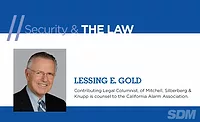
Lessing E. Gold of Mitchell, Silberberg & Knupp is counsel to the California Alarm Association and a contributing legal columnist. He can be reached at sdm@bnpmedia.com.

Recommended Content

JOIN TODAY
to unlock your recommendations.

Already have an account? Sign In

  • SDM 100

    SDM 100: Top 100 Security Dealers of 2026

    The top 100 security dealers navigated a complex...
    Exclusives
    By: Karyn Hodgson
  • Security camera

    State of the Market: Video Surveillance

    As video surveillance shifts from siloed systems to...
    State of the Market Series
    By: Brianna Wilson
  • 2026 Industry Forecast

    SDM 2026 INDUSTRY FORECAST

    Rapid technology advances meet shifting economic...
    Annual Industry Forecast
    By: Karyn Hodgson
Manage My Account
  • SDM Newsletters
  • Online Registration
  • eMagazine Subscriptions
  • Subscription Customer Service
  • Manage My Preferences

More Videos

Sponsored Content

Sponsored Content is a special paid section where industry companies provide high quality, objective, non-commercial content around topics of interest to the SDM audience. All Sponsored Content is supplied by the advertising company and any opinions expressed in this article are those of the author and not necessarily reflect the views of SDM or its parent company, BNP Media. Interested in participating in our Sponsored Content section? Contact your local rep!

close
  • Doctor examining child patient with mother present in medical clinic
    Sponsored byHID

    The Human Side of Hospital Security: How Modern Visitor Management Protects People First

Popular Stories

April Maloney, Guardian Protection

State of the Market: Security’s ‘Sixth Sense’ Drives Intrusion & Smart Home

ESA Board of Directors Q2 26 Elections

Electronic Security Association Announces 2026 Board of Directors Election Results

AMAG CONNECT-2.0

Beyond the Buzzwords: What Security Integration Really Looks Like Today

SDM Dealer of the Year 2026 Promotion

Events

July 23, 2026

Fire Alarms in Focus: Tech Trends, Code Changes & Business Growth Strategies

In this webinar, SDM will explore how companies are expanding their fire offerings, increasing recurring revenue, and strengthening customer relationships. Discover practical insights to help position your company for success.

View All Submit An Event

Poll

What’s the most promising trend in the industry?

What’s the most promising trend in the industry?
View Results Poll Archive

Products

Physical Security Assessment Handbook An Insider’s Guide to Securing a Business

Physical Security Assessment Handbook An Insider’s Guide to Securing a Business

See More Products
SDM 100 2026 Rankings

Related Articles

  • Security  Law 2019

    Was a Security Alarm Company Negligent in Fire Death?

    See More
  • What is the Duty of the Fire Alarm Company?

    See More
  • Alarm Company Case Decides Verdict In Snowmobile Lawsuit

    See More

Events

View AllSubmit An Event
  • July 23, 2026

    Fire Alarms in Focus: Tech Trends, Code Changes & Business Growth Strategies

    In this webinar, SDM will explore how companies are expanding their fire offerings, increasing recurring revenue, and strengthening customer relationships. Discover practical insights to help position your company for success.
View AllSubmit An Event
×

Be in the forefront of security intelligence when you receive SDM.

Join over 10,000+ professionals when you subscribe today.

SIGN UP TODAY!
  • RESOURCES
    • Advertise
    • Contact Us
    • Directories
    • Store
    • Want More
  • SIGN UP TODAY
    • Create Account
    • eMagazine
    • Newsletter
    • Customer Service
    • Manage Preferences
  • SERVICES
    • Marketing Services
    • Reprints
    • Market Research
    • List Rental
    • Survey/Respondent Access
  • STAY CONNECTED
    • LinkedIn
    • Facebook
    • YouTube
    • X (Twitter)
  • PRIVACY
    • PRIVACY POLICY
    • TERMS & CONDITIONS
    • DO NOT SELL MY PERSONAL INFORMATION
    • PRIVACY REQUEST
    • ACCESSIBILITY

Copyright ©2026. All Rights Reserved BNP Media, Inc. and BNP Media II, LLC.

Design, CMS, Hosting & Web Development :: ePublishing