ALARM COMMUNICATION
ASAP-to-PSAP: The New Gold Standard for Alarm Monitoring
The Monitoring Association’s ASAP-to-PSAP service could revolutionize the way your monitoring center operates.
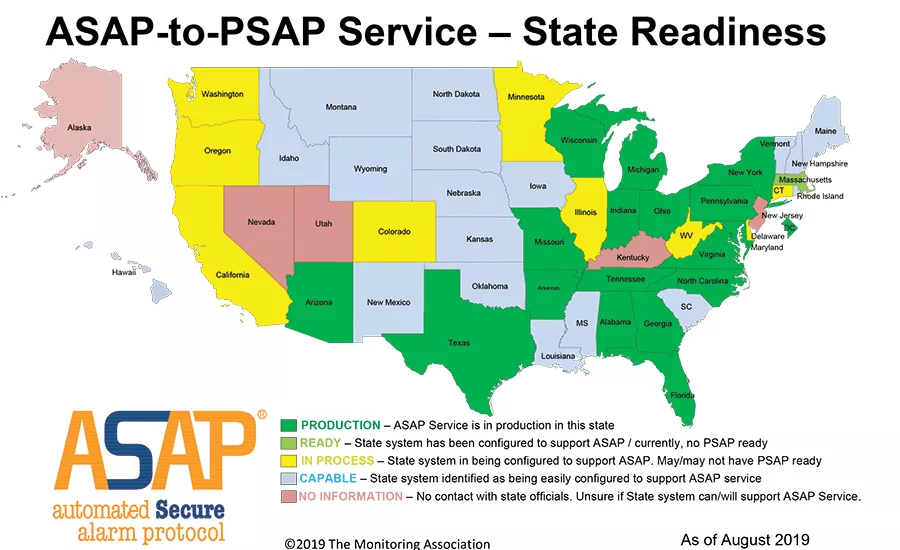
There are currently 62 PSAPs using ASAP, 24 PSAPs in testing or implementation, 25 alarm companies using ASAP and 13 alarm companies testing or implementing the platform.
IMAGE COURTESY OF THE MONITORING ASSOCIATION

Todd Shuff, vice president of operations at National Monitoring Center, Lake Forest, Calif., says the greatest benefit of ASAP-to-PSAP is that it allows the central station operator to contact responsible parties while the dispatch is being processed.
Nine years after its 2011 launch, The Monitoring Association’s (TMA) Automated Secure Alarm Protocol (ASAP) service is slowly — but surely — creeping into monitoring centers everywhere. As the most efficient way to process information from alarm monitoring stations needing emergency dispatch, it won’t be long before it becomes the standard for the industry, according to those already using it.
“From a central station’s perspective, ASAP-to-PSAP is a game-changing technology — from a customer service perspective, a 9-1-1 dispatch partner relationship development perspective, and from a central station perspective — because you’re delivering emergency services to people more carefully, you’re saving lives and property more quickly and you’re saving so much time,” says Steve Crist, director of monitoring, ADS Security, Nashville, Tenn. “For all those reasons, ASAP-to-PSAP is the gold standard for how we dispatch and how we do our jobs. Our anticipation is that all the dispatch centers we communicate with will eventually be on ASAP-to-PSAP, and we’re willing to create partnerships with them to get them there — it’s that important to us.”
Using the ASAP service, critical information about life safety events is delivered digitally directly to the Central Alarm Dispatch (CAD) system in seconds through the NLETS nationwide public safety network. The use of data communications virtually eliminates errors that are inherent in voice communications, ensuring that accurate information is being transmitted to the Public Safety Answering Points (PSAPs).
ASAP-to-PSAP was created almost 10 years ago when APCO, the trade association representing PSAPs, and TMA, then known as the Central Station Alarm Association (CSSA), sought to provide an electronic method to deliver alarms to first responders, according to Morgan Hertel, co-chair of TMA’s steering committee, member of its ASAP-to-PSAP committee, and vice president of technology and innovation at Rapid Response, Syracuse, N.Y. It then took time, test sights and monitoring centers willing to serve as guinea pigs to the new technology in order for the solution to become available five years ago.
Vector Security, Warrendale, Pa., was probably the most involved of all of these “guinea pigs,” engaging with TMA in its progress since the program’s inception. Vector was a part of the working group that, in conjunction with APCO and the IJIS Institute, worked to develop a standard for third-party integration with 9-1-1 centers, or Emergency Communication Centers (ECC), formerly referred to as PSAPs. As an early adopter, the team at Vector has been able to assist onboarding efforts for new ECCs, software providers and alarm companies.
“ASAP is all about utilizing today’s technology to share information with speed and accuracy,” says Vector Security President and CEO Pam Petrow. “ASAP passes relevant data and updates on alarm activity to the ECCs, eliminating the need for human interaction. The result is a better use of resources for the 9-1-1 center, accurate information because communications errors are eliminated, and a faster response to the constituents in a community. The time the automation saves is very impactful, especially for fire and medical situations.”
When using the ASAP-to-PSAP platform, the initial actions taken by the monitoring center remain the same, with an alarm being received and efforts being made to verify the alarm with the customer. ASAP enters the picture when the ECC needs to be alerted of an emergency. Then, the alarm industry automation providers have written code that integrates via ASAP with the CAD software in the ECC. Through that, the data is passed over the secure NLETS network, populating the computers in the ECC, and eliminating the need for information to be verbally relayed and then entered into the system.
Looking for quick answers on security topics? Try Ask SDM, our new smart AI search tool. Ask SDM →
At the time of writing, there are 62 PSAPs using ASAP, 24 PSAPs in testing or implementation, 25 alarm companies using ASAP and 13 alarm companies testing or implementing the platform.
Brian Vanderheyden, CEO of Richmond Alarm Company, Midlothian, Va., says that the company’s biggest push has been in the past 12 months, as they’ve on-boarded several PSAPs.
“We’re the largest monitoring center here in Richmond, so it just made sense for us to introduce the program to a large percentage of our customer base here locally,” Vanderheyden says.
Vanderheyden says that preparing to go ASAP was relatively easy for Richmond Alarm, with just some light staff training and adjustments to software. The only challenge, he says, is that different municipalities use different address abbreviations, so the monitoring center has to research what abbreviations to use for each municipality.
“Honestly it’s been really easy to use and helpful, so you sort of disregard any challenges because the benefit of it is so great,” Vanderheyden says. “I think any time you have more direct and efficient communication with authorities, that’s a good thing. So our goal is to help more jurisdictions see the benefit of this and want to onboard the technology.... We’re just so excited to provide this service — looking back I wish we would have done it sooner.”
Todd Shuff, vice president of operations at National Monitoring Center, Lake Forest, Calif., says the greatest benefit is that ASAP allows the central station operator to contact responsible parties while the dispatch is being processed by the agency.
“In some cases, we can reach a responsible party who may cancel the dispatch before the agency has a chance to send a unit, thus avoiding a false alarm charge,” Shuff says. “This also speeds up the dispatch process, allowing operators to handle more alarms more efficiently.”
Crist says that TMA was a huge help in getting ADS set up with ASAP. The organization helped them find a municipality partner to kick off the process — Morgan County, Ala. — and after eight or so weeks of preparation, they were able to use ASAP.
He urges any monitoring centers that haven’t starting using ASAP-to-PSAP to make the switch.
“Do not delay — you should advance ASAP-to-PSAP to the top of your priority list,” Crist says. “The time savings is very valuable, which is secondary only to the importance of getting emergency services to people who need them. ASAP-to-PSAP shaves precious minutes off the dispatch process, which saves lives.”
Adoption of ASAP-to-PSAP is not happening as fast as some thought, which is partially due to a lack of government funding for ECCs to update their CAD systems. Guardian Protection, Warrendale, Pa., implemented ASAP-to-PSAP when it first became publically available five years ago, and while they are connected to all of the municipalities utilizing the technology in their coverage areas, Vice President of Care and Monitoring Operations Jason Bradley is looking forward to a future where they can use ASAP for all emergency dispatches.
“If we get the whole industry on this platform, it makes it more appealing for the PSAPs to become involved,” Bradley says. “All the big security companies are on there now, so if we continue down that path, I think we have proven there are tremendous advantages. I think it seems strange in today’s world that two professional entities exchange information over the phone, but don’t take the technology that’s embedded into the monitoring center and input it electronically. ... I imagine that one day — I don’t know if this is 10 years from now — everyone will be using ASAP-to-PSAP. It’s time to get onboard.”
Looking for a reprint of this article?
From high-res PDFs to custom plaques, order your copy today!