SDMmag logo
search
Go to Ask SDM AI
cart
facebook twitter linkedin youtube
  • Sign In
  • Create Account
  • Sign Out
  • My Account
SDMmag logo
  • NEWS
  • PRODUCTS
  • TOPICS
    • Access Control & Identification
    • Integration & Network Solutions
    • Life Safety & Fire Alarm
    • Monitoring
    • Smart Home
    • Trends & Industry Issues
    • Video Solutions
  • COLUMNS
    • Digital Shuffle
    • Editor's Angle
    • Insider News & Business
    • Integration Spotlight
    • Marketing Madmen
    • Security & the Law
    • Security Comings & Goings
    • Security Networkings
    • Technology @ Work
    • Technology Solutions & Skills
    • SIA Waypoints
    • Cybersecurity Chronicle
  • EXCLUSIVES
    • Annual Industry Forecast
    • Dealer of the Year
    • Project of the Year
    • SDM 100
    • State of the Market Series
    • Systems Integrator of the Year
    • Top Systems Integrator Report
    • TMA Excellence Awards
  • BLOG
  • MEDIA
    • Videos
    • Podcasts
    • Polls
    • White Papers
  • EVENTS
    • Industry Calendar
    • Webinars
  • MORE
    • Classified Ads
    • Newsletters
    • SDM Store
    • State of Security eBook
    • Sponsored Insights
  • BUYERS GUIDE
    • Buyers Guide
    • Take a Tour
  • EMAG
    • eMagazine
    • Archive Issues
    • Monitoring Today
    • Advertise
  • SIGN UP!
Trends & Industry IssuesSecurity & the Law

Security & The Law

Legally Going Green
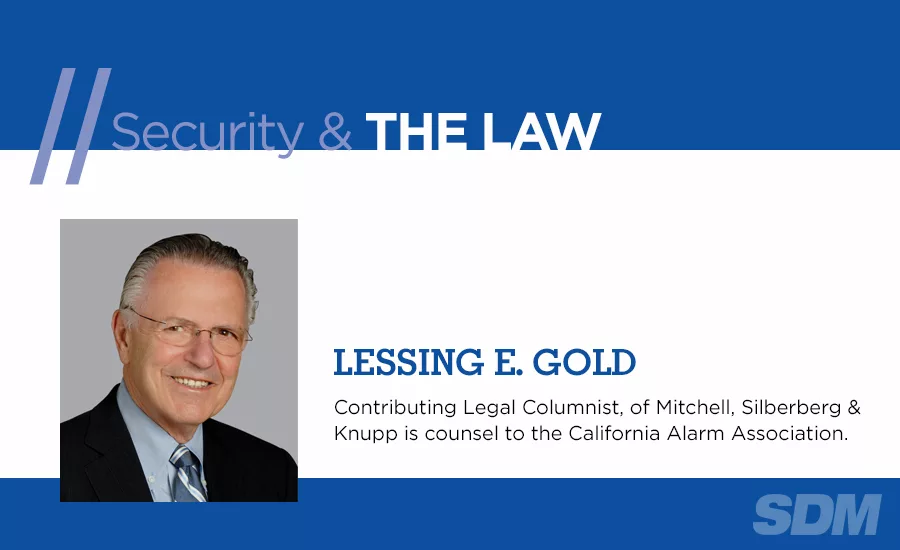
By Lessing E. Gold, Contributing writer
Security  Law 2019
November 2, 2020

Kermit the frog said, “It’s not easy being green.” While it takes some effort and may not be easy going green for an alarm company, it is certainly an achievable goal. 

One of the most commonly considered areas of going green is the reduction in paper usage. Currently being used by a small number of alarm dealers, the use of paperless contracts electronically signed by customers is an available method for going green, but it does require adherence to a variety of rules and regulations.

The law with respect to the use of electronically signed agreements is found in two principal codified acts. The first is the Uniform Electronic Transactions Act that sets forth the state requirements for electronic signatures. Because having different requirements in different states made it difficult for a business to comply on a multi-state basis, the federal Electronic Signature in Global and National Commerce Act (E-Sign) was adopted in 2000. 

Electronic contracts and signatures are valid and enforceable. E-Sign impacts how the contract may be formed, but it does not change the basic contract law. Many jurisdictions require that an alarm agreement be in writing. An electronic agreement can satisfy this written requirement if certain procedures and disclosures are followed. However, because of the nature of the security industry and the significance of having a good contract because of liability limitation issues and other matters, compliance with the E-Sign rules is very important.

The alarm dealer must still comply with basic contract law. As examples, if you use an electronic signature process for an in-home solicitation (e.g. use electronic signature pad), this does not alleviate your obligation to provide the appropriate notice of cancellation, although you may be able to give it in electronic form. Generally, the terms and conditions of your electronic contract will be the same as your paper contract, and must comply with any unique laws regarding security agreements that are found in various states such as limitations on automatic renewals and disclosures of licenses.  

I strongly recommend that an alarm dealer who intends to use electronic agreements and signatures engage the services of a company that specializes in creating and storing electronic signatures. You can find these companies with a simple computer search for electronic signatures.


READERS ASK


Q:  Because of the COVID-19 pandemic, a number of my administrative employees are working from home. Do I have to provide lunch breaks, rest periods and/or overtime while they work from home?  


A: This is a question that is governed by state law and it really depends on which state(s) you are doing business in. One of the issues which I am sure you should be concerned about is whether the employee is working from home voluntarily or whether the employee is required to remain at home. If the employee is working voluntarily, the decision may be construed more liberally. I do know that various states have taken the position that notwithstanding the fact that the employee is working from home, the employee would be entitled to his/her normal lunchbreak, rest period or overtime. I would suggest, however, that you check the rules and regulations of the state(s) in which you are doing business.  

Looking for quick answers on security topics? Try Ask SDM, our new smart AI search tool. Ask SDM →

KEYWORDS: contracts eco-conscious electronic signatures environmentally responsible green law security dealers security industry

Share This Story

Looking for a reprint of this article?
From high-res PDFs to custom plaques, order your copy today!


Lessing E. Gold of Mitchell, Silberberg & Knupp is counsel to the California Alarm Association and a contributing legal columnist. He can be reached at sdm@bnpmedia.com.

Recommended Content

JOIN TODAY
to unlock your recommendations.

Already have an account? Sign In

  • SDM 100

    SDM 100: Top 100 Security Dealers of 2026

    The top 100 security dealers navigated a complex...
    SDM 100 Report
    By: Karyn Hodgson
  • Security camera

    State of the Market: Video Surveillance

    As video surveillance shifts from siloed systems to...
    Exclusives
    By: Brianna Wilson
  • 2026 Industry Forecast

    SDM 2026 INDUSTRY FORECAST

    Rapid technology advances meet shifting economic...
    Exclusives
    By: Karyn Hodgson
Manage My Account
  • SDM Newsletters
  • Online Registration
  • eMagazine Subscriptions
  • Subscription Customer Service
  • Manage My Preferences

More Videos

Sponsored Content

Sponsored Content is a special paid section where industry companies provide high quality, objective, non-commercial content around topics of interest to the SDM audience. All Sponsored Content is supplied by the advertising company and any opinions expressed in this article are those of the author and not necessarily reflect the views of SDM or its parent company, BNP Media. Interested in participating in our Sponsored Content section? Contact your local rep!

close
  • Doctor examining child patient with mother present in medical clinic
    Sponsored byHID

    The Human Side of Hospital Security: How Modern Visitor Management Protects People First

Popular Stories

Video surveillance camera

Why Video Health Monitoring Is a ‘No Brainer’

ESA Board of Directors Q2 26 Elections

Electronic Security Association Announces 2026 Board of Directors Election Results

TMA & SDM Logos

Becklar, Elite & Puget Win 2026 TMA/SDM Monitoring Center Excellence Awards

SDM Dealer of the Year 2026 Promotion

Poll

What’s the most promising trend in the industry?

What’s the most promising trend in the industry?
View Results Poll Archive

Products

Physical Security Assessment Handbook An Insider’s Guide to Securing a Business

Physical Security Assessment Handbook An Insider’s Guide to Securing a Business

See More Products
SDM 100 2026 Rankings

Related Articles

  • Electronic Contracts: Legally ‘Going Green’

    See More
  • Security  Law 2019

    Can a Certificate of Occupancy Legally Be Withheld?

    See More
  • Security Law

    Responding Officer Conducted Lawful Seizure

    See More
×

Be in the forefront of security intelligence when you receive SDM.

Join over 10,000+ professionals when you subscribe today.

SIGN UP TODAY!
  • RESOURCES
    • Advertise
    • Contact Us
    • Directories
    • Store
    • Want More
  • SIGN UP TODAY
    • Create Account
    • eMagazine
    • Newsletter
    • Customer Service
    • Manage Preferences
  • SERVICES
    • Marketing Services
    • Reprints
    • Market Research
    • List Rental
    • Survey/Respondent Access
  • STAY CONNECTED
    • LinkedIn
    • Facebook
    • YouTube
    • X (Twitter)
  • PRIVACY
    • PRIVACY POLICY
    • TERMS & CONDITIONS
    • DO NOT SELL MY PERSONAL INFORMATION
    • PRIVACY REQUEST
    • ACCESSIBILITY

Copyright ©2026. All Rights Reserved BNP Media, Inc. and BNP Media II, LLC.

Design, CMS, Hosting & Web Development :: ePublishing