SDM Exclusive - Part 1
State of the Market: Intrusion & Smart Home Stay Steady Amid Unease
June 2, 2025
SDM Exclusive - Part 1
State of the Market: Intrusion & Smart Home Stay Steady Amid Unease
June 2, 2025John Loud, president, LOUD Security Systems, has spent 30 years in the residential intrusion market. Bio image courtesy of LOUD Security Systems. Background image courtesy of bubaone / DigitalVision Vectors / Via Getty Images

The convergence of technology is apparent in the world of residential and small commercial intrusion alarms. Today’s residential intrusion often features video — especially in the SimpliSafe era. It can even be the basis or starting-point for the smart home. End users have time and time again shown that they are interested in an integrated whole, a single-pane-of glass. Intrusion alarms continue to be an integral part of that smart home whole that includes most commonly security, video, automation, energy management, and lifestyle integration.
While political unrest and supply chain concerns around tariffs have potentially hindered the market for some, others experienced growth in the intrusion market. But overall, intrusion seemed to hold relatively steady, with those rating the intrusion market in 2024 as good to excellent tipping down slightly by 4 percentage points over 2023, according to the 2025 SDM Industry Forecast, published in January. Those rating the smart home market in 2024, however, rated it 5 percentage points higher than the previous year.
In part one, the experts in intrusion, smart home and monitoring — both manufacturers and integrators —provide specific insights into the state of the market and what they believe is driving it.
Mostly Steady Performance
On the security dealer side, John Loud, president, LOUD Security System Inc., Kennesaw, Ga., says, “2024 probably ended up more as a flat year — Not as good as we've typically had, but in talking to many other dealers, we’ve heard similar scenarios.”

Loud, who is featured on this month’s cover, points to interest rates, inflation and political unease as factors that led to this. “It was almost as if everybody held their breath,” he says. “The phone didn’t ring for cancellations either. People weren’t buying, selling, cancelling, moving forward. Interest rates are a factor. Then there’s the fight going on politically in the U.S. — all of that angst and uneasiness I think has led folks to feel like they don’t have that comfort and security and peace of mind.”
Zane Crouch, director of sales and marketing, Ener-Tel Services, San Angelo, Texas, says his company experienced a similar 2024. “During the first two quarters of 2024, we fared well, keeping pace with the prior year,” he says. “We did see a moderate decline in demand during the remainder of the year — we do see this as typical in a major election cycle across all areas of our business. The uncertainty of an unknown outcome tends to have consumers hold out on making decisions that involve financial commitments. With inflation and higher interest rates, we also recognized that many families saw a lack of disposable incomes and those that do have more disposable incomes were taking advantage of higher interest rate returns on savings investments.”
Some dealers did note a year of growth, like Chris Oram, service department manager, Eagle Sentry, Las Vegas. “Las Vegas continues to grow in the ultra-luxury category,” he says. “Since COVID, there has been a large influx of individuals coming from California. For the ultra-luxury segment, smart home elements are a requirement for the $3 million plus category. Without a control system in the home, buyers may not see the property as a right fit.”
On the manufacturing side, Resideo also noted a steady pace last year. “2024 held steady for Resideo in the intrusion/smart home space,” says Ryan Park, senior product director of safety and security, Resideo Scottsdale, Ariz. “There was excitement as we rounded out our camera offerings with the introduction of a new indoor camera, as well as the announcement of our new hybrid series in the fall, which has positioned our dealers for future success.”
Looking for quick answers on security topics? Try Ask SDM, our new smart AI search tool. Ask SDM →
Looking for a reprint of this article?
From high-res PDFs to custom plaques, order your copy today!
Jon Adams, vice president of sales, DMP, Springfield, Mo., says, “We did really well in [2024]. It was a year of growth for us on the residential side.” As for factors that led to a strong year for DMP, Adams says he believes it took a certain amount of time for the market to get comfortable with cameras at a residence, specifically inside one.
“It also took some time for our part of the industry to be able to make those cameras affordable,” he says. “I think to be honest that SimpliSafe and some of those [DIY companies] might have done us a little bit of a favor — they’re the ones that introduced residential cameras largely into the market.”
Adams also noted American politics as being an influence on the market, but potentially a positive one. “The other thing is, anytime you see any sort of unease — instability in the economy, or an uptick in crime — people do start to identify ways that they can feel safer, and I think video cameras provide that.”
NAPCO has also found traction with the release of some new products aimed at the residential intrusion/smart home market. “NAPCO has seen growth with our new self-contained smart home/security/video panels,” says Judy Jones, vice president of marketing, NAPCO, Security Technologies, Amityville, N.Y., “We’ve also added new accessories to fill out the line, including a second keypad/touchscreen and wireless Wi-Fi extender most recently.”
Jones says she does see a more stagnant state of the residential intrusion market. “Industry-wide the residential market has been seen as largely flat over the last couple of years, due to downturn in traditional new housing starts, peoples’ hesitance to move and/or leave/replace low mortgage rates, etc..”
On the purely smart home side, however, Avi Rosenthal, chairman of Z-Wave Alliance, and managing partner, BlueConnect Partners, Ashburn, Va., says, “2024 was definitely better than 2023. If I look at it from a Z-Wave angle, 2024 was definitely a record year for us. We added a bunch of members, there were a whole bunch of new initiatives that came out, Z-Wave long range came into its own. And then if I look at it from a general business perspective — the business grew, the opportunities grew, the market grew. I think people are really starting to take a hold of the whole concept of intelligent living.”
I believe the driving forces here are going to be just that — safety, security, convenience.
Rosenthal continues, “We’ve been talking about this for a very long time, but we’re finally at the point where people understand when we say that these systems can help them live better lives — increasing both the convenience and safety of their homes. It’s no longer selling them on the concepts; it’s selling them on the solutions. It’s really developing the solutions and products that solve their problems. That has really at the end of the day helped the business grow. It’s not about buying an alarm system. It’s about buying a home system: ‘I’m paying per month because I believe in what the system can do for me and my family.’”
Rosenthal says COVID was the turning-point for the smart home system. “There was a moment at which people started to realize this wasn’t just gadgety, but that this was real life,” he says. “We built on that in 2024. We had a big surge during COVID. Everybody was stuck at home, so they wanted home control systems and home theater systems, so they did some really cool things with their homes because they were stuck at home. In 2022 and 2023 we were coming off of that high.
“In 2024, we’re now reminding people how cool it is to have this stuff in their homes,” Rosenthal adds. “From a Z-Wave perspective, the COVID period showed a lot of companies how important it was to develop new products. And so after we got through the supply chain nightmares, 2024 was the year that we got back to engineering. We got back to developing and designing cool new stuff.”
Smart Home Market Size
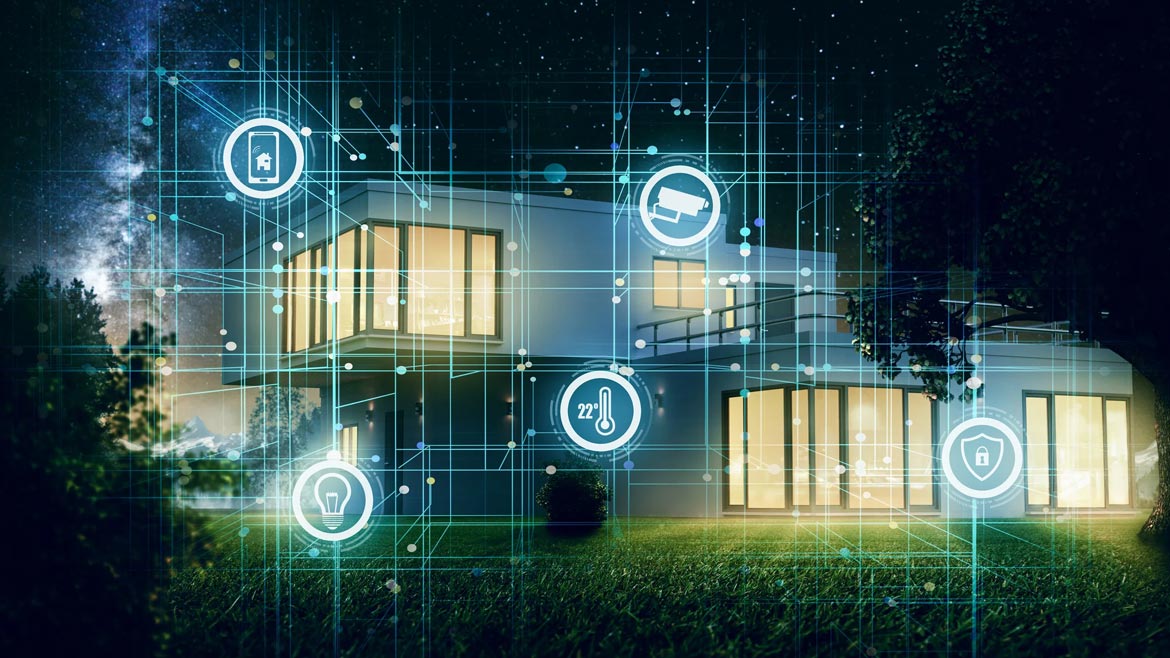
For the dealer/integrator planning to expand into the smart home market, the market was valued at $127.67 billion in 2024 by Today’s Homeowner. The market is projected to reach $1.4 trillion by 2034.
Image courtesy of Marcus Millo / Via Getty Images
What’s Driving Intrusion & Smart Home?
With all of that context for the year prior, how is 2025 fairing for the residential intrusion and smart home industry? And what is driving the market forward? One topic that will get more attention shortly is AI. Especially as residential intrusion alarms have expanded to incorporate video, analytics are redefining the market.
“As people are adopting video and we’re able to put analytics on small boxes, it’s video as intrusion that is really driving it,” Adams says. “It’s going to be the next big thing over the next five to 10 years.”
Speaking to what DMP is doing in 2025, he adds, “In late 2023, we introduced a gateway that can be connected to our alarm systems and any cameras that are installed there. You don’t have to buy the cameras from us, but it takes those cameras, even ones that don’t have analytics and they get fed over a network that has analytics like human detection, etc … which means they have a single app that they can manage security, video and the analytics service. So it takes that otherwise not smart camera, and brings full analytics into it all on one app.
“We’re aiming for false alarms,” Adams says. “That’s another thing that's helped us drive it is people are used to door contacts and motion detectors, which — while highly used in our industry — are part of the false alarm problem because they just see motion. The cameras don’t know what it is. But now I can take these cameras and now they’re only setting off an alarm when they really see a human, as opposed to a balloon blew in front of it, a plant fell over, my cat jumped high enough that it set the alarm off, etc. We’ve seen significant false alarm reduction, and so have our dealers that have adopted it.”
Park also cited the integration of video, intrusion and smart home technology as a current driver. “The main business drivers in the intrusion and smart home space include the increasing consumer demand for connected and integrated home solutions, advancements in AI enhancing device capabilities and a growing emphasis on energy efficiency and sustainability,” he says. “From a security perspective, video is a critical component of a security or overall intrusion system for the foreseeable future.”
Beyond the appeal of technology, Rosenthal expects the political unrest and tariff concerns to continue into the rest of 2025. “I think people are going hunker down again,” he says. “I think we’re going to have a little bit of the feeling — like during the pandemic — where we want to make our homes safe spaces. ... That’s going to be very important to them because whenever there’s chaos in the world, people look to family, they look to friends, they look to their internal spaces to create sanctuary. I believe the driving forces here are going to be just that — safety, security, convenience.”
Rosenthal also stresses the energy saving aspect of the smart home experience — as did many others. “I think energy savings is still underrated in our business,” he says. “I don’t think we take enough advantage of the ability for our systems to provide energy management. I look at the rest of the world and they take energy management much more seriously than we do in our homes.”
Even more underutilized is water detection, Loud says. “To me, it’s about water detection, notification, and shut off,” he says. “Alarm industry folks need to start talking a lot more about water detection. Even though we do talk about life safety, smoke and carbon monoxide detectors, and certainly burglary alarms, you’ve only got a certain level of market penetration with that. I’ve gone before a cop county chamber of commerce here a few years in a row, and I’ve asked how many people in the room have ever had a friend, a family member, a neighbor that have had a burglary or a fire and they had an alarm system and a bunch of hands go up. Then, I ask how many have had a friend, family member, neighbor, that have had water damage in the home — from the washing machine, the water heater, the dishwasher, the faucet, the tub, the sink? Four times the amount of hands go up.”
Park also notes that leak detection is an increasingly common request for connected devices. “The most popular connected devices today include smart thermostats, security cameras and a variety of environmental monitoring systems like water leak detectors,” he says. “Over the past year, we’ve seen increased integration of these devices into cohesive smart home ecosystems.”
Jones points to specific verticals that are driving the residential intrusion alarm market. “For NAPCO we’d cite the two latest drivers in the business today as the escalating growth of MDUs (multi-dwelling-units) and new DIY ship/install consumers,” she says. “In stark contrast to the aforementioned reduction in traditional new housing starts, multi-tenant residential units/multi-family /MDUs are quickly outstripping availability throughout the country. NAPCO and its dealers see the demand for an MDU security solution, largely coming from two market groups — baby-boomer/retirees who are downsizing, shedding large home maintenance to instead enjoy gated security, tech and video in a community setting; and the first-time home-buying millennials and Gen Z-ers who are attracted by smart home amenities, video and remote-in smart home tech.”
Jones continues, “We’ve found these two new consumer groups are indeed a potentially lucrative market for our dealers in particular, because self-contained touchscreen panels make the multi-family sale easier, as there is nothing to prewire or preprogram. It’s simply plugged in after the sale and ready at the time of occupancy. It is also multilingual in both spoken voice prompts and on-screen language, so it appeals to a broad market. And finally, it’s portable for young subscribers, couples, and tenants on the move.
“Last but not least, the third driver — applicable to any traditional alarm system — is addressing the need for security system communication upgrades, migrating millions of existing alarm systems off retired and disappearing copper landline alarm reporting, to fast, secure cellular alarm communications. Recently, we’ve expanded that lineup with our broadest cellular-network-inclusive comm. product, supporting and auto-selecting the best of three carriers onsite (Verizon, AT&T or T-Mobile),” Jones says.
A Warning to the Wireless
Avi Rosenthal of Z-Wave Alliance, very passionately highlighted an imminent threat to the intrusion and smart home markets. “NextNav is a publicly traded geolocation company that has petitioned the Federal Communications Commission (FCC), to remove the unlicensed spectrum between 900 and 920 MHz and create a licensed bandwidth that only they are allowed to use and only they are allowed to license.”
This is an issue that SIA wrote a letter to congress addressing in late 2024.
“There are literally billions and billions of devices that operate in North America between 900 and 920 MHz,” Rosenthal says. “Millions of them happen to be Z-Wave devices. Equally, millions of them happen to be security sensors. If NextNav has their way, all those devices will have to be migrated to a different frequency. Imagine having to replace every single one of these devices and redesign every single one of these panels.”
Rosenthal continues, “The FCC has issued what’s known as a Notice of Inquiry (NOI), which is government speak for, ‘We want a research project.’ In America, we do not have a backup for our timing and geolocation services. GPS — what we use every single day to navigate around North America — is based on a satellite system. We have NO terrestrial backup system to GPS, which leaves us vulnerable to things like sunspots, weather, jamming and other problems that are not very prevalent today but are expected to become more prevalent over time. NextNav has proposed an idea that they’re doing good for the world by providing a backup to the timing and geolocation services that we have today.
“They claim that the only way to solve that problem is by taking over these frequencies along with some other frequencies that they have acquired and create a situation where they are then using them for 5G radios to give everybody the ability to pinpoint their location from a terrestrial based system instead of a satellite-based line,” he says. “Now the problem with that — other than the fact that it’s going to completely destroy our industry as well as other industries — is there are alternatives that are much more viable, much less expensive, and that do not create the havoc that this one will.”
As for those alternatives, Rosenthal says, “The National Association of Broadcasters, for instance, has two different solutions — one that uses AM radio and one that uses NTSC 3.0 in order to provide these services, but will utilize terrestrial locations without disrupting any current RF spectrum. So the FCC has issued this NOI to ‘study’ the problem of backup geolocation services for the United States. And we are right now embroiled in the creation of responses to that NOI, which were all due on April 28. If for some reason we are unsuccessful in convincing the FCC that there are viable alternatives for backup GPS that don’t include the NextNav proposal, then we are very much in danger of NextNav being awarded this spectrum.”
Rosenthal offers up an example of what this could look like: “A few years back, there was a situation where all of the wireless microphones in the world had to be redone because there was a spectrum that was handed out to somebody and the Shure company was unfortunately using that for their wireless mics. So all the wireless mics had to be reconfigured and it wreaked havoc in the music industry for a number of years. That is small potatoes, my friend, as compared to what is going to happen [here].”
Rosenthal concludes, “900 spectrum is extremely important to the security industry and extremely important to Z-Wave. It is even more important to people like the railroads who use 900 MHz for their signaling and tracking and the tolling industry, who use 900 MHz for all of those little tags and all of our cars that collect all the tolls and all the highways. Those are 900 MHz too. Not to mention the secret service uses 900 MHz to monitor all of the things that they do to protect their protectees in the government. Those are all 900 MHz.”
SDM will update on this issue as news continues to develop.