Wholesale Monitoring & Central Stations: What’s new in 2026?
An update on the latest offerings from third-party central station companies.
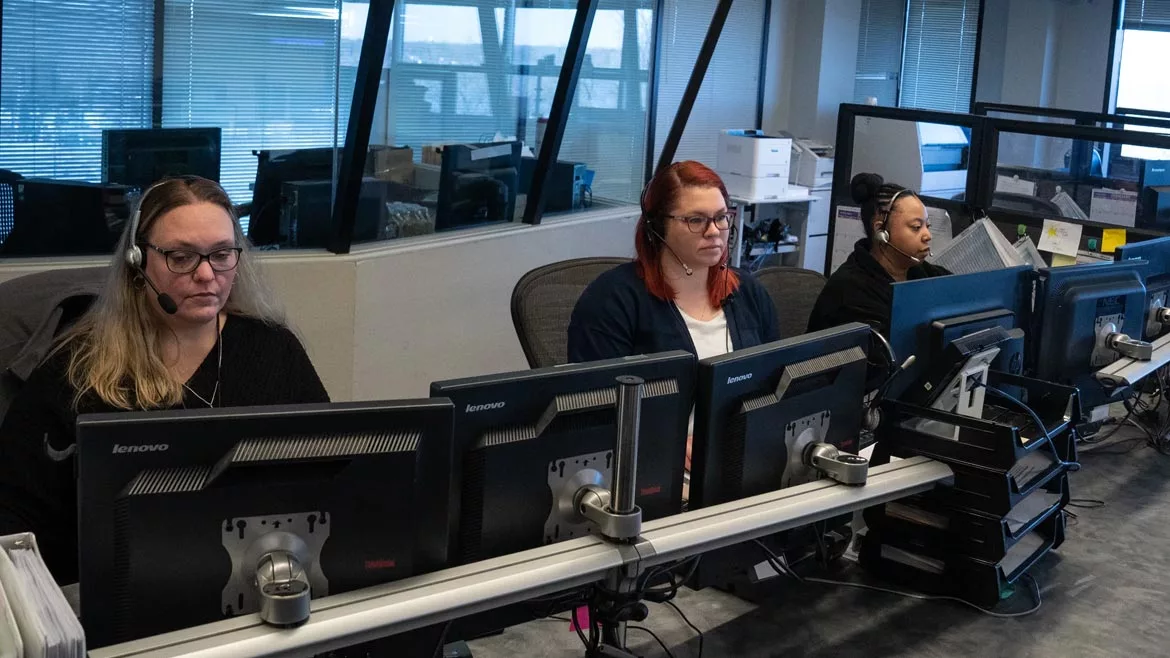
Wholesale monitoring stations are constantly updating and upgrading their offerings, services and technology for their customers.
What’s new in the central stations of wholesale monitoring companies? We talked with representatives from a cross-section of them, who cited trends like the continued expansion and upgrading of ASAP to PSAP, burgeoning emphasis on training and cybersecurity, and integration of artificial intelligence (AI) into everything from video analytics to basic “conversations” with customers.
Security Central, Statesville, N.C., has been shifting its focus from being a monitoring center to a technology company, layering in conversational AI that enters the chat in a secure portal and handles false alarms and other “non-dispatchable” events, says CEO Caroline Brown, who adds that the company is working to pair that technology evolution with its traditional services.
The company fully supports the expansion of ASAP to PSAP, adding municipalities every week and boosting efficiency on both ends, while tying into the effort to reduce false alarms, she says. Other innovations in the recent past have included smarter video verification through AI analytics screenings, increasingly popular temperature and water sensors that are “non-dispatchable but critical alert events,” and a soon-to-be-unveiled accounting package in the dealer portal to go alongside the conversational AI agent, she adds.
Security Central also onboarded a new chief technology officer, Dan Turner, formerly with Per Mar Security, and the company is doing a phased approach to ramping up its cybersecurity program, Brown says. “It has been a lot of penetration testing, different network monitoring, and we’ve also added changes in network routing,” she says. “We’ve added new equipment and a rubric that goes to cybersecurity and has threat layers and monitoring.”
Emergency 24 (EM24), Des Plaines, Ill., offers its own UL-listed proprietary software that the company is able to quickly enhance and continuously update to make operations more efficient, responsive and rapid, says CEO Steve Mayer. The company has been using the Intrado solution to leverage digital dispatching and has begun to roll out ASAP to PSAP as well, while also continuing to partner with Rapid SOS on a digital dispatching solution developed in tandem with Honeywell, he says.
“A lot of central stations are automating calls,” Mayer says. “We are very committed to having humans handling calls critical to the end users. … But we think the value in automation is to the 911 centers, the PSAPs. A lot of the 911 emergency call centers want that digital because they’re short-staffed.” That saves on time and helps expedite response, he says.
EM24 continues to offer video monitoring, preferably through CHeKT, and it’s exploring opportunities to offer a full range of monitoring for large commercial buildings, Mayer says. The company has isolated its network and enhanced systems that track and monitor cybersecurity threats, in ways that go beyond UL requirements, he says. “We have also increased training for all employees to increase awareness of phishing, smishing and other social engineering attacks,” he adds.
Looking for quick answers on security topics? Try Ask SDM, our new smart AI search tool. Ask SDM →
We’re no longer hamstrung by what we can send through the network. You can send an alarm one way and other data through a different platform. That gives us flexibility while reducing calls for service, and false alarms.
Rapid Response, based in Syracuse, N.Y., with three sites and 200,000 square feet of monitoring, has been tracking and tapping into “better versions of things that are out there,” such as improving video and audio, and the various applications of AI, says Morgan Hertel, vice president of technology and innovation and a past president of The Monitoring Association (TMA).
TMA helped inspire the next iteration of ASAP to PSAP to include organizations like fire departments, private guarding and others that couldn’t access the original iteration, while opening up the ability to send items like images and crash data. “We’re no longer hamstrung by what we can send through the network,” Hertel says. “You can send an alarm one way and other data through a different platform. That gives us flexibility while reducing calls for service, and false alarms.”
Rapid Response has been able to get dispatching rates down to 3%, and that will continue to fall, Hertel predicts. The company also has been doing more provisions of hosting services for companies that want to maintain their own monitoring centers without the costs of technology and personnel. “If you can’t monitor, we take over. It’s the best of both worlds,” he says. “You also may have redundancy like you’ve never had it before.”
Lastly, the company has grown its video team while separating it out, with a management-level supervisor inside the business, and it’s invested heavily in cybersecurity solutions and training. “If you work on a device that lives on our network, you have to take the classes,” he says. “If you don’t take them, you don’t work here.”
Affiliated Monitoring, Union, N.J., has been growing in areas like interactive video monitoring, with dozens of new installations and hundreds of new cameras every week, said Michael Zydor, managing director of business development. “AI enabled analytics are making monitoring more efficient than ever while improving the end user experience,” Zydor says. “The ability to filter out false activations boosts efficiency and cost-effectiveness, making video monitoring a cost competitive solution for a wide variety of monitored use cases.”
The company has been a huge proponent of ASAP to PSAP, with CEO Daniel Oppenheim co-chairing TMA’s efforts. “We couldn’t be more pleased with the progress made over the past few months,” Oppenheim says. “Participation in the program, which allows monitoring centers to dispatch alarms and other emergencies without having to make a phone call to a PSAP or ECC, continues to grow, and we see new agencies joining every day. ASAP is perhaps the most important program to come out of our industry in the last twenty years. It continues to result in faster, more accurate responses and more lives saved.”
Hosted monitoring is also a big part of Affiliated’s growth story. “We’ve signed up dozens of new alarm companies to our Alpine hosted monitoring platform in the last year or two who use their own operators and facilities but use us for receivers, network, and telephony infrastructure,” says Rob Sutton, director of monitoring operations. “We see that it helps our partners focus on what they should be focusing on — growing their business — instead of the complexities of technology management.”
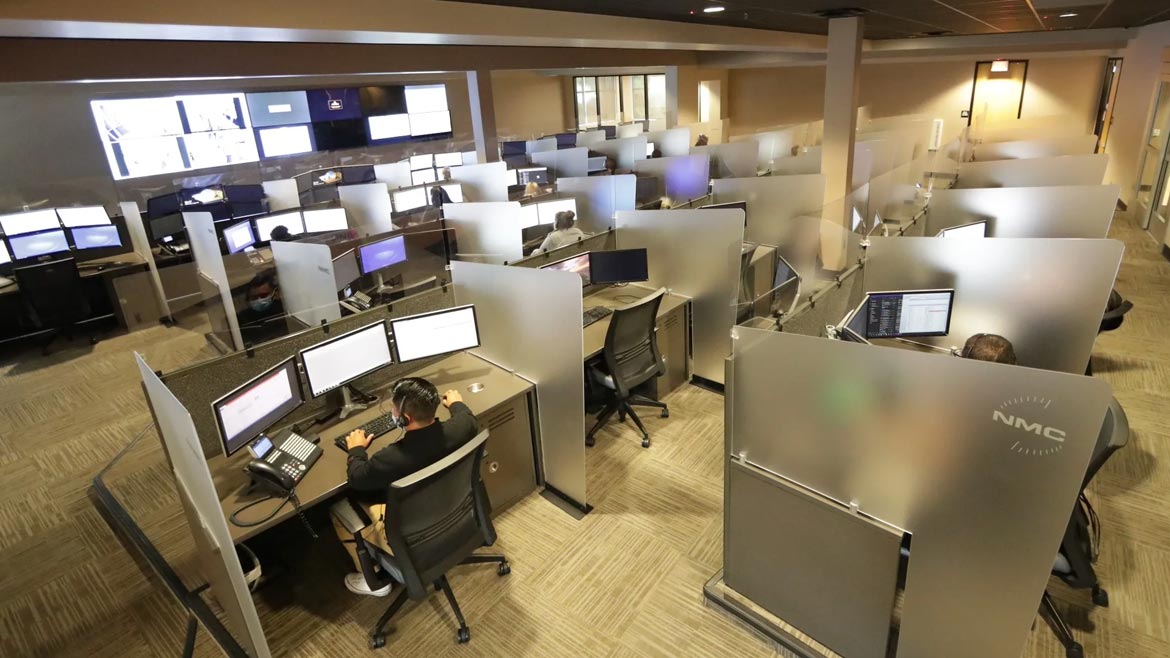
National Monitoring Center (NMC), Lake Forest, Calif., sees the need for all central stations to shift to AI-driven video as well as outbound notifications, rather than operators making the calls, says Todd Shuff, vice president of operations. His company has implemented conversational AI in partnership with Replicant Inc. to handle functionality, cancel alarms, put systems on test and request emergency dispatches. “It’s a whole slew of things we’ve implemented internally that allows end users to interact with us more,” he says, adding that 80% of calls placed go unanswered. “We’re trying to improve connections through text, and email and apps.”
For commercial end users, NMC has built in a new software platform called Nexus Corporate that allows them to create a virtual central station in their own environment, in which they can pull up a live activity dashboard and cancel alarms as needed, Shuff says. “It provides robust reporting, primarily for the banking industry, using a central station software tool that they never had before,” he says.
The company also has launched its Partner Success Program, a new group that specializes in working with dealers to analyze their performance, keep them current with technology and remain competitive, Shuff says. And NMC’s Training Academy, with a full online curriculum containing three five- to 10-minute videos detailing all of the company’s technology and tools, gives dealers the ability to learn how to use them as well as what best practices are, he says.
[With ASAP to PSAP] each city and public safety answering point must be individually vetted, certified and connected; it’s a meticulous process that involves coordination among multiple agencies and our technology partners. We’re steadily bringing new jurisdictions online.
COPS Monitoring operates a multi-location network of monitoring centers with strategically located, load-sharing UL-listed central stations, which provides geographic, technological and personnel redundancy, providing us the ability to balance call loads across centers while maintaining fast response times, says Jim McMullen, the company’s president and chief operating officer.
A charter member of ASAP to PSAP, COPS Monitoring is encouraged by the progress to date, although expanding the program across the country takes time and precision, McMullen explains. “Each city and public safety answering point must be individually vetted, certified and connected — it’s a meticulous process that involves coordination among multiple agencies and our technology partners,” he says. “We’re steadily bringing new jurisdictions online.”
The company’s proprietary MPower Dealer Access platform provides alarm companies with access, tools and controls to monitor accounts and system activity and produce detailed reports and customized services, McMullen says. The centralized, user-friendly interface can be accessed on a computer, tablet or smartphone. “This redesign lays the groundwork for many new tools and features we have planned, all aimed at helping our dealers grow, operate more efficiently and stay ahead of evolving customer expectations,” he says.
COPS continues to boost its video monitoring and personal emergency response expertise with dedicated, specialized resources and infrastructure, McMullen says. “They require experienced dispatchers, specialized training and represent the next generation of protection,” he explains. “Verified video is helping to reduce false alarms, improve situational awareness and prioritize police response when every second counts.”
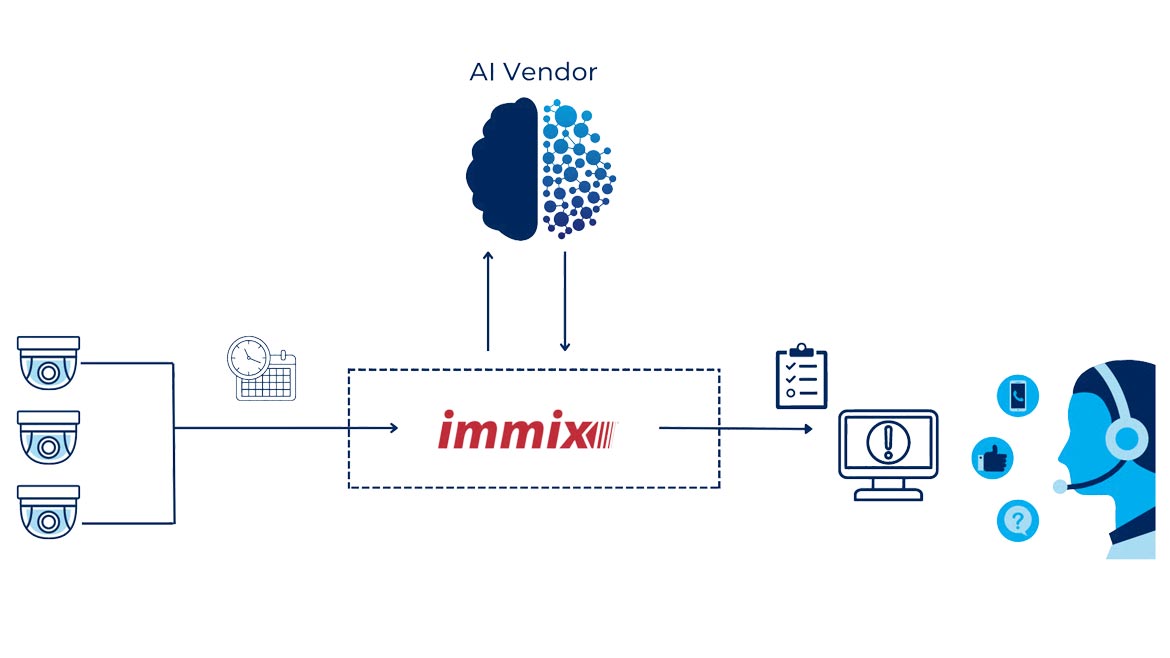
Immix, which provides central stations with a software automation platform for remote video monitoring and managed security services, has focused on strong partnerships with AI providers to ease monitoring center operations so that operators can focus on action items, says Tina Simolaris, the company’s vice president, global client experience.
In the past six months, Immix has introduced a few new offerings, including the Visual Camera Health solution that tracks cameras’ operability and visual quality, providing a layer of insurance and removing the need to do this manually, Simolaris says. “The time, money and inconsistency in the quality of having a human do that makes it difficult,” she says. “The system will come back with an anomaly if any one of those things are affected on the camera.” The service checks not only the primary stream but also substreams all the way back to the station, four times per day, adds Jason Caldwell, director, marketing and guard force accounts, Immix.
Immix also offers AI Link, designed to enable monitoring centers to filter out false and nuisance alarms and improve detection services to focus only on truly actionable events, creating cost efficiencies and enabling them to scale and pivot to higher-margin services, Simolaris says. And Immix’s AutoPatrol, another AI solution, notes anomalies like people or vehicles moving where they shouldn’t be, or a door or gate opened that shouldn’t be, and raises an alarm for a human to follow up on, she says.
Looking for a reprint of this article?
From high-res PDFs to custom plaques, order your copy today!