Detecting Fires without Wires

Ron Nelson
1. All commercial fire alarm initiating devices must be listed by the National Fire Protection Association (NFPA).
a. True
b. False
2. What frequency do in-house fire alarm devices utilize?
a. 290-305 MHz
b. 345 MHz
c. 900 MHz
d. Any of the above
3. What type of approved commercial wireless fire alarm detectors are available?
a. Smoke detector
b. Heat detector
c. Manual pull stations
d. All of the above
e. None of the above
4. What is the date established by the Federal Communications Commission (FCC) when cellular carriers may discontinue analog wireless networks (AMPS)? (It is called the Sunset Clause.)
a. June 2007
b. December 2007
c. February 2008
d. December 2008
5. Wireless devices can be used locally for initiating devices but not for transmission of signals to a remote monitoring office.
a. True
b. False
6. Which of the following can affect the reliable range of wireless devices?
a. Frequency
b. Transmitted power
c. Construction materials
d. All of the above
e. None of the above
7. After the date established by the FCC when cellular carriers may discontinue analog wireless networks, cellular can no longer be used for alarm transmissions.
a. True
b. False
8. Any wireless initiating device can be used with any wireless control.
a. True
b. False
9. How often must batteries in wireless devices be replaced?
a. Annually
b. Every two years
c. Every three years
d. Every four years
e. None of the above
10. Because wireless smoke detectors are battery-powered, their listed spacing is less than hardwired devices.
a. True
b. False
11. Which UL standard covers control units and accessories for fire alarm systems?
a. 268
b. 681
c. 864
d. All of the above
e. None of the above
12. Repeaters are used in wireless systems to provide the required supervision intervals.
a. True
b. False
13. All approved wireless fire alarm initiating devices are bi-directional.
a. True
b. False
14. GSM digital cellular communicators are affected by the FCC’s Sunset Clause.
a. True
b. False
15. Which UL standard covers smoke detectors for fire alarm systems?
a. 268
b. 681
c. 864
d. All of the above
What's Wrong with This?
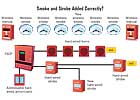
One of Wally `Larman’s commercial accounts did some minor renovations to its office, which required that Wally add one smoke detector and one strobe to the existing approved local fire alarm system. Because the system was wireless, Wally selected a compatible wireless smoke detector and hardwired strobe, ran a listed two-conductor cable for the new strobe to the nearest existing strobe as shown in this diagram, and T-tapped the connections. When he was finished, Wally tested the system and found that it appeared to work, but when the local AHJ inspected his work, a violation was issued. Can you see what Wally did wrong and what he must do to correct the problem?5-Minute Tech Quiz Answers
Here are the answers to What's Wrong with This? and the 5-Minute Tech Quiz that appears on Page 37.1. b
2. d — Manufacturers of wireless devices select a frequency for their products within FCC regulations, so the frequency used by each may vary.
3. d
4. c — Although the FCC ruling allows the cellular carriers to discontinue supporting analog wireless systems, AMPS networks are not required to do so. Additionally, the FCC may extend the date for ending support. Given the limited time frame, check with your supplier of cellular services to see what options exist for migration to a replacement technology.
5. b — Wireless transmission of alarm signals to remote monitoring offices is available by using public or private wireless networks.
6. d
7. b — Although the cellular carriers may stop supporting the service at that time, they are not required to do so. It is possible that due to the number of users of this service, some carriers may continue to support the service for a limited time. Additionally, digital cellular products such as GSM radios are not affected by this ruling.
8. b — Because the frequency and transmission protocols vary by manufacturer, you cannot use wireless initiating devices of one manufacturer with a control manufactured by another company.
9. e — How often the batteries must be replaced is determined by the design of the wireless device. You should check the installation instructions provided by the manufacturer.
10. b
11. c
12. b — Repeaters, if available, are used to extend the overall range of the system.
13. b
14. b — Digital GSM cellular radios are not covered by the FCC’s February 2008 clause and are one alternative to analog AMPS cellular radios.
15. a
Answer to: What's Wrong with This?
The violation is a result of how Wally connected the new strobe. By running a two-conductor cable and T-tapping the connections at the existing strobe, the new strobe and its associated wires are not supervised, so that a break in the cable will not be detected by the control. Wally must rewire the system so that the new strobe and wire are supervised, as shown in this diagram. Correct installation requires not only using the appropriate devices but also locating and installing them properly so that system integrity is maintained. If you are not sure how to install a device, check the installation instructions or contact the manufacturer.Looking for a reprint of this article?
From high-res PDFs to custom plaques, order your copy today!