Learning to Love Do-It-Yourself Security
DIY Security gains momentum as dealers try to determine the best role to play in this market
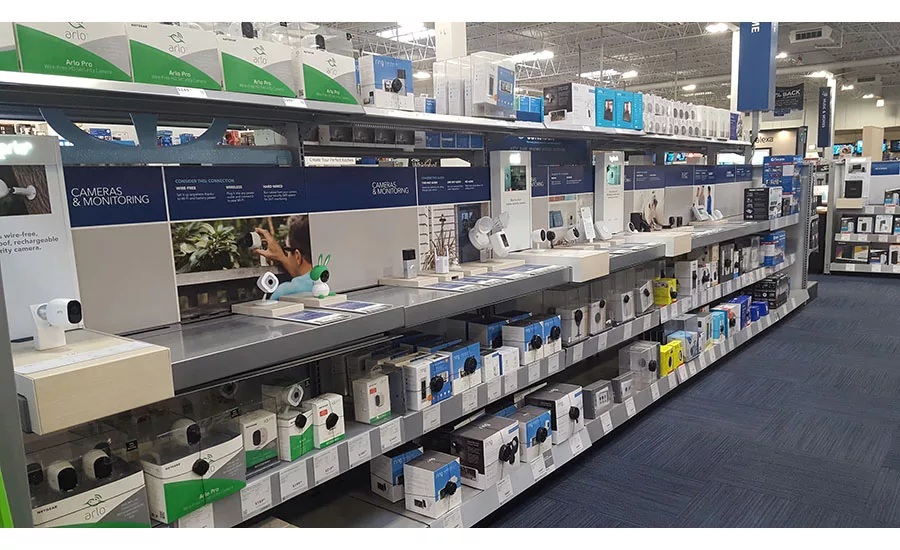
A recent look at the Smart Home shelf in a Chicago Best Buy store illustrates how dominant the video camera is in a DIY security offering. Photo by SDM staff
Perhaps 2017 will be remembered as the year the traditional security industry got serious about the do-it-yourself (DIY) market.
Some security manufacturers that never played in the DIY market before have launched products that consumers can install themselves and which the dealers will monitor. Some of these dealers also sell systems without monitoring to those people who are content with simply getting smartphone notifications when an alarm is triggered. New monitoring options — including short-term monitoring when, for example, a customer goes on vacation — also are emerging.
Can dealers make a profit in this market? SDM asked manufacturers making products for the DIY market about this and their answer is “yes.”
Some of the people we talked with prefer not to use the term “DIY” because they see dealers playing important consultative and ongoing support roles for customers who want to install their own systems. Instead they prefer to call them “self-installed” systems. We will use the two terms interchangeably in this article, however.
Another term some people like to use is “hybrid DIY,” which refers to a system that the customer installs but the dealer monitors.
DIY Systems
All five companies interviewed for this story introduced new products or new versions of existing products for the self-install market in the last year. To simplify installation, these systems typically use what some call a tabletop “hub” in place of a traditional wall-mounted panel. The hub typically has Wi-Fi capability, enabling the system to be controlled and viewed remotely using a smartphone over the homeowner’s broadband connection. Short-range wireless communications is also built in to enable the system to communicate with door/window contacts or other sensors. Products from companies we spoke with can be remotely monitored over a broadband and/or cellular data connection.
Some manufacturers have eliminated the need for a wall-mounted keypad for their DIY systems by providing a smartphone app, wireless key fob or other options.
Looking for quick answers on security topics? Try Ask SDM, our new smart AI search tool. Ask SDM →
Atlanta-based Honeywell Home and Building Technologies, for example, built voice control and a camera with facial recognition capability into the hub for its self-install system, known as Smart Home Security. End users can speak commands to the system to arm it and control other functionality, and “when it sees me, it automatically disarms,” explains Scott Harkins, vice president and general manager for Honeywell Connected Home.
Both Honeywell and San Jose, Calif.-based Qolsys give customers the ability to use their smartphone’s Bluetooth capability to control some system functions. For example, as Mike Hackett, senior vice president of sales and marketing for the company, explains, the Qolsys system can automatically arm or disarm itself when it receives a signal from the homeowner’s Bluetooth-capable smartphone indicating that the homeowner has entered or left the home. In addition, the Qolsys system has what Hackett calls an “app-ified” touchscreen that operates in a manner similar to a smartphone app rather than using a traditional alphanumeric keypad.
The traditional letter-and-number keypad is not conducive to a DIY model, particularly when it comes to system installation, Hackett notes. The Qolsys touchscreen enables consumers to feel very comfortable installing the system without a manual, he observes.
Some self-install systems have Z-Wave, Thread, and/or Zigbee capability, enabling the system to communicate with smart lighting controls, smart door locks, and other smart home devices. Some systems also support video cameras or other devices via Wi-Fi.
DIY systems typically are sold as part of pre-packaged systems. A typical system might include door/window contacts and a motion detector.
The manufacturers’ suggested retail prices range between $300 and $500. (See “The Products” on page 66.) In the DIY market, end users are more likely to purchase a system outright, but at least one manufacturer interviewed here is aware of dealers who offer a more conventional pricing approach in which the customer pays for equipment over time in exchange for committing to a term contract.
Marketing DIY Security
DIY is causing both manufacturers and dealers to rethink how they market and sell products.
Springfield, Mo.-based Digital Monitoring Products has developed what Mark Hillenburg, executive director of marketing for the company, calls a “logistics engine.” DMP developed a Web portal that dealers can offer end users to indicate what devices they want their system to include and how they want it configured. DMP then pre-configures and ships the product. Consumers can pay online and the money flows through into the dealer’s bank account.
End users also can use the portal, which dealers can customize with their own branding, to set up on-demand monitoring. This would enable a homeowner who relies primarily on smartphone notification when an alert is triggered to order professional monitoring for a specific time period, such as when the homeowner goes on vacation.
Other opportunities might include setting up a logistics engine for an apartment complex or for a big box retailer, Hillenburg notes.
Honeywell made creative use of Web marketing to support Smart Home Security. The company initially did a soft launch of the offering through the Indiegogo website (http://bit.ly/2CwKrI3). Indiegogo may be best known as a fundraising site, but it also provides tech-savvy individuals with the opportunity to purchase products before the products are broadly launched and to provide feedback to the manufacturer that can be useful in making improvements to the product.
Some manufacturers do not plan to sell their DIY security systems directly to end users or retailers but only through dealers. Honeywell, however, plans to offer Smart Home Security through both retailers and dealers. Harkins predicts, though, that “the professional market will be the biggest.”
He believes many customers will make the decision to purchase Smart Home Security primarily because they want cameras and smart home capabilities, rather than traditional security. “Smart home and cameras are the on-ramp to get professional security,” Harkins comments.
Although some DIY systems initially will be sold without monitoring, Harkins envisions that changing over time. “Even if the system is not monitored day one, there will come a day when [the customer] will want it,” he observes.
Palo Alto, Calif.-based Nest Labs, meanwhile, sees the security industry as one of four key vertical markets for the company’s Nest Secure system, which will roll out in 2018. Nest Labs plans to sell the security system through the same wholesale distribution network that offers the company’s popular Wi-Fi thermostats and other products.
“Wherever they buy [Nest products] today, they will be able to buy Nest Secure,” observes Gene Lanois, general manager, professional channels, for Nest Labs. He adds, though, that Nest expects that many Nest Secure purchasers will want their system professionally installed. The manufacturer will be giving purchasers the opportunity on its website to locate a dealer in their area to handle the installation.
“What we bring to the industry is a lot of consumer demand,” comments Lanois, who notes that Nest offerings are supported by radio, billboard, and television advertising, as well as advertising on the Pandora streaming music service.
An important opportunity for dealers selling Nest Secure involves the Google Wi-Fi mesh router. Nest has a deal to sell that product in combination with Nest Secure and Lanois expects to see security dealers going to customers’ homes, checking their Wi-Fi coverage and where appropriate, recommending that the customer purchase the Google offering. Security dealers also may be able to sell Nest smart home devices, generating additional incremental business, Lanois observes. Consumers will be able to purchase Nest Secure with or without monitoring, he notes.
One aspect that may make Nest Secure unattractive to some security dealers is that Nest Labs requires any monitored systems to be monitored by Dallas-based MONI Smart Security. Lanois acknowledges that this requirement may be unpopular with some dealers. He adds, though, that other dealers may say “That’s not how I normally do business, but it’s a chance for me to come into a lot more doors that I wouldn’t necessarily be able to do on my own.”
Another DIY security offering that is tightly tied to a specific central station comes from Memphis-based wholesale central station SentryNet. In response to requests from its dealer base, SentryNet recently launched Swarm Secure, a system designed to be installed by the end user but to be sold only with monitoring.
SentryNet encourages dealers to tell customers that “a professionally monitored system is security; a self-monitored [system] is notification, not security,” explains Julie Beach, vice president of sales and marketing, direct channels, for SentryNet.
DIY security is so new that dealers are still in the process of determining the optimum marketing strategy for these offerings. One thing sources we spoke to agree on, though, is that dealers may need to hone their Internet marketing and search engine optimization skills or enlist someone who can help them with that kind of marketing.
Dealers have to spend money on their website if they want to make money in DIY, Hackett advises. He adds, though, that “most dealers still want [customers] to configure systems online, then call to close the sale,” noting that “you can upsell when you create a phone call.”
Incremental Business?
Although the security industry initially was wary of offering DIY, more and more dealers are offering DIY systems newly launched by manufacturers to address the self-install market. Manufacturers argue that the target market for DIY systems is comprised largely of people who would not buy a professionally installed system and therefore dealers offering DIY can gain business that is incremental to their traditional lines of business. (See “An Untapped Market: 60 Percent of U.S. Households,” on page 64.)
Being successful with DIY, though, will require tailoring sales, marketing and other operations to address the needs of this new market. Manufacturers are trying to help facilitate those changes, but dealers also will need to do their part as they learn to love DIY.
The Products
Here’s a rundown on the products that the five companies interviewed for this story launched recently or plan to launch soon.



Honeywell found initial users of its DIY system, known as Smart Home Security, through the Indiegogo website. Photo courtesy of Honeywell

Door contacts for the Nest Secure DIY system do double-duty as motion detectors. Photo courtesy of Nest Labs

The touchscreen controlling the Qolsys IQ security system is designed to function in a manner similar to a smartphone app. Photo courtesy of Qolsys

The basic SWARM security system from SentryNet is sold through dealers but installed by homeowners. Photo courtesy of SentryNet
Looking for a reprint of this article?
From high-res PDFs to custom plaques, order your copy today!