Unified security systems are one of the industry’s latest buzzwords. But beyond the hype, what do these types of systems offer the security integrator and, ultimately, the customer? Plenty, say the experts.
By now, the benefits of cloud-based video should be quite clear. For starters, moving video to the cloud can reduce or even eliminate the hardware required on a customer’s premises.
ISC West will feature more than 1,000 exhibitors, including 200 first-time exhibitors. Here are just a few of the many things you can expect to see there:
Every business has a mix of laser leaders and prism leaders, so balancing these competing leadership approaches can be tricky. However, one type emerges as ultimately better for business success.
A prism, according to Merriam-Webster.com, is defined as a transparent body that is bounded in part by two nonparallel plane faces and is used to refract or disperse a beam of light.
When it comes to who is responsible for the security industry’s cyber security preparation, the correct answer is everyone: manufacturers, security integrators and dealers, consultants and end users.
Many in the security industry have suddenly realized — almost overnight — they are in trouble when it comes to how they handle the issue of cyber security. And while they may have started out by pointing fingers at others, such as the end users or “IT,” they have now come to realize that the only way forward is teamwork and making sure each participant in the security chain plays their role to the best of their ability.
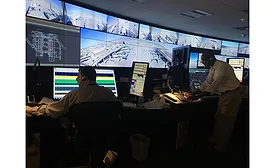
Marrying a variety of software and hardware, the goal of a video wall in any operations center or monitoring center is to provide operators with the visual information they need to monitor, assess and respond accordingly to a variety of threats.
In recent years, interactive services have been the cutting edge of security systems design, bringing new revenue opportunities and offering dealers an entrée into the smart home market.
Security dealers are increasingly taking advantage of the plethora of new technologies, business models and opportunities in the security alarm space, and seem to have found their footing in a rapidly changing landscape.
Doomsday didn’t happen. For all the concern many security dealers have shown in recent years — particularly about the rapidly changing residential market — all indicators seem to finally point to what was always the hope in the midst of the fear: that all the new entrants, technologies and business models would start to grow the pie for all.
Though many projects have been proven with pilots and real-case deployments, artificial intelligence (AI) in the security industry is in the relatively early stages and its role in video surveillance is as varied as the vertical markets that implement it.
 RSS
RSS