How Can Low-Powered Locks Benefit You?
Electronic locks have come a long way, offering significant energy savings and increased performance over their predecessors.
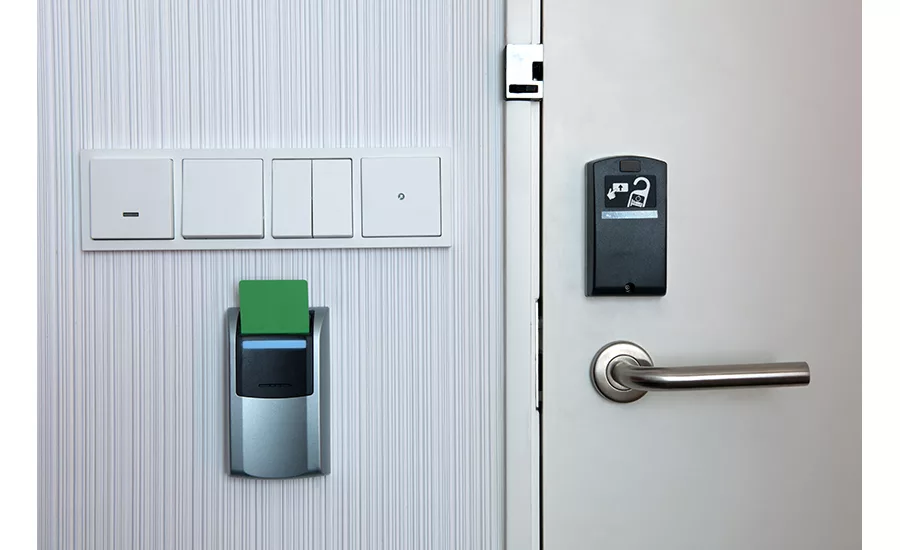
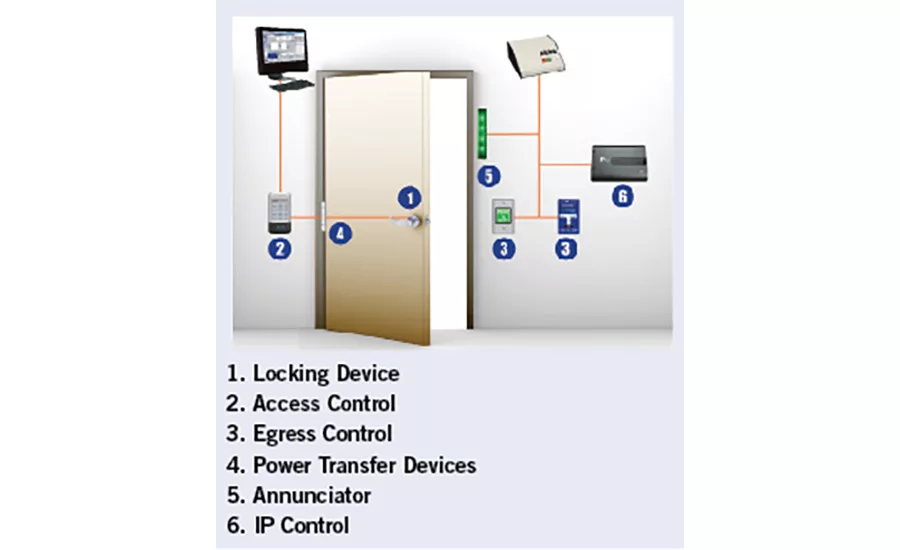
With increasing technology, lower energy consumption and the converging of mechanical hardware with low-power PoE/IP security, low-power locks can integrate with a number of products and services. Image courtesy of SDC.
In this Q&A, SDM talks to two industry experts about low-powered locks and the benefit they can offer security integrators.
These days replacing older electronics usually results in significant energy savings. In fact, the government will often supplement purchases through tax credits to homeowners installing new energy-efficient appliances.
In the security world, replacing outdated electronic locks could offer energy savings and provide a better product, especially with the convergence of mechanical hardware and PoE/IP technology. Lending their knowledge on the subject are two industry experts: Kerby Lecka, director of marketing at Security Door Controls (SDC), Camarillo, Calif.; and David Corbin, senior product manager, Securitron, an ASSA ABLOY group brand, Phoenix, Ariz.
SDM: What is a low-powered lock?
Lecka: Quite simply, a low-powered lock requires a smaller percentage of electricity to perform its function when compared with an older electric lock. Also, a low-powered lock is one whose holding power requires less electricity than its activation power. Most electric locks today are low-powered whether used in new construction, retrofit or replacement applications.
Corbin: Generally speaking, a low-powered lock is a locking device that uses significantly less energy than equivalent locking devices on the market.
SDM: How is “low power” defined — is there a standard power range that the lock must be in?
Looking for quick answers on security topics? Try Ask SDM, our new smart AI search tool. Ask SDM →
Lecka: No. “Low power” is a comparison concept, not a standard. Be sure not to conflate “low power” with “low voltage.” Low-powered locks in the security world typically run at 12 or 24 VDC.
Corbin: There is no real, generally accepted definition of “low powered,” just like there is no industry consensus on what constitutes a “PoE-friendly” locking device. At ASSA ABLOY, when it comes to electrified locking hardware we denote certain locks as “eco” or low powered. Our definition of low powered is that the product should reduce the power consumption compared with legacy locking devices by around 75 percent or more.
SDM: What is the technology behind a low-powered lock? How do they get their low power?
Lecka: Advanced electronics within the lock act like a power regulator to reduce the initial power use of the lock. Also, a new trend is the use of more efficient motors that replace more power-hungry solenoids in many electrified lock functions such as latch retraction, etc.
Corbin: Most locking devices that are low powered have eliminated inefficient solenoids as the actuator and replaced it with motorized technologies. Other devices could use latching solenoids that are only energized briefly to change the lock state. In both cases manufacturers have to ensure that the device fails in the correct state in the event of a loss of power (unlocked for fail-safe, locked for fail-secure locks).
SDM: Why is low power consumption important in the scheme of an installation?
Lecka: Having more low-powered locks per installation requires fewer power supplies, saving equipment and installation costs.
Corbin: Low power consumption has many benefits to the installer and end user. You can use smaller power supplies and smaller backup batteries for the same number of locks, or you can connect more locks to a power supply. When you draw sub 15mA of current like the EcoFlex and EcoStrike products, you can run thinner wire longer distances because the voltage drop is negligible.
SDM:Can low-powered locks help customers meet “green” requirements?
Lecka: Yes, but it really depends upon the specific installation requirements. For example, is the goal of the installation to achieve a LEED certification for the building, or merely to be as energy efficient as possible? The cost of using green certification locks — energy consumption being one component of green — could be high and not worth the return when compared with traditional locks. Conversely, a low-powered lock doesn’t have to have a green certification to provide a green benefit.
Corbin: Many low-powered locking devices can be used to qualify for LEED innovation credits. Additionally, some manufacturers are providing Environmental Product Declarations (EPD) and Health Product Declarations (HPD) — product transparency documents that are required in some green building programs, such as the Living Building Challenge.
SDM:Are there any drawbacks to a low-power-consumption door lock?
Lecka: The additional components required for low-power locks may contribute to an increase in their cost. The cost difference can be offset over time due to the energy savings achieved.
Corbin: Historically, motor-driven locks have suffered from a shorter life span than the traditional locking devices. This is no longer the case; among the ASSA ABLOY brands, EcoFlex and EcoStrike have both been cycle tested north of one million lock/unlock cycles.
SDM: When is it not a good idea to use a low-powered lock?
Lecka: Smaller installations may not benefit financially from the energy efficiency gained by using one or two low-powered locks when comparing their initial cost versus a traditional lock.
Corbin: I cannot think of a good reason not to use a low-powered lock. Most of our sustainable locking devices are sold at the same price as the legacy product. The only thing I can think of would be trying to shoe-horn a lock type into an inappropriate application, strictly so you can use a low-powered lock.
SDM: Are there any tips installers or technicians need to be aware of when servicing these locks?
Lecka: Understand where the power is coming from and if the locks are being provided a “clean” source of power — one that is filtered to ensure against spikes and surges, that is properly regulated for consistent output, and has short circuit and thermal load protection. Troubleshooting any electrically powered lock should always start with the power source and can eliminate 50 to 75 percent of operating problems (see “Retrofitting With Low-Power Locks & Where to Start” online at www.SDMmag.com/retrofitting-low-power-locks).
Corbin: The low-powered locking devices from ASSA ABLOY don’t have any special requirements for maintenance or service.
Retrofitting With Low-Power Locks & Where to Start
Typically, retrofitting any installation with low-powered locks means you are backing into an existing system that may or may not have documentation and may be many years old. To avoid power issues at the outset, determine if there is “dirty” or “clean” power available and how old the power supply is.
Most installers or technicians usually focus on voltage — the power at which the lock is designed for. Sadly, most don’t consider the amperage — the current that the lock’s “motor” runs at. Power supplies output a finite amount of amps to run electrified hardware and accessories. Because most installers or technicians don’t bring more than a voltmeter to the job, it make sense to review the power supply and understand its performance specifications before servicing locks or preparing a retrofit bid for the installation.
To ensure a successful retrofit and ensure against callbacks, it’s usually a good idea to bring a new power supply to the installation — in other words, start with clean power. Also, installers and technicians should identify what the total amperage requirements will be for the new locks they are installing to ensure they consume no more than 75 percent of the power supplies’ rated capacity.
Where the retrofit installation is located — city, suburb or rural — will also affect how clean the power is. Cities have more customers sharing the same grid that can affect the consistency and health of the power available. Conversely, systems in rural environments may be less reliable. Either way, battery backups and UPS (uninterruptible power supplies) should be considered as viable emergency options for supplementing the power supply.
When retrofitting with low-powered locks, always start with the power supply to ensure a problem-free installation from the power perspective and avoid liability and callback issues. — Contributed by Kerby Lecka, director of marketing, Security Door Controls
Looking for a reprint of this article?
From high-res PDFs to custom plaques, order your copy today!