Is it Time for Security Drones & Robots?
As drones and robots become more popular, they will become a part of the security industry, but in what capacities and to what extent?
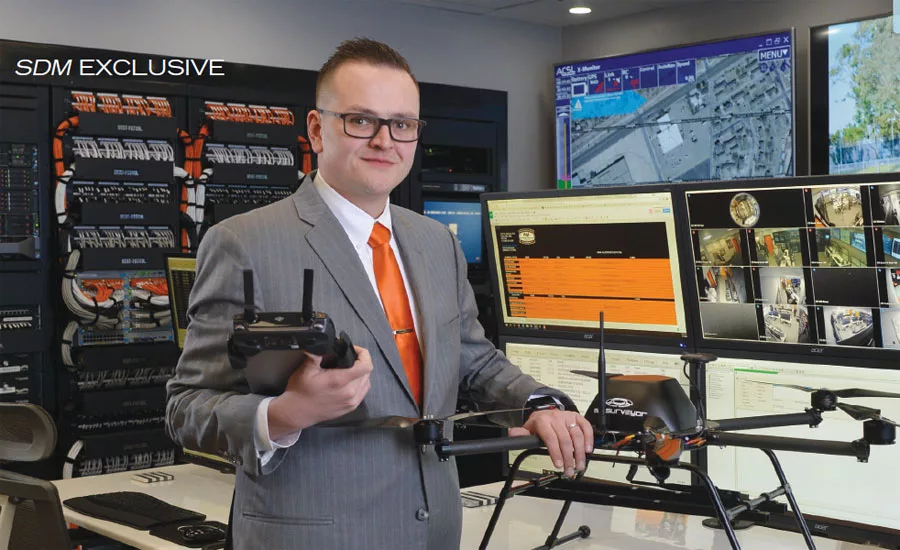
Randall Renfroe, CEO, Allstate Security, Amarillo, Texas, says drones are an economical solution for multiple applications. Allstate’s monitoring center and guard force pilot and monitor its drone. Photo by Ralph Duke for SDM
If you were to poll security systems integrators across the country, you would probably find few if any that are selling or promoting drones and robots as a solution or a means of profit. You’d be wrong, however, to assume there is little to no interest in the technologies by the security community.
“I talk to integrators every day — six days a week,” says Bill Bozeman, CPP, president and CEO, PSA Security Network, Westminster, Colo. “They are interested, but currently, with the exception of a small handful, they are not out actively promoting either drones or security robotics. That is going to change.”
And that change, though perhaps hard to detect now, may be closer than many think. Certainly the interest is there. One has but to attend a security conference to see the attention and interest drones and robots are getting. This year, for instance, ISC West will be hosting its second annual Unmanned Security Expo within the larger conference to focus on aerial drones and ground robotics for security applications.
For its part, PSA has taken an active role in drone and robot research. “We try not to waste our time and money and the stockholders’ money,” Bozeman says, “so we would not have [taken an interest in drones and robots] unless we felt that it was going to make an impact on the integrator community in our organizations. … We take this quite seriously.”
Steve Reinharz, president and CEO, Robotic Assistance Devices, Laguna Hills, Calif., says, “Since we started this business in 2016, we’ve seen interest in our robotics solutions skyrocket; organizations are interested in adopting a cost-effective solution that uses artificial intelligence to deliver improved performance to their security paradigm.”
The question is not really a matter of if, but rather of when, how and to what extent.
When we can expect drones (& robots) to take off
So if robots and drones are so promising, then why aren’t security integrators jumping on it immediately? There is the tired cliché of security integrators and the security community at large being a slow-moving group and resistant to change, but that isn’t a fair description, and, at least in this situation, it is a facile explanation. The situation is more complex; in an area that hasn’t been proven and that doesn’t have a clear path to monetization, integrators, while interested and open to the technologies, are understandably cautious in their approach.
Looking for quick answers on security topics? Try Ask SDM, our new smart AI search tool. Ask SDM →
Stacy Dean Stephens, vice president marketing sales, Knightscope, Mountain View, Calif., points out that drones and robots utilize three of the most advanced technologies on the planet: self-driving technology, artificial intelligence and robotics. “So taking the time to understand those technologies — how they work, where they can be applied successfully, and even more importantly in a lot of cases, where they cannot be utilized — it takes a great deal of time,” Stephens says.
Knightscope, a manufacturer of security robots, has partnered with two of the largest security companies, but has not yet partnered with any other dealers or integrators. “We’ve had many people inquire from a dealer or integrator standpoint,” Stephens says, “but nobody has really kind of latched on and said, ‘OK, yeah, let’s do this.’ So the primary way that we do business is either direct, where we’re going straight B2B, or we’re going through one of our channel partners, which are Allied Universal and Securitas.”
Dennis M. Crowley, senior vice president, integrated technology, Allied Universal, Conshohocken, Pa., says early adoption of ground-based robotics began in early 2017, bringing to the surface many issues that have been addressed in navigation algorithms and detection from the sensors, as well as informing them about the best practical uses for the technology. “We are seeing strong interest as we move into 2018,” Crowley says, “but still reservations, as clients better understand their use capabilities. We are very optimistic that autonomous robotics will soon become an accepted part of every major security program in the latter half of 2018 and moving into 2019.”
Early Adopters
Though few and far between, there are security integrators using these technologies now, however. Allstate Security Industries, Amarillo, Texas, is currently implementing drone technology for at least one of its customers — with plans to expand.
Allstate Security has its own UL-listed, Five Diamond monitoring station and guard and patrol force. “By the end of the month [February 2018, as of this writing] all of our operators will be FAA licensed so they can control the drone remotely, based upon the shift they are on,” says Randall Renfroe, CEO, Allstate Security. “We’ll always have two [operators] on duty, and we’ll be able to deploy these drones out at locations not only in parking lots, campus security, and private neighborhoods — we can do agricultural businesses, new constructions, and our patrol and guard force will then be on-site to keep the drone in line-of-sight so that we can have three sets of eyes whenever we have a drone out there.”
Renfroe says the drones can be programmed to make guard tours around facilities, sending live video streams to the operators in Allstate Security’s monitoring station. “You take the drone around the facility,” Renfroe says. “You map it out with Google Earth; you then have a plot for every location you want it to go around to, and then that does a simulated guard tour however often you want it to. The only limitation is just swapping batteries out; that’s why we will have either a standing officer or a patrol officer out at each one of these that will swap out the batteries after each flight.”
Renfroe sees this as a much more economical method of surveillance, especially for applications such as oil rigs, power stations, government facilities, and such, that have traditionally had to lease a helicopter and pay a pilot to do what a drone now can do.
Allstate Security currently has one drone it paid $30,000 for, not to mention the classes to license its pilots; but he says after this year the drone will have paid for itself.
While security systems integrator Northland Controls, Milpitas, Calif., has not deployed drones or robots to end users yet, Henry Hoyne, CTO, Northland Controls, says a few years ago, Northland Controls was an early adopter of Knightscope’s K5 autonomous robots. “We had two of them deployed at our Fremont office as a way of ‘eating our own dogfood’ before we approached any of our clients. Those clients represent some of the largest tech names out there and tend to accept bleeding-edge technology, thus allowing us to. This holds true with drone technology as well. While we haven’t deployed any just yet, we’ve been actively following them and communicating often with those manufacturers. We’ve come to the realization that this will play a large role in security.”
Hoyne believes the benefits of these types of technologies are great. “Dynamic camera placement and having eyes and ears on the ground without putting personnel in harm’s way — there’s more that you could get from them such as license plate cataloging, thermal imagery, aerial footage and extended reach through terrain that a human cannot reach.”
Facing the challenges
Although the technologies are not cheap, like all technologies, the prices will begin to decrease, which will help facilitate wider adoption. And certainly the technology itself will continue to improve. One challenge now is battery life, and as batteries continue to live longer, drone and robot solutions will make more sense.
Regarding adoption by commercial markets, Paul McInally, business development, Allstate Security, says specifically about drones that he sees a natural progression toward them, but says battery lifetime, the technology’s use cases, and proving the financial impact and the return on the investment from both security companies as well as the clients paying for those services — as well as making sure that drones are a reliable, deliverable and responsive product to add to their security protocols they have in place — all are factors to be considered. “It’s certainly not going to be a replacement for physical eyes,” McInally says. “A drone won’t make a judgement call as it were; it will be more fact-based. It’ll take video. There will still be judgement calls based on situational awareness and those things that impact it.”
But that facts-based approach is one of the benefits of these types of technology, Stephens says. “A guard walking a patrol does the same thing over and over again; that is the worst thing you can do to a human being because we’re terrible at that kind of behavior — we get bored easily, we become very complacent in what we’re looking at and we miss the details. So if you figure out a way to augment that boring and monotonous routine with something that doesn’t care about that kind of monotony, then you’re able to send alerts to the appropriate people for review, and then they can look at that and determine if we actually need to send a human being there to do something at this point.”
Stephens says some of the areas where they are seeing the greatest level of success have been shopping centers, hospitals, corporate campuses, logistics — think about warehousing and moving product in and out — and then also in manufacturing, just from being able to patrol those wide open spaces.
He also believes that robots do a much better job of deterring crime than, say, another camera. “If you look at the robots and you look at where we’ve had the greatest amount of successes, it has been on the deterrence side. When [bad guys] come up on a property and they see this interesting piece of technology that’s rolling around on its own, they have no idea all of the capabilities that are behind it, but they do know they don’t want to get caught.
“We had a client who was averaging two criminal activities per week on their property between January and September of 2016; we deployed our robot in September of 2016. Between September and today, they’ve had zero crime on their property where that robot has been deployed.”
Go-to market strategy
The question may arise, What can the integrator actually bring to the table in regard to drones and robots? Wouldn’t manufacturers just sell them directly to the end user?
Well, possibly, but integrators have something that is crucial to the success of this type of technology: a nationwide or regional network of deployment partners. “These products don’t mysteriously show up on the job site and work,” Bozeman says. “They don’t sell themselves, so you need someone who has some expertise to deploy those products in the field. They are machines with moving parts and technology; when they fail, who is going to go out there? Who is going to roll that truck with certified technicians to fix that product? Who is going to program that product out in the field? And that’s really where the integrator shines, even more so than the guard company.”
To be successful, however, integrators must do two things: They must get the special training for these products, and they must integrate them into the overall security system, whether that be VMS, access control or PSIM.
“I know that several manufacturers have looked at this and are looking at it both on the robotics and the drone side,” Bozeman says. “Milestone has had discussions with some of these manufacturers about integrating into its VMS, and I’m sure others have, as well. That would be a big benefit to the end user, which is, in turn, a big benefit to the security integrator who has the access control system and the VMS integrated already at, let’s say, a government facility or a manufacturing facility or a utility station.”
The bottom line, Bozeman says, is yes, you will see standalone deployments, but the end user doesn’t want 17 companies on their facility. They prefer to have this managed on a platform on which the systems are integrated. “The companies that win this game will be the companies that integrate this technology,” he predicts.
Crowley agrees, adding, “Having a one-off tool as part of the early adoption process has worked, but as more and more units become part of a program, the value will be in the full integrations, allowing skilled GSOC operators to gain actionable information from the robotic units and quickly dispatch or respond as needed.”
Michael Kobelin, national director of sales, Sharp Electronics, Montvale, N.J., suggests a path to market through security integrators as well, adding that selling directly from the manufacturer might be a challenge for two reasons: 1) The integrators have the relationship with the end users and they understand the needs of their clients, and 2) The integrators have the technical staff to help design, install and support the installation.
“Especially in the years of early adoption,” Kobelin says, “many of the end users will be large companies with national deployment requirements. Given the integrators already have their support teams in place, distribution through a manufacturer-approved integrator makes logical sense. Additionally, when a security integrator is not available, some manufacturers, like Sharp, have their nationwide distribution channel currently supporting the sales and service of our other business products. The security integrators who trail-blaze today are primed to grow with the technology instead of missing out.”
There is little doubt drones and robots will be a regular part of the security industry in the near future. How near may be up for debate, but what is clear is integrators should begin to get all the training and education they can now so they can be the trail-blazers primed to grow.
Looking for a reprint of this article?
From high-res PDFs to custom plaques, order your copy today!